An Irish Voice: Things Irish. Things Political. Things Topical. Things Personal. Things Literary. Travel: China, Cuba, Amsterdam, Spain, Poland, Ireland and elsewhere.
Sadly the item referred to below is no longer available. What was especially shocking about Banaz's death, apart from the fact that she went to the police some years before to tell them what was happening to her, was that as part of the planned process of killing her, (after her parents left the house, supposedly to go shopping), she was subjected to depraved sexual abuse by relatives. Later, and caught on a police bugging device, one of the killers was heard to boast, that in degrading her sexually, his objective was, to destroy her soul, so that (according to his mindset), she would die worthless. Cormac March 3rd 2013 __________ Last night quite by chance, I came across the story of Banaz Mahamod. It was broadcast on ITV 1. It is still available on their I Player, so if you can spare 50 minutes, please watch it; but I must warn you, that the description of how Banaz died is detailed and especially disturbing, so have regard to that in making your decision http://www.itv.com/itvplayer/video/?Filter=327184
Growing up as we did in uncertain circumstances, my mother had a few sayings that made light of the situation. When as a small boy I asked, "What's for dinner?" the answer always was, "roast duck and green peas." Now as roast duck had never ever appeared on my plate, I had nothing to go on; but as for the peas being "green," that really flummoxed me. "Aren't peas always green?" that voice in my head kept asking, but I never confided in my mother over this conundrum, because my inclination, from a very early age, when confronted with something that I didn't understand, was to try to find the answer myself.
And I was just the same at school. When the teacher first told us that a noun was: "the name of a person place or a thing," I fell behind in class, when it was pointed out that some things that I thought were nouns, were not. What bothered me, was the concerting of nouns with "things." Now whether or not I was especially bright, and the rest of my classmates were bluffing, or I was in some sense deficient, I will leave you to decide; but, from where I sat at my desk, any idea that came into my head was, "a thing," which made it well-nigh impossible to conceive of anything that wasn't a noun. And I was just as bad, when my ear was glued to the wireless, listening to serious voices telling me that strike breakers had been, "sent to Coventry." At moments like these I would come away perplexed, wondering what it was about Coventry that caused people to be sent there; and I never thought to ask for an explanation, for to wonder was more important than to know.
All of that said, and in the context of my nose, when we come to look back, Saturday the 19th of May will mean different thing to different people, and especially if their forte was sport. A day if you like of extremes of emotion. Happily, for those who are running in the relay that will carry the Olympic flame from Lands End in Cornwall to the Olympic Stadium in East London, there will be no losers. But spare a thought for the players and fans of Ulster, (Rugby) who were thumped 42-14 by Leinster, in what was an all Irish, Heineken, European Cup Final; and for Hibernian, (football) beaten 6-1 by their Edinburgh city rivals Hearts, in the Scottish FA Cup Final. And Blackpool, who failed to secure promotion back to the Premier League. I have nothing whatever against the people of West Ham, but I have a soft spot for "the seasiders", whose manager Ian Holloway was a refreshing voice when they were last in the Premier League. And what of Bayem Munich and their fans, who could, and should have won the prise that went instead to Chelsea: the European Champions League Final; and all the more hurtful, as they lost at their own stadium in Munich. As a spectacle the match offered little until the 84th minute, when Buyem scored, only for Didier Drogba in the dying seconds to make it 1-1. And the thirty minutes of extra time was just as forgettable. But again Buyem who appeared to be winning the penalty shoot-out, lost, to that talisman, Drogba.
Now sincere apologies if you are not interested in football, but as I am, and I missed all but the last of these showcase events, it fits the bill, for I will remember the 19th May as the date in which the second, and hopefully final stage of reconstructive surgery on my nose, took place. I say "hopefully final," because when Dr Moncrieff spoke to me before the operation, he held out the prospect of further surgery: when the bulge in the graft would have to be paired down. But afterwards, he seemed well pleased with his work, and inclined to the view that further surgery wouldn't be necessary. So my hope is, that when we meet again, that will still be the case.
In my previous blog I wrote, I hope, with precision and skill, as well as a degree of humour, about my pre and post operative experiences: of the general anaesthetic and the subtle way in which the anaesthetist went about knocking me out. And I told of the unexpected pleasure when I found myself wrapped in a thermal blanket. Well this time it was different. As I lay on the operating table, with a wry smile, and an apology, I confirmed to the nurse, (seemingly for the umpteenth time,) that I was who I was supposed to be. At that moment my sense of the ironic, came from the fact that I was wearing two name tags, one on my left wrist and the other on my right ankle; and my apology was in recognition of the seriousness of the processes that were underway, as will be apparent from this, a story that I know to be true, because it happened to me
In 2001. after an appendectomy, I had a longish stay in hospital, and when I had got to the point where I was no longer in need of careful attentions, but was not quite ready to go home, they moved me into a private room. I had not been lying there long and marvelling at my good fortune, when a geeky nurse (professorial looking and bespectacled,) appeared at the side of my bed. In her hand she had a large syringe and asked rhetorically: "You are Mr Hall?" Well I never found out what was in the syringe, nor did I complain. Without doubt I had at least one name tag, almost certainly on my wrist, but as this strange creature had wanted to hear directly from the horses mouth, I was thankful that I knew who I was, and could tell her so.
Well returning to the operating theatre, they were busy fixing me up to the heart and blood pressure monitors, the oxygen supply, and other things, when one of the nurses turned and asked if I was alright. In the circumstances it was an entirely reasonable question to ask, but as I was not sure that her asking it, was a coincidence, in reassuring her, I felt the need to explain that I had just been engaged in what was - a very private moment.
As for the post operative experience in the recovery room, I wasn't at all happy with myself: my mouth was dry, my throat uncomfortable, and I was struggling to cough and felt agitated; and there was no thermal blanket to keep me company, just ice cubes, for which I was mighty grateful. Now I don't want to speculate as to why I felt so different this time around, or to imply that in an age of cost-cutting, there was something less that the best in the treatment I received. To begin with, I have no professional knowledge to go on; and that apart, this operation was quite different from the original more extensive surgery. So the processes surrounding it may justifiably have been different; and help to explain why I felt so rough, and was missing that thermal blanket.
Now in telling my story there is a sense in which I feel that I am cheating, with the dramatic headline, "CANCER", for however concerning mine was, it was never life threatening. And even if I accept, that when one thing goes badly wrong, it might be the catalyst for worse to come, I still feel uneasy, because I know that for many, cancer is a deeply distressing, and all too frequently, fatal condition.
On Thursday last, at the local Parish Church, we attended the funeral of Charlotte, a loved family friend, who died after a six year battle with the disease; and adding to the sadness, was the fact that her death came just a few days after her sixtieth birthday. Through most of her illness she shared her experiences with her many friends, only in the latter stages did she leave us to come to our own conclusions, as she opted out of her regular engagements, and left the door open as to whether or not she would or would not turn up on a particular day. All of us understood that she would not recover, but what took us aback, was the speed of her decline at the end. And something of her courage and commitment to her friends, is reflected in her coming here to dinner with her husband Richard, just a month before she died. She ate little and stayed for a long time, and rightly or wrongly, as we thought about how long they had stayed, we interpreted it as Charlotte's way of thanking us for our friendship and of saying goodbye.
Until she discovered her own cancer, Charlotte had lived a full and healthy life, during which, and though she had lived in different places, she had made and kept many friendships, a truth affectionately confirmed, when Jenny, after the funeral, asked of someone whom she knew to be a friend, where she met Charlotte. Just one word said it all, "Everywhere!" She had a passion for the outdoors; for walking, not just here at home, but in far away exotic locations, and this aspect of her life was reflected in the funeral service that was a celebration of her life. The small church was packed, and though the vicar reminded us that it was a place in which prayers had been said for a thousand years, my experience of life, told me, that at this poignant moment, believers, non believers and skeptics, were well represented.
Well as a believer with his own share of uncertainty, allow me to tell you of something unexpected that came from Charlotte's funeral. Among her chosen hymns was Lord of the Dance. I was familiar with it, but, believing it to belong to what is sometimes called the "happy-clappy" movement, I never thought to take it seriously. But now I was experiencing it differently, as a hymn deeply rooted in the Gospels, and one that confronts the world as it appears to us, in particular the dichotomy between the presence and absence of God in the world; an absence, that for many, quite literally, "beggars belief". And in terms of these seeming contradictions there was something majestic, powerful, and challenging, in the Dance, that I hadn't noticed before.
Though the hymn is well known, it is still under copyright, so I quote it only in part, but in a way that I hope will help to reinforce the point.
For me, there was a particular ring of truth in those opening lines that remind us: that it was fishermen, and not the acclaimed religious leaders, "the scribe and the pharisee" (who were expecting the Messiah,) who responded to Christ. And there was a deeper truth in those lines that address the vexed question of suffering:
"I danced on the Sabbath and I cured the lame.
The holy people said it was a shame.
They whipped and they stripped and they hung me on high;
They left me there on the cross to die."
Here, I was being reminded of the truth, that God incarnate subjected himself to the worst excesses in the human condition: to a barbaric form of execution, in which, (even by our standards,) there was no justice; whatever, and that, to that extent at least, we can know the mind of God.
Nor had I spotted until now, in the hymn's happy refrain, that there is an invitation and subtly expressed message of hope:
"Dance, then, wherever you may be;
I am the Lord of the Dance, said he,
And I'll lead you all, wherever you may be,
And I'll lead you all in the Dance, said he."
The point being, "wherever" [in your life] "you may be."
Now in wanting to make the point that however inconvenient or taxing, my cancer was as nothing compared to what it might have been; I want to tell you also, that when I first went in to hospital, I brought with me, the "Wishing you well again soon" message, that Charlotte posted through the letterbox less than three weeks before she died.
And now that I can once again wear my reading glasses, for me, the dance does go on. So, it is back to the poetry of Yeats, to Dante's Divine Comedy, and the late historian Alan Bullock's vast study of the "Parallel Lives" of Hitler and Stalin, and to books of poetry that I have yet to read, and in the hope that all this endeavour, will, at some point in the future, feed in to another book of poems. And on the subject of published poems, I must tell you that mine had nothing to do with UNESCO recently declaring Norwich to be a city of literature. As I understand it, the award is given in perpetuity, and it is the first city in England to receive it. And right now we are in the midst of the Norfolk & Norwich Festival, that some are claiming will soon be on a par with that of Edinburgh. So myself and Jenny will be cultured out when it is over. Recently it was the Berlin Symphony Orchestra and Julian Lloyd Webber accompanying them on his 17c Cello. And last night at the Theatre Royal, we were warmly applauding an Afro Cubism eleven piece band; that as you would expect, was musicianship of the highest order, with dancing in the isles.
Wednesday 14th June 2012
So far so good & the sheen comes from Bio Oil which I will be using for the next couple of months
If you have read my previous blog "CANCER" you will understand when I say that this morning I was feeling down on account of my nose, though things are going well and according to plan; in fact, it was bandaged in such a way today as to suggest that they are starting to expose the graft to the elements. But what has had me feeling low and frustrated, is, not being able to read. Well, mid-day a large envelope arrived addressed to me, which was a surprise, as a good deal more wood pulp is used in communicating with Jenny. But, what had arrived for me, was the Self Publishing Magazine for Spring 2012, which I leafed through, and there on p. 46 was a review of my poems, some 7 months after I had sent them to the magazine. In total 30 books were reviewed under the headings: Biography, Writing, Academic, History, Fiction, Children's Fiction and Poetry, (with just two books reviewed in this last category). The reviewers are independent of the magazine, and are named on the Reviews Editor Page, but I have no idea who, among them wrote the review in my case. So allow me to share with you, something that made a difficult day, a whole lot better.
Book Review
"Who Would be a Girl when
You Can be a Boy?"
"This little volume of poetry is an absolute joy. The poems are simply constructed, take you through all that life throws up and are presented in the order in which they were written, although I much preferred to dip in, marking out my favourites as I went along. There are six pages of notes at the end of this book, which put a little extra colour to the main work, and I found this a very nice and thoughtful touch.
Small collections of personal poetry are notoriously difficult to market and sell, so I don't think that Mr McCloskey will make a fortune. He will however, have something very special to pass on to his family, friends and complete strangers like me. The title is wonderfully un-PC and I hope that it does not put the ladies off. "Who Would be a Girl..." is the fourth poem in this book and I found that transposing "Boy" and Girl" all the way through did not make any difference as even my future wife wanted to join the Navy!
Most books I get for review are given away, go to the car boot sale or are recycled. This little book sits on my bedside table. I think it may be there for a long time.
Cormac E McCloskey Publications
780956845504 £ 8.00"
Now here is an interesting thing, an indication of how stupid I can be at times.
Recently while at the Norwich & Norfolk University Hospital for a pre operation assessment, I got myself in a tangle over the request that, when admitted for surgery, I bring my medications with me, and in their original containers. Perhaps because my medications are few, and I don't think hospital, that helps to explains how I came to be confused, and certainly the nurse on duty must have thought me profoundly stupid when I queried this request. As I told her, "everyone knows what an Aspirin looks like, and most people know what a Statin looks like." But she agreed that there was no point in my bringing them, if, as I told her was the case, that I don't keep them in their original packaging, but instead, in a especially designed wallet. Well back home and in more reflective mood, and knowing that I was to be admitted on the following day, (for two lots of surgery on the same day), I decided that regardless of my point of view, I would bring them with me, only to forget when the time came..
Well, what was profoundly stupid, on my part, was my failure to see the obvious: the situation from the hospital's point of view, as the reason why they were asking for my medications in their original containers, wasn't so that they could see what they looked like, but rather, so as to be able to dispense them to me from the securely locked medicines cabinet.. Silly! silly! me!
Now another experience that I must share with you, about this pre operative assessment, is, that while there, I had thoughts about death row. As the nurse went carefully through the list of questions so as to determine my general state of health, I couldn't help thinking that if I was on death row and they were looking for an excuse not to give me a lethal injection, they wouldn't find it; because in relation to the questions being asked, (and allowing for the fact that I had a stent fitted into an artery in my heart in 2006), I was simply far too healthy. And after I had been subjected to the handiwork of two surgeons, and was lying in my hospital bed, I had a more profound thought. Looking at the curtain in front of me, that had been drawn around my bed, (leaf patterned and in pastel shades of green and yellow), I found myself reflecting on the fact that I would not want this to be my last view of the world. And I was reminded of something that I had heard in a radio broadcast many years ago. It was of a young man who, at the point of death, asked the hospice staff to carry him out into the garden, where he died, close to nature, and in the warmth of the sun.
And now I am sitting here feeling sorry for myself, with my computer set to large print, as I cannot wear my reading glasses, and unable for the time being at least, to go for my long walk each day. So by my standards, I am having to learn to be idle, and to be satisfied with things as they are.. You see, I have lost an eyebrow, have a large patch and stitches on my forehead, and a very ugly and askew bandage on my nose; and I have stitches through and behind my ear, from where cartilage has been transplanted to my nose. In time the stitches will dissolve, and my nose regain its shape, and by some miracle of modern surgical technique, my eyebrow will be restored, which is a roundabout way of saying that it is only a matter of time! until I am restored to my handsome self.
Now continuing on this hospital theme; there was a time when I thought that I had a high pain threshold, an illusion shattered, when, some years ago, I went for a bladder examination. Thankfully, (and as I suggested to the doctor at the time), there were no issues: but the tears were rolling down my cheeks while the probe was in use. And this time, when the needle carrying the local anesthetic was injected deep into my nose by the surgeon, the pain far outweighed any desire on my part, to be heroic. And if you think that a burka is a restricted form of dress, let me tell you that it has nothing on the garb in which I was clad during the Mohs surgery. Fully conscious, and with people rattling cutlery around my head, the only part of my anatomy exposed to view, was my nose. And apart from the cutlery, there was a sound-effect that perplexed me until I worked out what it was. It was the type of sound that you get when liquid is flowing from a pan on to a hot stove. It was of course a gentle suction pump that was following the course of the surgeons knife.
So why was I there? And what is Mohs surgery.?.And what of the plastic surgery, under general anesthetic that I had later that day?
For quite some time I had been aware of a small nodule on the tip of my nose, between the nostrils, that was new, and its shape struck me as odd; but as someone who has been known to fight his way into trees with one hand while dragging a saw in the other, it seemed not unreasonable to conclude, that somewhere along the way I had acquired a wound that had healed untidily. Not only was there no pain, but a stranger would have been hard pressed to notice that anything was wrong. But what finally persuaded me to visit my GP, (doctor), was the very occasional speck of blood that appeared when I blew my nose;. And when biopsies were taken, it was confirmed that I had what is known as a Basal Cell Carcinoma. A (BCC) is a slow growing, and non life threatening cancer, that if left untreated, results in the breakdown of tissue, and in my own case, if neglected, would have resulted in significant damage, if not to the actual loss of my nose.
Now we have a saying, "needs must," and this was the point at which I was made aware of Mohs surgery: an intricate and painstaking process designed to keep the disfigurement from surgery to a minimum. Having determined the likely boundary of the cancerous cells, and going slightly beyond them, the surgeon removes the tissue, and by a process of mapping, dying, and freezing, prepares it for the laboratory. The idea in going beyond the boundary of the cancerous cells, is, of course, to ensure that all the cancer, (including the caner roots), have been removed. But in truth, it is not an exact science, which is why, after waiting two hours for the laboratory results to come through, the patient might require a second, third, or even fourth incision to be made, before the all clear is given. And this is the point at which the mapping is important, for it guides the surgeon to where these remaining cancer cells are located, and keeps the areas of additional incisions to a minimum.
Well l was the first of three on that morning's list, and as we sat waiting for the lab to come back with their findings, we kept each other company. We exchanged notes on the instructions that we were given in respect of fasting before the operations, with myself explaining how, before midnight, I had managed to have today's breakfast, yesterday. We talked about our respective pasts, about children, and dare I say it, politics, and about whatever else readily came to mind. But with the two hour deadline past, and my dreading the prospect of another incision, and yet another two hour wait for the results, you can imagine my relief when the nurse appearing at the door told me that Dr Garioch had been advised that all the cancer cells had been removed. "Good", that imaginary voice in my head said, "they have got it early, and you will be home in time for tea." But, when she next appeared and invited me out into the corridor, I had a feeling of foreboding, and rightly so, for she had come to tell me that Dr Moncrieff, wanted a word.
Now as someone who is frequently looking beyond the immediate, and though I know him to be personable, on this occasion I had a sense of Dr Moncrieff as a man in a hurry: someone who was wholly mentally engaged on the tasks in hand. So with my back to the wall, (or so it seemed), I knew that it fell to me, at this decisive moment, to remember everything that I was now being told: that as Dr Garioch had had to cut in to the cartilage on my nose, reconstruction surgery would be necessary, and with cartilage transferred from from my ear. And that I would remain in hospital for several days, until the persistent bleeding associated with this type of surgery had stopped. And no less important was his closing remark, that if in the future I was in any way unhappy about the outcome, that was something that we could discuss.
Well I was lying there gazing at the ceiling and waiting to feel relaxed, as the anesthetist said I would, when I woke up in the recovery room, with a nurse asking how I was, while she pulled a warm thermal blanket around my shoulders. As out of nowhere I was wide awake, and thinking, every house should have one - a thermal blanket.
As for hospitals more generally, I have long had the view that no one should want to go there, and that if they must, it should be for as short a time as possible. And I am just as disregarding of the media, who, when the political climate is right, refer to nurses as "Angels". As I lay there, I was reminded of how they are just like us, women, and in many instances men, who are making their way against the ups and downs of life. Some, without doubt, are passionate lovers, while others despise their spouse or their partner, or break into a cold sweat when they realize how little money is in the bank, or are too afraid to think too much about their children; as to whether or not they might be going off the rails. But there was a sense in which I admired them greatly, and considered them special, for their life's work requires them to care for people when they are at their most vulnerable. And I wrestled with the dichotomy: the personal care and attention to detail, as applied to the patients around me, as compared to the absolute disregard of human worth, and need, in so many parts of the world. And while there, I did something that I would never do at home.
On my second day and when I was almost, but not quite restored to health, and the trolley shop was passing, I asked Jenny to get me three bars of chocolate, the sort of stuff that I would never eat at home. But as I explained to her, and later to Leo and Lynsey, I wanted them, "because the nurse's didn't love me any more;" a mischievous way of saying that I was so improved that I felt like a fly on the wall, while the nurses, understandably, were giving their time and attention to people whose needs were real. And that's a thing about hospitals; just as things can go quickly from bad to worse, or dare I say it, alarming, the converse is also true, as I observed in a patient more advanced in years than myself. On my first night there, and permanently on oxygen, he kept all of us awake as he endured extreme pain when needing to urinate. On the second night and in "the wee small hours," I was lying there and marveling at the transformation: with all five wards seemingly sleeping like babies, when the buzzer in my own ward sounded. It was my friend from across the way, and in the distance I could hear the light steps of the nurse as she came towards him. Notwithstanding his torments from the night before, and having wakened from a restful sleep, what he wanted was not oxygen, painkillers, or even to use the toilet, but rather, (and without anxiety,) to know where he was. - And I was smiling.
Irrespective of your point of view, that is, as to whether or not you are religious, today, for me, belongs to St. Valentine, though if you are not religious, no harm is done by your calling it, Valentines Day.
As for the day belonging to lovers and would be lovers, rather than to a third century Christian saint and martyr, it seems that it was Geoffrey Chaucer, author of The Canterbury Tales,,Troilus and Criseyde, and other great works, who set the ball rolling in that particular directions, with, The Parlement of Foulys; a poem that has lost some of its charm, since in contemporary English, it is known as, The Parliament of Birds. And the scholars tell us, that it was "probably" written in 1383, so as to be ready for St. Valentine's Day.
Now as this poem runs to 21 pages, and it has never been my intention to discuss it in detail, you will have to be content with a flavour of what it was that Chaucer achieved, all those centuries ago, in, The Parlement of Foulys. And a part of what makes this piece fascinating, is, that in its characterisations it is mischievously contemporary.
At the outset, and before the Parliament of Birds has assembled, Chaucer, whoa has been reading, is in reflective mood:
So short is life, so long to learn its art!
So hard the trial, so keen our least success! Our perilous joys, so swift to leave the heart! All this I link with Love, and I confess Myself astounded by his artfulness, Which brings such pain that when I pause and think, I'm hardly certain whether I float or sink. For though I know not Love in every deed, Nor how he pays the folk who've earned their hire, It happens that in books I often read About his miracles and cruel ire, And resolution to be Lord and Sire: And since his blows are fierce, "God save that Lord!" Is all I dare say - not another word.
Then with the Parliament Of Birds assembled, (as was the custom on St. Valentine's Day), and according to rank as determined by nature, Nature herself, presiding, presents "a fornel eagle, quite the loveliest", as natures greatest achievement; and that in turn, prompts a succession of eagle suitors, in descending order of rank, to declare their undying love, and promise of fidelity. But soon there is uproar among the assembled birds, who, anxious to find their own mate, tire of this public pasturing:
So loudly through the air the bird-calls flew To be set free - "Have done, and let us go!" I thought the forest would have burst in two. "Come on!" they cried, "You'll bring us all to woe! This curst debate must stop! When will it so? How can a judge without a sign of proof Resolve the case on my bird's behoof?" Then cried the goose, the duck, the cuckoo too "Kek-kek!" Quack quack! Cuckoo! Cuckoo!" so high - That with the din my ears were riddled through. "All this," the goose said, "isn't worth a fly! I've got a thorough cure for it, have I.: Whoever's pleased or cross, my vote I cast For water-birds, and do it loud and fast."
But as you would expect in a parliament, the tensions subside; and order is restored; with each of the species selecting one of their own to address the Parliament, a task, which some of them accomplish, with wisdom, and wit.
As told, the story is a dream, with Chaucer having fallen asleep while reading tales of romance, a story that ends when he awakes, and as he tells us, carries on reading.
_______________ And just as interesting, though for different reasons, is the idea of St. Valentine's Day belonging to one particular Valentine. There are in fact, 14 of them, three of whom were martyred at Rome, and two of them on this date, February the 14th.
We are in the third century, at a time when the persecution of Christians, wherever they were to be found in the Roman Empire, was a common occurrence. And there was no shortage of cruel methods, by which, they were put to death. Some, for sport were pitted against wild beasts, while others were crucified, or thrown into pits of lime, or burned at the stake, or lowered into vats of hot oil. And some, quite literally, were roasted alive on grids. And what perplexed the Roman rulers as much as the lives of these early Christians, was their willingness to die for Christ, rather than accept the alternative, which was to worship the gods that the Romans worshipped, and live. What they, the Romans feared, was what they could not understand, a way of life that was diametrically opposed to the brutal methods by which the Romans exercised power.
Stepping back in time, into the second century, when Pliny was appointed magistrate, in Bythnia-Pontus, by the Emperor Trajan, Pliny was surprised and alarmed by the number of Christians that he found there, And having questioned some, and put others to death, for their obstinacy: their refused to worship the Emperor, or offer wine to the Roman gods, he wrote to Trajan asking for advice as to how to deal with them, because according to his informants, the Christian way of life, could not br considered a threat to the imperial power. To Trajan he wrote: - "This the information told me was the whole of their crime or mistake, that they were accustomed to assemble on a stated day before dawn, and to say together a hymn, to Christ as a god, and to bind themselves by an oath, [sacramento] (not to any crime, but to the contrary) to keep from theft, robbery, adultery, breach of promise, and appropriating deposits.After this they used to separate, and then meet again for a meal, which was social and harmless. However, they left that off, after my edict about their meeting." _______________ And something else that gives significance to St. Valentine's Day, is, that it is my birthday; and this year, (despite a youthful premonition that I would die young), I am celebrating three score years and ten. And when, a few days ago, a card arrived bearing a rather large 70, I found myself gazing at it in near disbelief, and thinking, - numbers don't mean what they used to. And something else has arrived. that I had not foreseen or planned for. In a weeks time I will be visiting the Norwich & Norfolk University Hospital, to discuss with a surgeon, her suggestion that I should have Mohs surgery on my nose, the idea being, to remove "a non life threatening cancer." As I understand it, Mohs surgery is a painstaking procedure, that requires an hour of waiting, each time a portion of tissue is removed for analysis. And it is painstaking also, so as to do as little damage as possible, to what are described as "sensitive" areas, (by which I think they mean, those areas of the body where disfigurement from surgery would be visible. And by this method, if necessary, they will keep removing tissue and analysing it, until all traces of the cancer have gone.
The Parliament of Birds Taken from Love Visions by Geoffrey Chaucer Translation by Brian Stone Publisher: Penguin Classics (1983)
Pliny quotation taken from An Essay In Aid of A Grammar Of Assent Author: John Henry Newman Publisher: Elibron Classics ISBN 1-4021-3523-8 www.elibron.com Do Not Worry The Gospel of Matthew 6. 25-32 Luke 12. 22-31 Gospel quotation Matthew 625-34
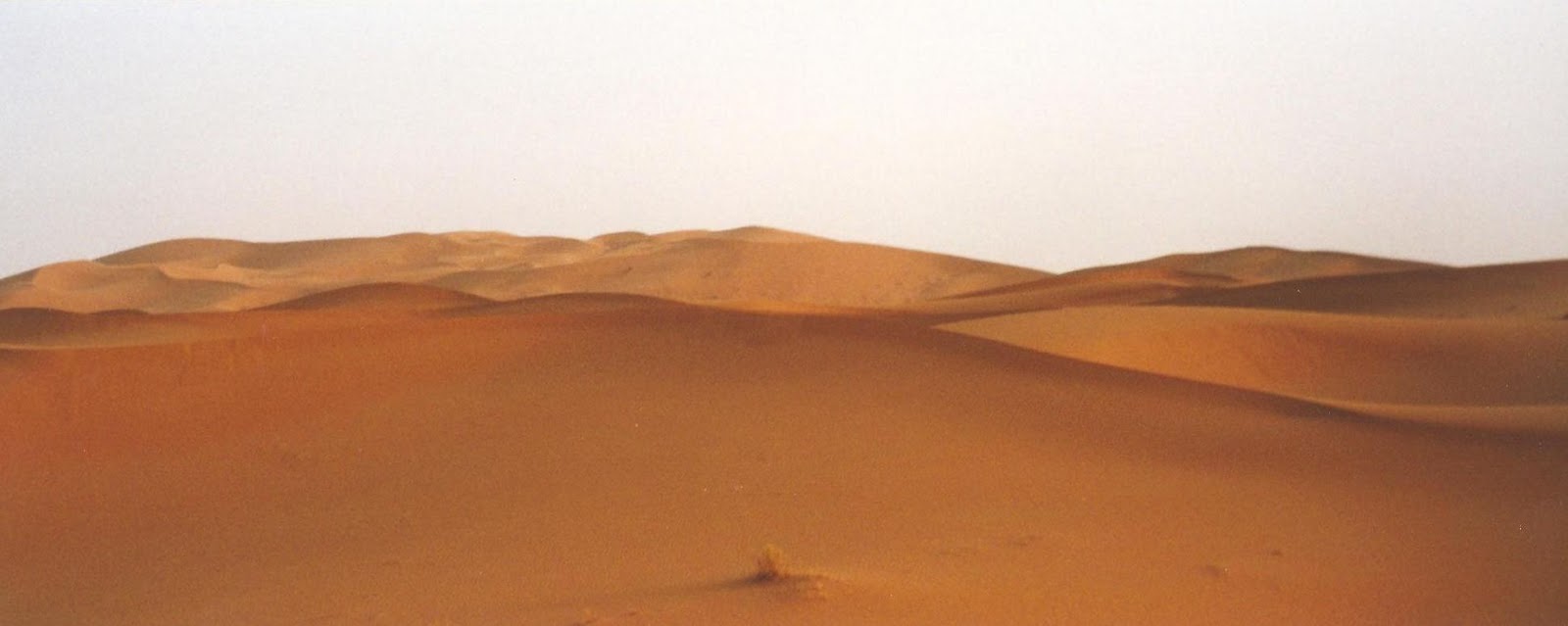
Morocco - The Sahara Desert from Erfoud Preamble This long letter to Jessica, (Li Jie,) was written between September 01 and March 02; and while, as stated, it was written for Jessica's enjoyment and understanding of the world beyond China, it was intended also, to be a full account of what, for us, had been a remarkable holiday. We have been to Morocco twice, and would happily go again, notwithstanding the fact that there are many wonderful places that we have not been to, and will never see. Beside photographs of the holiday that were sent to Jessica by e-mail, the pages of the letter, itself, were interspersed with pages from the Internet, that provided additional information, and many more images. At appropriate points in this letter, in square brackets, I have provided the links for those pages, and I have also inserted into this edition of the letter, some of the photographs that were sent by e-mail _______________ For the time being it is my intention, that this blog should be the last of what I call, regular blogs, that is, blogs that appear on average, once a month. For the foreseeable future I want to focus entirely on poetry. To some extent, blogging has been an easier option, a diversion or distraction, perhaps because blogs are more easily written, and the rewards more immediate. But having recently published a collection of poems, I want to try to take the poetic craft, to a higher level. I will of course be following the website, keeping an eye on who is coming, or going. And I will post the occasional blog. [ Morocco Time - Geography p.1 ] [ Morocco Time h History p. 1-3 ] 29th September 2001 Hi Jessica I know it is not October, but as it is the last weekend in September I might as well start my next series of monthly letters. Here it is overcast and damp, but temperature-wise, close. There are though, a few autumn leaves about, a sure sign that the difference between daytime and nighttime temperature is becoming more extreme. The Koi are still quite lively, but are feeding once a day rather than twice, not because of the time of year, but because I am not here to feed them in the early evening. Now Jessica, the big challenge in this letter is to write coherently about our holiday in Morocco. I have typed up all the hand-written notes that I made at the time. I have also located some interesting details on the Internet that are a supplement to my notes. There is, however, so much material and so much of it interesting, that I could just as easily write badly about the experience. So the question is, should I begin at the beginning, the middle, or the end? You might think that beginning at the end is a bit daft. Not so, because one of the spectacular images that I will recall for a long time to come, was the view as we passed along the coast between North Africa, and Spain. We were about thirty thousand feet up, or more, in a cloudless sky. The sea was a deep blue, and the respective landscapes were a patchwork of lush green vegetation and parched areas. From that height, both Southern Spain and Northern Morocco seemed much the same, and I was moved by the spectacle of seeing them, these continents of Africa and Europe from across the Straits of Gibraltar. You just never had a geography lesson like that at school. On a literally more down to earth note, we left for Morocco in the pouring rain. Living in England, that was not a surprise. What was a surprise as we boarded the Royal Air Morocco flight, was that it was to the strains of Viennese waltzes, and not to Moroccan music, either ancient or modern. The plane was full, with at least one school party and a significant number of women dressed in the traditional Muslim style. Just immediately in front of us was Thomas. European, and with his mother, he was off to Morocco for a holiday and just for fun had brought along his favourite dinosaur. As is often the case, and with no eyes in the back of his head, Thomas decided that the people sitting behind him were more interesting than the people in front, so he popped his face and eventually his dinosaur over the back of his seat. He had a lovely smile which was enough to get Jenny's maternal instincts going, and the more she pretended to be frightened by the dinosaur, the more Thomas enjoyed himself. Unlike Jenny, I am not very good at pretending to be frightened, so I can't imagine that I figure at all in Thomas's memory-bank, or maybe he has me filed away under the heading, "Boring Old Man." But either way, I remember him. And when Thomas wasn't terrorising us, we were eating, Prawn Cocktail with bread rolls followed by fish and rice mixed with an assortment of vegetables. Pudding was something approximating to Kiwi fruit, after which we had cheese biscuits and coffee. I think I am right in saying that the flight lasted three and a half hours, but as Moroccan time was still Greenwich Mean Time, they were one hour behind our "Summer Time." What it meant, in effect, was, that by the time we met our tour guide, John, it was dark. He was a short and slightly built man, a few years younger than me and conspicuous in his Panama hat. As was the case in China, you can't take Moroccan currency, (Dirham,) in or out of the country, so on arrival, we had to get the preliminaries out of the way, and part with a few sterling travellers cheques. We also had to walk the gauntlet of young men eager to carry our bags. It's a strange thing about travel, but there is always someone who seems to know, so, within seconds, the advice filtered along not to let these lads as much as touch the bags, because if you did, you would have to pay them money even if they take them nowhere. Our hotel for the overnight stop in Casablanca, was the Hotel Al Mounia, at 24 Boulevard De Paris, and this Jessica was our first encounter with the complex history of Morocco, and with its more recent, (in modern times, that is,) colonial past. I don't know that I can describe it, but the hotel had a distinct French provincial feel to it. At one and the same time it was large and intimate, but the baize decor suggested that we were in a subdued or an unhurried place. A feature of this French influence was the professionalism of the waiters. It was obvious that they took a pride in their work. They were courteous and efficient, and in most instances very attentive. In the lounge bar, and even after they had closed, they willingly made up a fresh jug of crushed orange juice with ice. And looking at the bar staff in their white silk shorts and booties, we could have been in Paris. It was in the foyer of this hotel, while waiting to be allocated our room, that we heard that Beijing had been awarded the Olympic Games for 2008. As I explained, I had mixed feelings about the decision, but I suspect that what you felt, and what thousands of people in China felt, was far more significant and relevant. Moroccan hotels are not blessed with the most sophisticated of air conditioning. In this hotel, as in others, there was a large apparatus fitted to the window and indeed to a distributor in the room. God knows what was sucked in and pushed out into the room, but at least it was cool. The noise though, was almost unbearable. Many years ago, on holiday in Salou in Spain, I managed to fall asleep with the verandah windows open and a brass band playing full belt by the pool below. But unlike the air conditioning, that was music that you could listen to, and you instinctively switched off and went to sleep. And [an] interesting feature of life at the Hotel Al Mounia, was the game we played at breakfast. It was called, Hunt the Coffee, or at least that's what I called it. All the drinks were in thermos flasks that were indistinguishable from one another, so you either had to guess, or not bother guessing and unscrew the caps until you found what you were looking for. I poke fun at the hotel. It was a three star hotel and if it wasn't for the air conditioning I might stay there again.
Hassan II Mosque Casablanca - with the worlds tallest minaret On the Internet Casablanca looks good, and in reality it looked interesting enough. The name means, White House, and in the architecture it had the feel of a modern European city. In fact, much of the older architecture with its curved corners and cushioning, was decidedly French. [ Morocco Time - Casablanca ] [ Morocco Time - 2 ] As we left Casablanca, heading north for the capital city, Rabat, John drew attention to some of its more notable features: the Anglican Church, the ornate Clock Tower, built by the French, and as we made our way out through the suburbs, I noted that they were not just "flat" and "spacious," but softened with "lush green vegetation." With us all seated and listening, and having imparted all the usual holiday does and dont's, John reminded us that between 1912 and 1956, Morocco had been a French Protectorate. In that year Morocco gained its independence, and part of the fascination for John, lay in his description of Morocco as: "a world within worlds." His interest was genuine, and not just that of a tour-guide doing his job, and that deep personal interest helped to make the tour a success. Long stretches of travel that might otherwise have been tedious, were saved by his informed, but home-spun narrative. So given the interest, and during a coffee break, I though I would kindle his enthusiasm still further, by telling him that I was reading, "The Shadow of the Sun," by Raszard Kapuscinski; a Polish journalist, who had spent a lifetime reporting from Africa. I did, but quickly discovered from John's lack of enthusiasm, that if it wasn't Moroccan, he wasn't interested. As we journeyed towards Rabat he explained that the Berbers and Arabs were the principal races in Morocco and Islam the principal religion. Politically, he described Morocco as a parliamentary monarchy in which the King had executive power, as well as the influence that comes from being head of the armed forces and of religion. As for the distribution of wealth, he asserted [that] the gap between the rich and poor was widening, what he described as a "huge economic chasm." The average income for Moroccans he put at $1000 a year, with 4 million Moroccans subsisting on $1 a day; 300 Dirham (DH) or £200 per month, he told us, was considered a good salary, and of how Moroccans function on a cash economy, and economy where "cash is exchanged for everything." All of this of course was interspersed with the practicalities of travel. You will be asked for money; watch and see who the local people give money to. Give with the right hand. Drinks are not included in the price of meals. If service charges are not included give 10 to 15 per cent. If service is included, still leave a few coins on the plate. And with an air of jest it was explained that there were more Mercedes in Morocco than in Germany. Petite taxis it was explained, were coloured yellow, and restricted to the town or city boundary, but, with a special police permit, taxis can travel between cities. And if at any time you are travelling by taxis/Mercedes, negotiate the fare first. So as we travelled through a flat landscape towards Rabat, a picture was emerging, and there was more to come. 5 Dirham was the recommended tip for a guide, and 2 -5 Dirham per day, the rate for the coach driver. As for John, well he managed to make the point that gratuities for him were not included in the tour package. We were to try to stay together as a group, and he cautioned about befriending strangers. As I discovered, Moroccans are a bit like the Irish, actors, and I liked that aspect of their nature. They have a way with words. Unbeknown to me at this point, was the fact that I would eventually come across a carpet salesman, who, with some eloquence, and charm, would apologise for his poor English. We were to be aware of people coming up to us who would pretend to be friends of "John," or our driver, as a means of gaining our trust. They will even invite you to come and meet their relatives and then take you to an old part of town where you will be lost, and the story will change, their predicament is dire, can you help? We have a family member who is ill. This was a cautionary tale delivered to thirty one pairs of eager ears, some American, some Canadian, several Australians, including one whom the tour guide thought was on his last legs, ourselves as "English" and a Scottish couple. Not only did they have a son studying Arabic in Fes, but after this trip they were flying to China to do the Yangtze Three Gorges cruise. As it was, Jessica, the principal language of this region is French, and journeying to Rabat was the first stage of what, in effect, was a circular tour. It would take us from there to Meknes and Fez for our first overnight stop, (2nights,) and later on through the Atlas Mountains to Midelt, descend and pass through the Ziz Gorges to Er-Rachidia, an area once occupied by the French Foreign Legion. As we travelled, the landscape would become progressively more arid. We would spend Monday the 18th and Tuesday the 19th at Erfoud on the edge of the western Sahara Desert, and it was from Erfoud that we would travel by camel into the desert to view the sunset. From there, on the Wednesday, we would travel to El Kelaa des M'Gouna, on route calling at Risani, to see the Mausoleum of Moulay Ali Sharif, the first ruler of the Alouite Dnasty. After that, the journey would take us along the road of 1,000 Kasbahs, on through the Dades Valley, itself called the valley of 1,000 Kasbahs, "for its superb and noble fortresses" and through Rose Valley renowned for the "intense perfume" of locally grown roses. And as if that wasn't enough, and before getting to El Kelaa des M'Gouna, we would pass through the "canyon like" gorges of Du Dades. On the following day, Thursday, our destination was Marrakech. On route we would pass through El Kelaa Ouarzozate, and through the Tizi-n-Tichka Pass. This latter part was such a spectacular and seemingly precarious journey, that I mischievously asked Jenny why she was holding on to her seat. This pass took us to the very heart of the High Atlas Mountains and on to Marrakech. Then after two nights in this unique spot we would return to Casablanca, the circle completed. A long paragraph Jessica, for which an Atlas would help. [ In a separate window and so as to follow the journey, you might like to open this copyrighted map, by Jason Sadler, here ] But before we got to Rabat, we had more statistics to digest. We were reminded that Fez a Medieval city, had been designated a World Heritage site by UNESCO. And true or not, (I can't say), but that the Quinine in Fez was the best in Morocco. Once there, John could arrange an unscheduled guided tour of the Medina "£13" per head, or alternatively, $11. On the second night a dinner had been arranged at The Casino,. £27 per head, drinks and entertainment included. At Erfoud, the trip into the desert to view the sunset would cost £17, not just for the camel-ride, but for the land rovers that we would require to get there. By now we were in the suburbs of Rabat, seeing it in bright sunlight under a cloudless blue sky. The King, we were told was Mohammed VI, age 38, who, just over two years previously had succeeded his father. In Morocco they are Sunni Muslims, with John explaining that they are the group that "give the most liberty to women." And as we passed a Jewish cemetery, he explained that while Jews can become citizens of Morocco, Christians can not, but that they reside there as "guests of the monarch." Rabat is on the coast, and as we passed a vast expanse of Royal Palace enclosures and the principal Sunni mosque, John explained that not only is it forbidden for other religions to seek converts, but that among the King's many titles, is that of "Commander of the faithful." Surprising as it might seem, Morocco has a parliament of both Upper and Lower chambers, in which function a coalition of socialist groups. What I was getting via John, was a sense that benevolence was built in to this complex political structure. Our guide was Saladin originally from Guinea, (you have a photograph of him standing with Leo). He looked athletic and splendid; his shining ebony features and long flowing robes complimenting the brilliant sunshine. After greeting us in impeccable English, and before leading us through the Necropolis of Chella to the ruins of the ancient Roman town of Sala, we were made welcome by a ceremonial Moroccan drummer. He was doing a rhythmic dance, or should I say, I think he was making us welcome. As the political and administrative capital of Morocco and the place where the King resides, we saw at Rabat, many different faces. The first was Sala, a neglected and overgrown ruin that spoke not just of a bygone age, but of continuity in the cultural life of Morocco. As we walked and sometimes gingerly climbed among the ruins, our guide explained that this decaying place, had been the last of the southernmost cities of the Roman Empire. And as we surveyed the ruined streets, paved as they were in large slabs of stone, Saladin reminded us, that the northernmost point of the Roman Empire had been Hadrian's Wall. So here at Rabat, Jessica, both the ancient and modern worlds were fused, and myself, Jenny and Leo, at least, appreciated that it was a lot cooler at Hadrian's Wall. Sadly neglected, (in terms of conservation), we passed along, on through the ruins of the Koranic school, noting the remnants of the mosaiced floor and the damaged mosaics at the base of decayed columns. It was a world of sandstone, of blue sky where roofs should have been, of wild grass growing around crumbling doorways, and not inappropriately, delicate bird-song. And just as powerfully emblematic was the decaying minaret with its faded floral and geometric pattern still visible; that today is inhabited by Stork's. As we made our way back in white sunlight, to every-day Rabat, Saladin explained that though Rabat has only been the capitol of Morocco since 1912, it has an ancient and proud history. The city walls, he told us, belong to the 12c, and that today it is home to 77 foreign Embassies. The word Rabat, (or ribat), Jessica, means "camp" or "fort", and the city had its origins in the 7 c. BC. A Mauritanian trading post extended to what is now the Chellah area. Before the Romans came the Carthaginians were there as colonisers, and the Romans used the port as a bridgehead for their occupation of North Africa. Then Sala (accented above the a), being their place of occupation. As with China and elsewhere, Jessica, Morocco had its dynamic periods, and it was during the Almohad Dynasty and under Yacoub El Mansour that Rabat grew in stature. He made it his capital and built the Hassan tower or minaret, at the unfinished Merinide Mosque. Standing apart under a deep blue sky, this tower was, and is, another forceful reminder of the past, and of Morocco's links with its neighbours, a replica of the tower having been built, not just in Marrakech, but in Seville in Spain. Our next stop was to a striking monument, the Mausoleum of Mohammed V, whom the language of diplomats would have said, "Guided Morocco to Independence". Glistening white in the sunlight, the Mausoleum sits on a dais of Carara marble, (Carara in Italy). As you would expect, the interior light is subdued, but the low hanging chandeliers and intricate mosaics gave it a curious feeling of opulence. As tourists, we made our way slowly around the gallery looking down on to the tombs. They are simple in design but sculpted in white onyx, or marble, from Pakistan. With barely no space between them and the respectful slow moving tourists, costumed guards stood to attention on each of the gallery corners. It was here, Jessica, on this site in 1956, that Mohammed V was greeted as the founder of modern Morocco. Adjacent to the mausoleum is the vast paved concourse of the Merinide Mosque, with its regimented rows of stunted columns that seem to stand in deference to the Hassan Tower. I think Sadalin told us that the tower was built from [......?] Today it has a curious aspect, in that the side exposed to the sun is a rustic or rich sandstone colour, while the opposite side, facing inland, is grey. This was a good place for photographs, so we took a few, and I stood for a moment to reflect on the gentle trickle of water flowing through the stone fountain. The Mausoleum of Mohammed V
The Merinide Mosque and partial view of the Hassan Tower from the steps of the mausoleum A Different Perspective
Entrance To The Kasbah of Ouduyas From here, and passing through the gardens of the central mosque, we went to the Kasbah of Ouduayas, but what I especially remember is the artists quarter. An austere place, with its fort like houses precariously perched on the hillside and separated by the narrowest of stepped cobbled streets. Immediately I was reminded of Spain. The light, vivid, danced from the walls, the lower portions of which were painted blue and the upper portions an insipid white. There was no street activity here, as we climbed to the topmost point, only the occasional shrub that flourished, or so it seemed, in the most unlikely of places. But on the plateau above, it was different; a mixture of old and new. Costumed women on their way to the bakery and carrying dough on a platter. Above the ram-shackle old buildings towered the Minaret of the mosque, and scattered here and there and staring defiantly wide eyed at the sun; white satellite dishes. What we had passed through, was in fact, a fragment of Spain, dating back to the Andalous Corsairs of the XVI century. After this, and by bus, we made our way to the Royal Palace. A vast concourse behind protective walls. We entered through the Ambassador's Gate, and journeyed along unused and spacious roads, past neat houses, (residences for palace staff), and past the Ahl-Fas mosque, at which the King leads Friday prayers. But even on this journey, we were reminded of the complexity of Moroccan life and of the benevolence of the monarchy, for our journey to the compound took us past St. Peter's Roman Catholic Church, run by Franciscan Monks, and a small French protestant church. As tourists do, we got out, walked around, walked as near to the palace gate as seemed appropriate, took some photographs and marvelled at the newness and spaciousness of the complex. Allowing for the opulence of some of the suburbs, this was still a world apart. Here Saladin explained that 45 per cent of the inhabitants of Rabat work for the government. He also told us that the King, in a break from the practise set by his father, was holidaying in Tangier. By now, Jessica, we were hungry, so before leaving Rabat we had lunch in a city centre restaurant. There, and before saying goodbye, Saladin made sure that everyone was seated, and that the waiters knew who among us were vegetarian. As recommended, myself and Jenny had a traditional Moroccan dish of meat balls topped with egg and cooked and served in the traditional tagine (A dish with a pointed lid.) to say that it was delicious seems less than focused, but it was truly enjoyable. [ Rabat: This web address will take you through a selection of pages showing Rabat in all its splendour.] As we left Rabat and headed for Mecknes, John was back in charge and missing nothing. He drew attention to the Renaissance features, [think it should be Romantic features?] of public buildings, such as the cushioning effect of the stone work on the base of public buildings. He stressed the influence of the French in architecture, and drew attention to the Parliament Building as we passed. It was modern and opulent. On our right, and under the shade of pepper trees, we passed a flower market, and were surprised to learn that Morocco exports flowers to Holland. Thus under a blue sky and soft white cloud, we crossed the river and were on our way. Like all tour guides, John had stories to tell, and with something of a gap between things of interest, he told this one, prompted by the fact that piracy had been a feature of life in Rabat in times past. "A small boy meets a pirate who has lost a leg, an arm, and an eye. But fortunately, given that he was so disabled, he had an artificial arm with a hook on the end. "How did you loose your leg?" asked the boy. "Well, me lad, it was like this. I stood behind the cannon as it was firin' a shot and it rolled back with such force that it severed m' leg." "Gosh!" said the boy, and after a hesitation, "How did you loose your arm?" "Well," said the pirate; "m' lad it was like this. "We were just about to board another pirate ship when m' mate, raising his musket set it off b' accident and shattered m' arm, so the ships doctor had t' saw it off." "Gosh!" said the boy, and then a little more thoughtful asked. "Did you loose your eye in a fight?" "No." said the pirate. "I was watchin' this beautiful bird flying overhead when it shit in m' eye, and I wiped it."" On route to Mecknes, we passed through the Mamora; a 124,000 cork-oak forest dotted with wild pear trees and fragrant pine groves, as well as acacia and eucalyptus plantations. According to John, the cork belongs to the Ash family, and as the tree regenerates its own bark the cork can be harvested every seven years. The brighter the colour of the bark the more recent the harvesting. From here we passed through a banana plantation, and further out, caught a glimpse of the Moroccan mint, (coin making.) By now we were in open country, crossing a fertile plain and with the foothills of the Rif Mountains in view. The sun was still white hot and shining on olive groves, vineyards and wineries. But what was not apparent, Jessica, was, that if we were travelling later in the year, this plain would be transformed with the colour of ripening maize and sweetcorn. As we went, and with time to spare, John put everything in its proper historical context, or at least, the history according to John. He explained how Mauritania was to the south as Caledonia was to the north of the Roman Empire. The capital was Tangier, and Mauritania he described as a great civilisation. Then, with the decline of the Roman Empire, and as they retreated, the Romans left behind in Mauritania, a largely Christian and Latin speaking civilisation. Mauritania, he said, has a name for its people other than Berbers; Moors. "From the old kingdom of Mauritania." But the Berbers dislike being called dark people, instead, they prefer to see themselves, and to be thought of as, a free people. They have, we were told, three languages, and though the written alphabet has been lost, John went on to hold out the intriguing prospect that the alphabet is preserved in the Berber tapestries. Aboutt three thirty, and before arriving in Mecknes, we stopped at the Hotel Transatlantic for coffee.
Bab Mansour In terms of the old and renowned cities of Morocco, Jessica, Mecknes is third in line of importance to Fes and Marrakech. A walled city, the royal palace, built under the rule of Sultan Moulay Ismael, was intended to rival the palace at Versailles, and it takes up a large portion of the city. Both John, and our guide in Mecknes, Omar, explained how some 30,000 black slaves were used in its construction. Moulay Ismael ruled for some 55 years, and a flavour of the time is reflected in his attitude to his citizens. "MY subjects," he declared, "are like rats in a basket, and if you don't shake the basket, they will gnaw their way out." For all the idealism, Jessica, Mecknes is a place that time, (in the grand historical sense,) has passed by. From a distance we viewed the ruins of the Roman city of Volubilis, but in Mecknes itself, we walked through the huge vaulted granary, with its capacity to store a 6 year supply of grain. It was a curious place with its sandstone walls illuminated by orange lighting, and its security cameras, where there was in reality nothing to safeguard. Perhaps they were there to ensure that no stragglers had been left behind. From there we walked in to the arched stables, open to the sky, and with shrubbery that had seeded haphazardly growing against the walls. The roof, long decayed, would have been made from cedar. In its day, 12,000 horses were stabled there. Later we stopped at Bab-el Mansour, one of the finest gateways in North Africa, and attention was drawn to the wool market though it was too late in the day for activity, and possibly not the right day. A special feature of our visit to Mecknes was that we were able to visit a Mosque, (something rarely permissible.) In keeping with tradition, we removed our shoes before making our way in to the inner sanctuary with its gentle fountain and window facing to Mecca. The interior was bathed in a soft orange glow, and the inner sanctuary ornately decorated, while the outer areas were mosaiced in the traditional style. For me, it was a privilege to be here, and to have a sense of the sacred. Another intriguing feature of Mecknes was our visit to a general store. The specialities were jewellery and artifacts in cast iron inlaid in silver, as well as delicate embroidery. The embroidery is the work of orphan girls who have been trained in the craft by Franciscan Nuns. (Nuns of the Roman Catholic Order of nuns founded by St. Francis of Assisi.) As we left Mecknes for Fes John described Mecknes as a place where "nothing seems to be done," and he used it to illustrate how in a wider ecological and tourist sense, Mecknes is struggling to maintain standards. [ Meknes This link will take you through a succession of pages on Mecknes On route to Fes we continued across the plain of Saiss with John drawing more historical parallels. The word travel, he explained, comes from travail, and of how at the time of the Canterbury Pilgrims, some 1,000 years ago, Muslims were coming to the tomb of Idris II, second Saint to Idris I. 14th Oct. 01 Fes, Jessica is a modern city, green and lush. But it is also a Holy City with an ancient past. It was founded by Moulay Idris I, who, in 789 was give a pick-axe in silver and gold, a "fas" in Arabic, from which Fes gets its name. With this he was to trace an outline of the city, and Fes, besides being the capital of Morocco for some 400 years, was to become a renowned religious and intellectual centre. We arrived there about 6:30, the sun was going down and we were staying at the Hotel Splendid. A family business, it had a small swimming pool in its inner courtyard, so we sat there, shaded, and drank a glass of sweetened mint tea, before going to our room. I'm afraid that the Splendid, for style, is not quite akin to European or even Chinese travel standards. There was a TV, but no volume control button, you had to go to reception for that. The bathroom was tiny and the air-conditioning, the same noisy apparatus that we had elsewhere. Be that as it may, we were in a unique place, a modern city, that at its heart has a Medina that is as alive and vibrant as it was a thousand years ago. Some idea of the scale of the Medina, and the extent of the influence of Fes in Morocco and beyond, Jessica, can be gleamed from the statistics. There are 230 mosques and 7 Koranic universities in the Medina. It is a maze of some 9,000 small streets that are traversed by 7,000 donkeys or mules, and it is renowned for its tannery, where skins are cured and dyed in honey-comb stone [?] vats: a technique unchanged in a thousand years.
As well as being a magnet for scholars, the Medina was, and is, a place for artisans, working in metals such as brass, silver and bronze. The work of the plate makers incorporates intricate designs that we were told are in the craftsman's head. It is a place for leather-workers, carpenters, blacksmiths, and the sellers of herbs fruit and vegetables. Fresh meat and skinned animal heads hang unrefrigerated and exposed to the elements. And something that would not have been there in the past, shops, no more than large cupboards selling modest stocks of simple electrical goods. A part of that ancient tradition is carpet weaving and "the carpet warehouse." The Medina may seem haphazard Jessica, but for centuries it has been regulated by craftsmen's guilds, that have set and maintained standards. The significance of the Medina in Fes is recognised by UNESCO, it being designated a World Heritage Site. So in that context we saw improvements that were not there twenty years ago. Large paved areas designed to cater for tourists, and ornate globular lamp posts. The Medina, thankfully, is unspoilt. In no small part the fact that it survived at all, was due to the influence of the French General, Lyautey, who, during the colonial era under the French, assiduously sought to protect the country's Medieval architecture. For our guide, John, he was clearly something of an heroic figure. A committed Christian, he asked to be buried among his Muslim brothers and was. But with independence in 1956, and in disregard for his wishes, the French exhumed his remains and carried them back to France. The past, in fact, seemed to be catching up with us everywhere, and Fes was no exception. We visited the outer walls and splendid gate of the fourteenth century Royal Palace. The palace is unoccupied, but through the chinks in the gate you could see that the gardens were maintained, and we were told, (with an eye to future tourists,) that the palace will be open to the public next year. These huge brass gates, with their intricate designs, are impressive, but the secret of their constructions is, that the brass is mounted on a cedar base.
Adjacent to the palace, Jessica, was the Mellah or Jewish quarter, small houses with Andalusian balconies. These were the homes of Jews who fled from Spain rather than submit to forced conversion to Christianity. And it was significant that they settled here, under the protection of the King. On the following morning we visited the Medina, starting at the Andalusian Gate, and there was an added edge to the sense of occasion. August, we were told, is the month when two million Moroccans return from abroad, many of them to get married, and Fez apparently is the place to come to for wedding garments. The sun was white hot as we entered this remarkable world, and again I could not help but note the irony of so many white satellite dishes glaring back from amid the ancient brickwork. For most of our journey we walked beneath a latticed rooftop, cedar wood, spread somewhat haphazardly across the narrow streets, and with green leaves in places, poking through. The result: shafts of sunlight that made the solitary electric light bulbs seem redundant. It was an assault on the senses. Moroccan music mixing with the smell of olive oil. Later, it was the aroma of fresh herbs, or fresh fish stacked on slabs. There were shop fronts adorned with lanterns and brass plates, and the hammering of craftsmen making them. And everywhere, amid this chaotic crumbling architecture were people. "Attentione!" they shouted as young men forced their way through with donkeys heavy laden, and "excuse me" as veiled women tried to get our attention in the hope of selling basketry. People sat in chairs by their shop fronts, the men in their woollen skull caps, while children, who sat on doorsteps gazed at us as we passed, or played where there was no room to play. Even the unburdened donkeys had learned to stand quietly amid the bustle and heat. Colourful printed fabrics, belts, leather goods and Moroccan drums hung from the drab walls as we climbed the stepped and winding streets, while rolls of synthetic matting half hid shop fronts. In a square we stopped by a gnarled tree where our guide explained that the huge copper pots that they were making, were for hire, for family occasions, and especially weddings. There were more donkeys laden with crates of bottles or canisters of gas, and a man in a Fez hat who persisted in trying to sell me one. It was worth 200 dirham he told me, but because I was Irish he would give it to me for 150. I made 50 dirham my final offer, which he accepted. It wasn't something that I wanted nor was it well made, but I have it here in the house as a memento, and testament to my willingness to enter in to the spirit of the adventure. It is easy, Jessica, to cause a tourist to feel vulnerable in a place like a Medina. Undoubtedly you could get lost, but I suspect, even allowing for the 9,000 streets, that there is a tried and tested strategy for getting safely in and out. But our tour of the Medina was an extra: a guided tour for £13 a head, and this particular arrangement was not flattering to the Moroccan tourist industry. Twenty nine of us paid up, and as we went our guide was at the head of the group with someone that he had waiting for us when we arrived, following at the rear. He rarely stopped to explain, and when he did, the explanations were perfunctory. When we got to the area of the tannery and stood on the balcony looking down at the vats of dye and materials, our guide was not there, and when he appeared he had nothing to say. At first I was surprised, thinking, surely he will say something, then annoyed when I realised that nothing was going to be said about the history or working of the tannery. When I mentioned this afterwards, some of the tourists suggested that it was deliberate, the guides way of expressing displeasure for the fact that no one bought a carpet at the carpet warehouse. The view was that he was annoyed at not getting a commission. There was a lot that we might have learned at this point in the tour, especially as the cycle of curing and dying of the skins is determined by the time of year. Some skins, such as those of sheep or camel are more in abundance at certain times of the year. Also it is apparently unusual for a tannery to be in the vicinity of a mosque, because tanning is considered to be unclean. Yet this tannery is just 50 metres distant from the famed Kairouyine Mosque. To get to the viewing gallery you had to go through the leather goods shop, consequently you had to come back through it to get to the Medina. It was a traders paradise, and a great place to watch the bargaining/haggling process. "Your taste is camel?" the assistant asked, wanting 500 dierham for a shoulder bag. And then more earnestly to Jenny, who was saying, "No!" and turning away in circles: "Madam," he said, "you have to shift your price!" At the carpet warehouse, and in full Berber dress, our host went out of his way to apologise for the poor quality of his English. It was impeccable to the point where I feared cunning. But he was full of charm and explained that we were welcome and free just to look, but obviously they would like us to buy. By the standards of warehouses here, this one was different. It still had a feel of opulence to it. Heavily mosaiced, our guide explained that the house or huge hall, as it seemed, was built in the fourteenth century for an Islamic teacher who had four wives. Twenty-eight years ago it was turned into a cooperative. After these introductions and a glass of sweetened mint tea, the smaller carpets were laid out on the mosaiced floor, while our host explained the significance of the colours and elaborated on the density of knots according to the type of wool used, He was reassuring, telling us that we would get a receipt in English and that the carpet would be delivered to our door by DHL, (a delivery firm of international stature.) The colours he said, were the colours of flowers, and indigo, the holy colour. Then larger and more elaborate designs appeared. During this display, I was quietly resolute that we were not going to by a carpet, a decision that myself and Jenny made at home; a wise strategy. After this display of carpets, people went off in small groups with the assistants to look at things that were of particular interest to them. We bough a small Berber rug, (second hand,) for Leo. He was keen to have it for his room, but no one bought a carpet. Our host, however, was gracious in the end, and encouraged us to climb the steps to the rooftop where we would have a panoramic view of the Medina. The concrete flat roof's were like a series of walled courtyards that shimmered in the fierce mid-day sunlight. And again against the skyline were more of those satellite dishes, but that noted, it was moving to recall, that in the past: it was on these flat rooftops that the women did the domestic chores and gossipped across the rooftops with their neighbours.
Before we left, our host engaged Leo in earnest conversation. He was willing to do a swap, a carpet for his football shirt. We never got around to discussing the size and value of the carpet, because for Leo, you simply couldn't compare a carpet with a football shirt, and especially as it was no longer available. [A Manchester United shirt bearing the name of a specific player]. As we carried on through the Medina we passed the entrance to the tomb of Moulay Idris I, and there jostling in the crowd by the doorway was a man with a ram slung across his shoulders. From the exterior, and with its candles burning at the doorway, it could have been a shrine in a Catholic church. Non Muslims are not allowed to enter, but it was nice to see parents and children going in.
Further along we stopped at the entrance to the Kairouyine Mosque, and looked across the mosaiced courtyard to its gentle fountain. It was a fleeting moment, and time for reminiscing, for myself and Jenny had stood in the same spot some twenty years previously. This particular mosque takes its name from the city in Tunisia, and for a thousand years it has been a centre of Islamic scholarship. From there we passed through the carpenters quarter, with its rich smell of freshly sawn timber. They were making ornate wedding furniture, and the strong smell of wood-glue was the only hint of modernity. By the entrance to the Mosque, we were told, that 25,000 could prey in its courtyard, but now, and amid all this antiquity, I got a fleeting glimpse of the wider Fes: hanging high on an ancient wall, a rubber dingy, and a decorative paddling pool, and both for sale. As we left the Medina we sere stopped by a small boy, no older than nine. He was selling trinkets. As we walked, he kept up. I gave him money and told him to keep the trinket, but he insisted that I had to take it. Then turning his attention to Jenny he told her that he needed the money because "I have got one son sick." So I can tell you for certain Jessica that childhood in Morocco means something quite different from what it does in England.
Our final stop on this guided tour, that wasn't quite a guided tour, was by the Bab Boujeloud. It is a much acclaimed gate through which you can see in to the narrow streets of the Medina, above which, tower the minarets of the mosques. But while it looks for all the world like a part of ancient Fes, this gate was built in 1913. A notable feature of it is that the mosaics change colour as you pass through The outer mosaics are blue, the colour for Fes, while inside they are green, the colour of Islam. Later that afternoon and with time to spare, myself and Jenny set off from the Hotel Splendid in search of a hair dryer. We would walk to the Mellah, (old Jewish quarter,) or so we thought, until, with the passage of time we discovered that we were not where we thought it was. It was late afternoon and very hot, but as we sauntered along it was interesting to note hoe the cafes, at that time of day, were frequented by men, with only the occasional woman present. Sunday 28th October On our last night in Fes the treat was a banquet in the Medina, a supposedly Moroccan evening with a break from tradition, in that [women were allowed], the Muslim tradition being that men and women entertain separately. The banquet was in a large house in the Medina, not unlike the carpet warehouse. The dining area was a hall, high and spacious, heavily mosaiced and gilded, and with the centre piece being a spectacular chandelier imported from Italy. It was a world apart from the narrow streets of the Medina that we had to walk through to get there. Low comfortable seats around circular tables, with linen cloths, and green napkins. There were no waitresses, but waiters. men in attendance at table dressed in traditional costume. At the head of the hall a group of musicians played. At times like these, there was no introduction to the culture, you had to make the most of what you saw. The meal was plentiful. Bread, followed by vegetable soup ladled from large terrine's followed by beef kebabs and an assortment of dishes. They were fresh and tasty, almost like starters or appetisers. The main dish was a huge portion of meat served with vegetables, followed by fruit. It was a wedding feast, so some of the younger tourists were selected and dressed in Moroccan wedding dress and carried in to the centre of the hallway. There they became the focal point for ritual wedding dances, (or at least I think that was what it was.) White seems to be the wedding colour. The bride was dressed in a rich red headscarf and a long flowing richly embroidered white robe. Her husband, (in real life,) sat erect in his red Fes hat and long white robe. Next to him was a patriarchal figure in a crown or headband. He too was in white, but also robed in a vivid green and ornate gown, silk in appearance, the colour, I think, representing Islam. We had a display of acrobatics, not Jessica, of the Chinese style, but in this instance, a man with a tray of burning wicks balanced on his head. He kept it there while going through a series of contortions, going down to floor level and doing some extraordinary twists and turns while keeping the fire in place. There was of course the obligatory tourist, willing to try the contortions, but without the tray of fire. Interestingly, and given the strict Islamic tradition as applied to women, the belly-dance is a feature of Moroccan life, and in this instance, we had a belly-dancer come fire eater. My memory of our holiday in Tangier some twenty years ago, is of the belly dance as a dance of seduction. In Fez, however, and not withstanding the exotic costume, I did not see it as that. And the answerer may lie in what follows, some details on belly dancing that I extracted from the Web. Otherwise known as the "Oriental dance," the belly dance did not originate as a dance of seduction. For centuries it was a folk dance: enjoyed at family celebrations such as weddings, or births, and for fun, by both men and women. It was not a "performance" dance as it is today. Instead, in an age when Islamic people lived in segregated households, men in one area and women and children in the other. "Harem" was a reference to the part of the house that was "forbidden" to men, and in particular to strangers. It was not, apparently, as perceived in the West a house full of seductive women, posing to seduce the Sultan. In the twentieth century however, colonisation brought change. The social taboo of men and women mixing, in part, broke down. The emergence of night clubs as places of entertainment, also affected change. The biggest change in perception however, was probably brought about by Hollywood. The film industry gave international stature to dancers, and Hollywood added embellishments, such as the jewel in the navel, and the coin/bra belt. Today, Jessica, professional dancers may be hired for weddings and celebrations, but even in mixed gatherings, men tend to dance with men and women with women. In our own case, the dancer began on a lighthearted and friendly note. In a white, ornately belted costume, she encouraged some of the guest to join her, including at least one portly man. Together they danced, and I am happy to record that I was not one of them. Her dance was unquestionably a performance dance, with lots of bare flesh, but that said, it was more artistic than erotic, (accepting that the erotic can be art.) [ Fes ] I had a strong sense of, the never to be repeated, as we left Fes the following morning. We had been there twice, and it seemed unlikely that we would visit this historic centre again. Leaving Fes, we were embarking on a journey that would take us to the edge of the Sahara, and in its own way, this days travel was probably among the most extraordinary of all, but at least we set off on a full stomach of orange juice, pogamon yogurt, Pain au Chocolat, French bread and hard boiled eggs. We were destined for Erfoud. We would stop at Ifrane and pass through verdant cedar forests, cross the plains and cross the Middle Atlas Mountains before descending into the spectacular Ziz Gorge. We would pass through Er-Rachida an important crossroads once occupied by the French Foreign Legion. From there we would pass through a truly arid landscape and criss-cross the Zis Valley oasis before arriving at Erfoud. Such was the landscape, arid, and enveloped in a searing heat, that you had to ask why anyone would want to live there. But they did, which was part of what made it such an extraordinary experience. Sunday 4th November Fes was rich in blossom, Jacaranda, the purple flowers of which bloom twice a year. There were orange trees: of the bitter variety and as we passed through the southern suburbs with their ornate flat roofed houses, the vivid sunlight was softened by Bougainvillesa and Hibiscus. As we headed towards the Middle Atlas mountain range, and as we crossed the plain of Sais we passed snow barriers before passing on through olive groves with wheat growing between the trees. The olives, according to John, are harvested after the autumn rains by the simple expedient of shaking the trees. They are then pressed under stone. By 8:30 we were in the foothills of the Atlas Mountains and driving through what were extinct volcano craters, with John as anxious as ever to keep us well informed. He explained that the mountain range was made from limestone, and consequently rich in ocean fossils. Likewise, the intense volcanic activity has left the area with an abundance of gems. The foothills were rich in greenery and as we passed through we discover Ifrane, an unlikely place, a town of red tiled summer villas, built by the French, and now taken over by the Moroccans. As we went, passing yet more snow barriers John continued the commentary. By way of comparison he reminded us of how, in the Middle Ages there were two societies, secular and clerical, with the universities of Oxford and Cambridge being monasteries. It was a time when the church monopolised learning, with bishops as both teachers and interpreters. By contrast, Islam emerged as a religion where every Muslim, male and female, learned the Koran by heart. In the modern Morocco, he told us, the state education system is modelled on that of the French. Education is free, but parents pay for ancillary items such as books and pens. The literacy rate is 50 per cent, which they are trying to raise to 75 per cent. As a fall-back for people who have failed in the state system, there are private schools, "crammers." In agriculture, and after independence, French owned farms were nationalised. Foreigners can own land in Morocco, but not cultivatable land. He spoke of the University of Two Systems; a gift given by the King of Saudi Arabia who wrote off the Moroccan debt. The teaching at this university is among American lines, with the tuition in Arabic and English. We stopped in the ski resort of Ifrane, sitting for a time at cafe tables in the shade at "Cookie-Craque." As the name implies, there was an American connection here, and as we looked around at the houses with their steeply pointed eaves, and brown roof tiles glowing in the sun, we could have been in any Alpine village. The greenery was lush, and as we passed the Royal Palace, under the shade of Maples, John explained that the Royal Family come here to ski and hunt wild bore. A strange pastime for Muslims, but the justification seem to be a way of keeping the Berber instincts alive. As we continued through a forest of pine and cedar trees, it seemed strange that there was such an abundance of wildlife, none of it visible to us, Barbary Apes, or Macaques, monkeys, panthers and leopards, and birds of prey such as Kestrels, Hawks and Ravens. But cats, horses and Storks we were told, are respected, and never hunted. They are, apparently, associated with good luck.
Soon we were to pass Berber tents on the high plains: sprawling dark skinned and isolated shelters, pitched in brilliant sunlight in what seemed like a desolate place. But there was a livelihood to be eked out, for we saw Berbers with small flacks of sheep or goats. Interestingly the tents, (presumably for safety,) were always pitched in clearings, even when they were near foothills. And there were other interesting features on the landscape. Dry stone walling such as you might see here or in Ireland, and farmsteads occupied by sedentary tribes with blue markings around the doors and windows, a deterrent it was believed to mosquitoes. Overall, this setting was deceitful. What looked like a dust bowl was a rich lava bed, that in Autumn, and with the rainy seasons, would be transformed and rich in vegetation.
By 11 o'clock we were descending from the higher plains and heading for the provincial capital of Midelt, but stopping beyond its suburbs for lunch. For his part, John was still explaining, and advising us on the more subtle aspects of Berber life. Berber women, unlike other Muslim women, do not cover their faces, and whether the face is covered above or below the nose, for other Arab women, is a matter of custom. Tattoos, he explained, are more than an adornment. They tell a story, and in particular, where the Berber women come from. Morocco, John told us, was rich in minerals such as cobalt, silver, manganese, and tungsten, and he was, and would continue to extol the virtues of the travelogue "By Bus to the Sahara," by Gordon West. He would refer to it frequently. But as we were heading towards lunch, he was praising Robert Carrier, and in particular, his book "A Taste of Morocco." He spoke of the tagine (Moroccan pinnacled cooking dish,) and disclosed the secret of good Couscous. In the past it was cooked in pots, today in aluminium. The secret in serving it, he said, was to fluff it up. He frowned on the idea of spices that are sold in the open and exposed to the elements. Here he may have had a mixed motive in discouraging us, but it was not something that we suspected at the time. Exposed to the air, he claimed, spices loose their flavour, and anyway, given the prevalence of insects, you just don't know what you're buying. Saffron, he told us, comes from the crocus, and is what is used to make rice yellow. It is ground up in oil, and Turmeric, he said, (though I am sure it did not need explaining,) is the artificial substitute. What we were being told, in effect Jessica was, that in one form or another, the rich colours that made the backdrop to Moroccan life, reflect the vivid natural landscapes. We passed through Midelt and a Catholic Church on the way, and stopped beyond the suburbs at an hotel on a sandy plateau. Eerily it stood, there on a wilderness, and if there is such a thing as the middle of nowhere, this seemed it, but as we made our way in for lunch the large gleaming brass pots, mosaiced entrance, and hall, with a large central fountain and gilded ceiling, gave reassurance that all the necessities of life were here. After lunch we left in searing heat and heading it seemed, nowhere. Eventually we would pass high into the hills through what, for all the world, could have been a lunar landscape. The road was new, and in places, sheer edged, but it followed the dry river bed. I could not help thinking that "Death Valley" must be something like this. But after we had passed olive groves and reached the bleakest landscape we did see evidence of life: adobe houses, fort or block like structures made from mud. Some were adorned with what looked like graffiti, but as John explained, these were greetings for family members returning from Mecca. Just at the point where I was thinking, "too bad if you run out of water here," we had our first sight of camels. By now there was a dull haze and I could sense sand in my nostrils. In fact, sand was rising in a steady currents of air. We passed through a short tunnel (Tunnel de Legionnaire) dug out, as the name suggests, by the French Foreign Legion in the 1930s. It was a means of gaining easier access to the Ziz Valley Gorges. We passed more isolated adobe houses, and criss-crossed the dry river bed and descended through canyon like ridged faces. It was a strange mix of vertical columns of pink rock-facing, and adobe houses, with the upper portions of the walls, holed, to allow for ventilation and the draining out of these mud structures. There had though, been no rain here for fourteen months, and as a consequence, and in terms of colour, the houses and the landscape were almost indistinguishable. We were heading towards Er-Rachidia through the spectacular Ziz Gorges and the temperature was 41c. As we crossed the "steppes" we were told that this seemingly uncultivated landscape was home to lots of small animals, such as snakes, that prey on the Jackal. Though bleak and rugged the landscape was impressive, and John was still explaining, but this time, on the significance of dates to the economy of the South, and on the importance of the palm tree. You can not, he explained, cut down a palm tree without permission, and it is only given when the tree is barren. The are pollinated, he told us, by fruit flies, and such is the need in these harsh areas, that every part of the palm is used. The leaves are dried and used in mud buildings, and also to adorn public buildings on the King's birthday. Sunday 18th November 01 Well Jessica, though I am just starting to write, again, I have spent a fair amount of time just making sure that I know where we are in Morocco. There were events that I thought I should be describing and was getting confused/ I have though, sorted it out, and in real time, the events I was thinking of, are, in fact, a day away. I remember nothing much of Er Rachiadia, and doubt that we stopped there. [ We did in fact stop at Er Rachiadia as evidence in these photos]
My notes tell me that we arrived at Erfoud at 5:10 pm. Erfoud was so remote that it was remarkable that there was an hotel there at all, but one of the curious features of Moroccan life is how the sophisticated and unsophisticated can coexist. Though called Hotel Kasbah Tizimi, it had the feel of an old fortress ex hippie commune about it, an unlikely combination, but that's how it seemed. The reception area bar area and dining room were like a court within a court, and the bedrooms, seemingly built in the outer defences. The rooms were high ceilinged and white, and ours at least, had been sheltered from the days heat by an ethnic rug draped across the window, something that we never attempted to move. The furniture was haphazard and painted in curious colours. The bead heads, and free standing wardrobe were painted pink and adorned with colourful swirling patterns. In a way, I liked it, because it was spartan and in that sense, it reminded me of how far we had come. But I can still see the computer behind the receptionists desk, a reminder, and reassurance, perhaps, that "civilisation" wasn't that far away.
Hotel Kasbah Tizimi, Erfoud. In this out of the way place, we came across our first waitress, up to then it was waiters everywhere. Next morning and with our guide "Prince" in full Berber dress, we set off for the city of Rassani, but in passing through it, Erfoud was described as an administrative town with a population of about 10,000, and its past, to some degree was reflected in its Jewish cemetery. Rassani on the other hand, is larger a provincial city, and in the past, a focal point for the caravan trains crossing the Sahara and bringing slaves and spices from Timbuktu; a journey that took 52 days. The population of Rassani today is 58,000. To get there we travelled across a sandy plain, and as we went learned a little more. Each family, we were told, owns 35 palm trees, and you have to distinguish between nomadic and sedentary Berbers. By any standards, it was a harsh environment, so I was not surprised to be told that drinking water is brought in from a distance of 75 miles. With our visit to this walled city, our visit to Morocco, in a sense, came to life. In brilliant sunshine and after we had looked in at the Mausoleum of Moulay Ali Sharif, (non Muslims were not allowed in,) I was assailed by a young man in his early twenties; he was one of many street hawkers and he wanted to sell me an ornate curved knife. His English was impeccable and his enterprise was in direct conflict with our Berber guide, who, seeing me barter, was keen to stress that we should shop in the Kasbah, as the goods in the street were inferior. In effect, I was being chastised, so I ignored Prince, and carried on the conversation with my new acquaintance. I persisted in telling him that I did not want the knife and he insisted on trying to sell it. As I boarded the bus for our next destination within the city, he was still trying, and I sat down satisfied that that was that. But there he was again coming after me as soon as we got off the bus. I couldn't believe it, or help laughing at the cunning, and joked with him that he must have a helicopter hidden somewhere. He replied: "No my friend, this is very good knife." I liked him and we disagreed amicably until I got the price down from 700 dirham to 150dh. So much to Jenny's disgust, for she has a natural horror of knives, I was the proud owner of a Berber knife. The blade on a cedar handle decorated in silver slides into a sheath. The sheath is an animal horn also decorated in silver. It is unusual to look at, and irrespective of its actual worth, or whether it would fade or tarnish, I was pleased to have it. Well Jessica, the purchase was barely made when our guide, who had obviously been keeping an eye on us, came across and asked with deep earnestness if I had been to Morocco before. It is strange what you remember from holidays where the cultural gap is so different from our own, but I remember another instance later, where an older man came running after me with a tray of similar objects, only to spill half of them in his haste. Somehow, and as I watched him gather them up, that moment seemed to capture the precariousness of his existence, and I felt sorry for him. Moulay Ali Sharif was the founder of the present Moroccan dynasty and came originally from Saudi Arabia. At leisure we strolled around the local market, but observing as much around me as possible, I became aware that a policeman was following us at a discrete distance. Here was there too with his bicycle when we walked through the Kashah. It had been refurbished in part, some of the enclosed roof space having been renewed with timbers from infertile palms. This particular Kasbah seemed to me like a bleak place, its flat mud walls leaving it devoid of any softness. In the inner open courtyard, our guide explained how the families would live in the three story houses. They would live in the upper open floor in summer, and move to the middle floor in winter, with their animals living on the ground floor. As we went through the Kashbah there were children watching, and following us, and when I offered a few dirham I could almost feel the force in the small limbs that shot out to collect the money. This visit to Rassani was a non too stressful way of passing the morning before our visit out in to the desert. There was an hour drive from Erfoud, so we set off in a convoy of land rovers and drove across a no less remarkable plateau than the one we had seen before. For about half the distance there was roadway, but after that just a wide plain, with seemingly no markings other than the occasional stone or the tyre tracks of other vehicles. On route we stopped at a Bedouin tent, looked around and peered in to the primitive stone shelter that they use for cooking, and then with clouds of dust everywhere, sped off again to our destination.
By accident rather than by design, I headed the camel train out into the desert. The camels were sitting tethered in line when we arrived, and all went well until one refused to carry its passenger. The passenger alighted, after which an unceremonious kicking of the camel started. That in turn resulted in angry exchanges between the Berbers. This I mischievously interpreted not as a defence of the camel, but as a rebuke for having kicked it in public. That said, and I suppose driven by the survival instinct, (but with less aggression,) the camel was made to comply, and it carried me at the head of the train. A desert, Jessica, is a very still place with no insects, or at least not at that time of day. In this instance there wasn't the hint of a breeze, and as with mountain peaks, crossing along the top of one dune simply brought more and more dunes in to view. It was like making your way over a huge quilt. After some distance we left the camels tethered and each of us with our guide made our way separately to the top of a dune. The sand was soft, so it was hard going near the top, but the guide was there to pull me up the last few feet. My own guide spoke no English, so we sat in silence, making only the occasional gesture. It was wonderfully still, but when people did speak, their voices carried easily. After about fifteen minutes I realised that we were not going to witness a sunset. Instead, the sun was setting behind a darkening sky. I learned later that this was not the time of year for spectacular sunsets. But before that, Leo came running across from his dune opposite, and took my picture before racing back to his guide. It was not clear who in the group made the decision that it was time to go, but we made our way back to where the camels were tethered. At that my guide got out a small bag and as it was dark, I presumed that it contained a prayer mat. Not so. He set it down on the sand and unravelling newspaper, displayed a variety of polished fossils. It was time to bargain. We may not have had a common language, Jessica, but we had plenty of sand, so we used it to barter. Having decided what I was not interested in, I put three fossils together and drew a ring around them. My guide wrote 300 dirham in the sand, and I with dramatic gesture, wiped it out, and kept wiping it out until we agreed 100 dirham. However, that did not stop him trying to extract and extra 20dh, but there was enough sand left to make it clear that I expected him to stick to what was agreed, and he did. I have the fossils here on the window ledge, together with the three stones from the lesser gorges along the Yangtze. They are as good as when I purchased them, so I am happy enough, and I still have in front of me on the desk, the sand that my guide packed into an empty water bottle. The journey home was even more remarkable than the journey there. It was in pitch darkness and no one could quite work out how the drivers knew their way across this shapeless savanna, and there were definitely no street lights. [ Erfoud with the old garrison ] Saturday 24th November 01 We were tired and ready for our meal, but there was concern for Frank, an elderly American tourist, for whom, Morocco was a stop-off on his way to London. He looked ill, and was known to have heart trouble. Eventually he made his way to bed , with another tourist, a nurse promising to keep an eye on him. Leo's opinion was that Frank was "a tough old bugger," who would be OK. Next morning he was, but Frank being unwell brought a few interesting stories from John about elderly tourists who had died on the journey around Morocco. The following morning early, we set off for Erfoud heading for an overnight stay at El Kella des M'Gouna. We would spend one night there at the Hotel Rose M'Gouna before going on to Marakech. At this point we could have been forgiven for thinking that we had seen everything that was worth seeing, from the splendour and opulence of Rabat, to the impoverished and seemingly subsistence living of Erfoud,. And, in one way, it was remarkable that we had left England on the Friday and on the Following Thursday were sitting on dunes in the Sahara. But our journey from Erfoud to to Kelaa des M'Gouna, was for me at least, to surpass what had gone before. We left the hotel at 8, and headed due west along what is known as the road of a thousand Kasbah's, the Berbers having erected them as a form of self-protection from invaders. Palm trees were growing high above the outer walls of these dwellings, and as we went along, John, drew our attention to what looked liked hundreds of mole hills. They were in fact, part of an elaborate underground irrigation system. The mounds were crude wells, the point at which water would be drawn off, but like the river beds, they were dry. And keeping up the momentum, John, had more to tell us about the day to day lives of Moroccans. The Gross Domestic Product of Morocco he explained, is $40 million. The rich, apparently, don't pay tax, and the poor have no money with which to pay it. But more shocking however, was the statistic that some 4 million Moroccans live on $1 a day. Hospitals, he explained, do not exist outside the main centres of population, and as a consequence, many women die in childbirth. 1 in 2 Moroccans can neither read nor write. The previous king, it was said, gave the "green light" to the cash economy, and recognised the dangers in reducing the civil service. The best jobs, he told us, were in Customs and Excise, and they don't come cheap. You have to pay to join "6,000" by way of a bribe, after which you are in a position to take bribes. In the more rural hospitals, the same process applies, You have to offer bribes or know someone within the system, to get additional comforts. Relatives, he told us, bring in food. Annual expenditure on health at £10 per-capita. At this point in the discourse our coach was surrounded by sheep and goats, and John, who had seen it all before, kept his commentary going, telling us that many Moroccans turn to medicine men, charms, or relics etc., when they are ill. In the city, a private doctor will see you right away, at 80-100 dh for a consultation. A home visit costs 300 dirham. So John's conclusion from this was, that if you can afford to pay, (and it is not expensive,) you get good treatment. John had his prejudices and he had a tendency to decry the health service in England, as he has experienced it on returning home for brief holidays, a system that he happily complained about, and from which he expected more, even though he was not contributing towards it in taxation. But there is another system of welfare in Morocco that comes from the provisions of religion, and John described Moroccans as overwhelmingly sincere in their beliefs. He pointed out that Christianity and Islam came from the same Semitic tradition, with their respective religions giving their followers a sense of separate identity from their neighbours, and also, that both the Christian and Muslim concept of God, is of God as compassionate and loving. And while we were held up again by another herd of goats, John took us through the 5 pillars of Islam. Firstly: that there is no God but God. Nothing created is to be worshipped and Mohammed is to be the last of the prophets. Secondly: that Muslims must pray five times a day. They have no priesthood and the habit of prayer helps to proportion the day. When attending the mosque the emphasis is on cleanliness. The basic ablutions are carried out at fountains, but there are bath houses for those coming to prayer after sexual intercourse. In the window in the Mosque that faces out to Mecca there is a meteorite stone, (symbolic of the heavens.) Muslims are attached to one spot on the earth, Mecca. Unlike Christianity which has a mobile priesthood, Muslims submit to God by bowing down and touching the floor with their forehead. And while Christianity is based on sacrifice and suffering, the Muslim religion is founded on the notion of submission, which John seemed to think accounts for a certain fatalism in the Muslim way of life. Mohammed, he reminded us, denied the Crucifixion of Christ, claiming that someone else was crucified instead. That of course, if true, would take away the whole basis of belief for Christians. Thirdly: Muslims are required to give alms to the poor. John described Islam as a capitalist culture, where people with capital have to give 2.5 per cent of their income to the poor. He compared this to early Christianity, where goods were held in common, the personification of this idea, being the monastery. Alms for Muslims can be given at any time of the year, but it is to people you know around you. Fourthly: They have to fast for one month in the year, the month of Ramadan. It was, as John saw it, the Muslim equivalent of the Christian period of Lent (the forty days preceding Easter Sunday.) During the month of Ramadan, no food is taken from sunrise to sunset. Likewise they have to abstain from drinking, and sexual intercourse during the daytime. The fast for Muslims is disciplinary rather than as it might be for Christians, penitential. At the end of the fast, children are given clothes and sweets and alms are given to the poor. [Fifth] : Such is the importance of the pilgrimage to Mecca, that children save to send their parents on pilgrimage, before they save to get married. After a stop for coffee in Thesdad ? a former French garrison town, we were on our way, with John as well as providing us with some interesting statistics on tourism, giving a further insight into the working of Moroccan society. 140,000 "Brits" had visited Morocco in the previous year, as compared to 877,000 French, a figure that clearly reflects Morocco's colonial past. Australians and New Zealanders came in at 14,570. For Moroccans, the family is everything, with the "extended family" network, much in evidence. Overwhelmingly, marriages are arranged, but John indicated that sons have a way of indicating to their fathers who they would like to marry. The father also negotiates the dowry. There is no secular marriage law; marriages are witnessed by an Islamic judge. Another cultural difference from the West, is that the sexes tend to spend significant periods of time apart. Monday 26th November 01 A man can have up to 4 wives, and each wife must be treated equally, the husband spending the same amount of time with each. The first wife, or subsequent wives, must agree to their husbands taking a new wife. And here, Jessica, given the complex world we live in, is an interesting multi-cultural aspect. A Muslim can marry a Christian woman, who can remain a Christian, but the children must be brought up as Muslims. A christian man can not marry a Muslim woman. He has to convert to Islam first. Culturally, the man is the provider, even if the woman has money. She may contribute, but she does not have to. For Muslims, all pleasures, including sexual pleasure, are good, and marriage is perceived as a marriage between two families. Be that as it may, there is always a negative side, and as described by John, it is something like this. There is no provision for illegitimate children, they have no entitlement. A lot of the illegitimacy, it seems, results from young girls working as servants, for better off families. The husband gets her pregnant, at which point his wife throws the girl out. More often than not, she then has to resort to prostitution to survive. But some help is being given, John pointing out [that] the order of nuns founded by Mother Theresa of Calcutta, run a house in Tangier for such girls, they train them and help them to find work. The official period of mourning for a widow, is five months, she wears white, and during this time she has no contact with men, in case she has been "impregnated by her dead husband." People do not marry for reasons of romantic love, but hope that they will grow to love. Essentially, a man's love is for his mother and the male offspring in his family. In death, men are shrouded and carried for burial. Women are shrouded and coffined so that males don't inadvertently touch the body. At this point in the discourse I left the bus to photograph the ruins of the Gloui family Kasbah. John was very keen on them, drawing attention to a book about them, by Kevin Maxwell, entitled "Lords of the Atlas."