Wednesday, 4 June 2014

CHINA: Refusing To Forget - part 1


"To belittle what happened in Tiananmen Square is to ignore something everyone needs to know about. China."   Mary Dejevsky 

Modern China

For those living in the totalitarian state that is China, today is "May 35th," while for the rest of us it is June 4th. But much more important, for all of us, is, that it is the 25th anniversary of the massacre in Tiananmen Square. On that day, and with the world watching, the Chinese Communist government choose to use its mailed fist on its youngest, brightest and most idealistic citizens. Having come to power, and remained in power, through successive reigns of terror, terror was the means they chose to use, to make it clear, that they would brook no dissent. So today, the reality of what passes as representative of a modern progressive China, (apart from the Shanghai skyline), are political thugs in suits.

   This concept of "May 35th" is taken from the title of a children's story by the German author Erich Kastner. It is a work of fantasy and satire, and tells the story of the boy Conrad and his journey to the South Seas. And absurd though it is, "May 35" bears witness to the Internet censorship with which the people of China have to contend on a daily basis. An abuse of power, that extends well beyond the scope of the Internet itself, and into the very fabric of Chinese society.

Harry Wu and the laogai: China's system of slave-labour


Harry Wu Captured in 1995 on his fifth return visit to China where he was secretly documenting conditions in the camps. Under severe public pressure he was released after sixty six days, and allowed to return to the U.S.
__________

Today the chief exponent of this all pervasive system of control and repression is Harry Wu. Born in Shanghai to wealthy parents in 1937, he has lived for many years in America, where, in 1992, he set up the Laogai Research Foundation, whose purpose was, and is, "to gather information on and raise public awareness of human rights violations in China's prison system." Then, in 2008, he opened the Laogai Museum, the only museum of its kind, whose purpose, through the use of exhibits and resource material, is to educate and encourage the public to confront "the Tragic Legacy of China's Laogai System of Forced Labour  Prisons." And Harry Wu knew from bitter personal experience why his foundations were necessary.
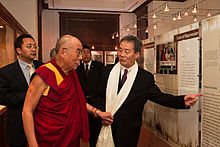

Harry Wu showing an exhibit to the Dalai Lama during his visit to the Laogai Museum in Washington DC, October 2009: Source Wikipedia
__________

Graduating with a degree in geology from university in Beijing, Harry Wu, when a student, fell foul of Mao's "One Hundred Flowers Campaign" when students and intellectuals were encouraged to say what they thought of the Communist Party and society more generally. Cautious, he voiced some criticism of the Soviet Communist Party crackdown in Hungary, [Hungarian Revolution 1956] only to find himself stranded, when Mao reversed the policy and deemed those who had raised their heads above the parapet as the true enemies of the Party. For his pains, Harry Wu spent 19 years in China's forced labour prisons:

"I was twenty three, a college graduate raised in an affluent, urban family, and a political criminal. Xing Jingping, three years younger than I, was a peasant from a starving village, a thief with no education and no political viewpoint. The gulf between us was vast, yet I grew to admire him as the most capable and influential teacher of my life."   


What brought this accolade from Harry Wu was, that Xing had taught him how to fight for survival in the camps: "how to dig for underground rat burrows in order to find clean cashes of grain and beans which then could later be boiled for food" so as not to die from starvation. (1)

Statistics on the scale of deaths, related to slave labour (Laugai) in China
The statistics associated with laogai (a three tiered system of oppression), are truly shocking. In 2008 the Laogai Research Foundation suggested that there were 6.8 million people still detained in a network of some 1,045 "facilities". While estimate vary, the total number of deaths since the laogai was established by Mao in the 1950s, range from 15 to 27 million.. Harry Wu suggests 15 million. Professor R.J. Rummel, the very precise figure of 15,720,000, that doesn't take account of "all those collectivized, ill-fed and clothed peasants who would be worked to death in the fields." Jan-Louis Margolin, one of the contributors to The Black Book of Communism, (1997), suggests 20 million. (2). But In, Mao: The Unknown Story  Jung Chang and the historian Jon Halliday suggest that 27 million may have died in prisons and labour camps during Mao's rule.

"Mao intended most of the population - children and adults alike- to witness violence and killing. His aim was to scare and brutalize the entire population, in a way that went much further than either Stalin or Hitler, who largely kept their foulest crimes out of sight.

"More might well have been killed if it had not been for their value as slave labour. Mao said as much in one order: some people had "committed crimes that deserved to be punished by death," but they must not be killed, partly because "we would loose a large labour force  . . ." * (3)

The three tiers of the laogai system are: convict labour; re-education through labour, and Juyao: a system of enforced residence, whereby as many as 70 percent of those released from the camps are required to live and work in designated areas. And the tentacles of all three aspects of laogai, are the means by which the civilian population are not just coerced, but deprived of some of the most basic of human rights.

Under this system, any citizen, can be detained (without trial), for up to three years; and on the flimsiest of charges,  i.e., "not engaged in honest pursuits," or "being able but refusing to work." And such is the duplicity, that in the absence of a trial and conviction, those forcibly detained, are referred to as "personnel".And as these detentions are carried out by the local security forces, the Communist Party's central government feels empowered to deny that these detentions are politically motivated  And meantime, those who have been detained (without trial) and assigned to the camps, are forced to undergo a program of re-education through labour: a program of two hours of indoctrination at the end of each days work.

Civil liberties and the Chinese Constitution
Now not only is laogai an affront to the most basic of civil liberties, but it also runs counter to China's own Constitution: to Article 35, that guarantees its citizens "freedom of speech, of the press, of assembly of association, of procession and demonstration." And yet, post Tiananmen, the Communist Party, through a series of legislative changes, has been assiduous in curtailing these liberties: by tightening the rules under which, all independent social groups, are required by law, to register with the government.

More repressive legislation, Post Tiananmen.
In 1998 China's State Council issued two sets of regulations: Regulations on the Registration and Management of Social Groups, and Provisional Regulations on the Registration and Management of People - Organized Non-enterprise Units; and the thinking behind them is self evident.

(1) The number of legal requirements and time necessary in which to establish a social group were increased.                      
(2) The authorities were given more leeway so as to prevent the registration of selected groups, and
(3) The involvement of people in social groups who had lost their political rights, was forbidden.
(4) The controls that could be placed on social groups by their "official government sponsors", were increased, and,
(5) Funding for such groups was reduced.

A year earlier (1997) and so as to draw more people into the system of controls, the scope of what constitutes collusion "with foreign states to harm the sovereignty, territorial integrity and security of the People's Republic of China", was widened. Article 9 of the criminal code was amended, so as to include "foreign institutions, organizations, and individuals" as well as foreign states. So not only did the broadening of the code allow the state to regulate more public activities, but the ambiguity of the language used, also allows the courts greater latitude in interpreting a multitude of attitudes as criminal. And there was more.

In this same year, the definition of of what constitutes a counterrevolutionary crime, was changed, so as to allow the Communist Party leadership, to criminalize any activity that it chooses to see as a threat to "state security". Where previously, the crime of counterrevolutionary activity was defined as, "all acts endangering the People's Republic of China committed with the goal of overthrowing the political power of the dictatorship," it was now loosely defined as, "endangering state security." (4)

Desmond Tutu and Chen Guangcheng call on world leaders to help bring an end to repression in China and in particular, to the laogai system of oppression. 
Now accepting that these legislative changes took place some 16/17 years ago, allow me to draw your attention to an article written jointly by Archbishop Desomnd Tutu and, the blind, and now exiled lawyer, Chen Guangcheng. It was published on 6 March 2013 and it was an appeal to world leaders to make the year leading up to the 25th anniversary of the Tiananmen Square massacre "A Year of Human Rights in China." Politely, they expressed the hope that the new incoming president Xi Jinping who had called for a ""renaissance" in China and the realization of the China dream; would be of a like mind with the "many in the Chinese leadership and media who have recognized that the dream for China can not become a reality without social and political reforms." After which they addressed the world's leaders in clear and unambiguous term:

"Since China's Cultural Revolution literally millions of Chinese citizens have been forced into slave labour camps for offences related to thought and expression. In recent times these include increasing percentages of innocents, including lawyers who tried to defend their own rights and rights of others, or ordinary public who tried to uphold their rights and were abducted and sent to jail to be persecuted; and those who have done no more than state their loyalty to their religious leader, His Holiness the Dali Lama, participate in Christian religions which have not been "authorized" by the Communist Party, or practice Falun Gong, a spiritual meditation system based on the ancient traditions of China itself.

"Reports from former inmates of the laogai camps detail prisoners living on the edge of starvation and exhaustion in infested and horrific environments, while being forced to produce commercial goods - commercial goods which we have unknowingly purchased in Western stores. Uncounted numbers of prisoners, credibly believed to be in the tens of thousands, have been executed and their organs harvested for sale, a practice so despicable  it is surely beyond our comprehension.

"As we approach this historic anniversary, today's world's leaders have the opportunity to distinguish themselves from leaders of the past, who,  for the sake of economic progress or in the name of "national security," have turned a blind eye to atrocities committed by Chinese leaders against their own citizenry. We ask our leaders to speak on our behalf  to President Xi Jinping and the Chinese Communist Party.. Tell them what they already know - that the dream of China can be realized only when its citizens' universal human rights and dignity are upheld and respected. And that the laogai system and the brutal repression of freedom of thought, conscience and speech, the most basic of human rights, will remain a festering sore on the Chinese dream until it is addressed and removed." (5).        

Human rights in China and the 2008 Olympic Games.
Now this appeal to world leaders, that they would be a beacon of light on behalf of the oppressed people of China, however well intentioned, left me feeling deeply skeptical, for I was instantly reminded of the 2008 Olympic Games. We were in Morocco when the games were awarded to China, and I recall being moved by the response when the news broke in China: of people crying openly. For me, these were tears of both joy and sadness, a cry of pain from a society that for so long had been locked out, and who, (even it they hadn't realized it, or dared to hope for it), now knew that they were accepted by the rest of the world. And I was reminded also of the fact that after the games there was disquiet at the failure of the Olympic Committee to deliver what the Chinese authorities had promised:: the free association of spectators at the games. So I went in pursuit of the Olympic Committee's report on the games and read this:

"Ultimately the games should be seen as a bridge - a bridge between countries, continents, cultures, religions and generations. The Beijing 2008 Games have surely contributed to China's opening up to the world and becoming more integrated within the international community. Through the Games, the world learned more about China, and China learned more about the world." (6)

These are the words of the President of the International Olympic Committee. Jacques Rogge, and they are taken from his introductory remarks to the Final Report of the International Olympic Coordinating Commission. And there is more, in a similar vein. But for the purpose of this blog, I want to focus on the concluding sentiment that is highlighted in the IOC report, that:  "Through the Games, the world learned more about China, and China learned more about the world." And they are important words, for they appeared to find an echo in remarks made to journalists by Xi Jinping, after he was appointed General Secretary of the Communist Party in November 2012:

"Friends from the press . . ."
"Friends from the press, China needs to learn more about the world, and the world needs to learn more about China. I hope you will continue to make more efforts and contributions to deepening the mutual understanding between China and the countries of the world."

These words of Xi Jinping's are quoted by Reporters Without Borders in the context of the publication of the World Freedom of Information Index, for 2014; and this is what they have to say about them:

"Woe to any journalist who thought he was saying "Describe China's stark realities" when what he really meant was "Follow the party's propaganda to the letter!" Since the speech, the authorities have arrested more journalists and bloggers, cracked-down harder on cyber dissidents, reinforced online content control and censorship and stepped up restrictions on the foreign media."

And in the context of China exporting its methods, (in that it is a model of censorship and repression in the area), they draw attention to Vietnam and Decree 72, introduced in 2013, that places severe restrictions on the use of the Internet:. What Amnesty describe as, taking censorship to a new level:

"Vietnam has stepped [up] information control to the point of being close to catching up with its Chinese big brother. Independent news providers are subject to enhanced internet clairvoyance, draconian directives, waves of arrests, and sham trials. Vietnam continues to be the world's second largest prison for bloggers. Of the 34 bloggers currently detained, 25 were arrested since Nquyen Phu Trong became the party's general secretary in January 2011.

And in respect of the World Freedom of Information Index, for 2014, China came 175th, in a list of 180 countries. (7)

Refusing to Forget
Now if it wasn't for the fact that it is the 25th anniversary of the Tiananmen Square massacre, I would be sorely tempted to stop digging in the bottomless and depressing pit that is the history of human rights abuses in China; abuses that were, and are, both ideological and political.. But as the title I have chosen for this blog: "Refusing to Forget" speaks for me, as I am certain that it does for others, allow me to sketch out a few more current examples of abuse and suffering, that I have collected along the way. After which, and in a later blog, I will reflect, (again in the context of the 25th anniversary of Tiananmen), on the past, on the present, and on the future for China, (and for us), in the context of, A Heart for Freedom : an autobiography by Chai Ling

Liu Xiaobo and Charter 08

In 2010 Liu Xiaobo was awarded the Nobel Peace Prize, for what the citation described as "....his long and non-violent struggle for fundamental human rights in China."; an award that he was unable to accept in person as he was serving an eleven year prison sentence in China. So during the award ceremony the citation and medallion commemorating the award were placed on the chair that he should have occupied.  Born in 1955 Liu Xiabo studied literature and politics, and later established himself as a literary critic and university lecturer. He lectured in Europe and the USA; and was one of a number of young "intellectuals", who joined the hunger strike in Tiananmen Square, and spent two years in prison as a consequence. Later, and for daring to challenge the system of one party rule, he spent three years in a labour camp. And agaian in 2009, he was imprisoned for11 years, for endangering state security, (but in truth), for his organizing, and being a signatory to, Charter 08.

Charter 08: signed by 250 Chinese intellectuals and human rights activists, was published to coincide with the 60th anniversary of The United Nations Universal Declaration On Human Rights, and among its 19 demands  were calls for constitutional reform, the separation of powers, reform of the judiciary and the election of public officials. And such is the vengefulness of the Communist political system in China, that since 2010, his wife, Liu Xia, has been held under house arrest in Beijing, and with neither telephone or e-mill access to outsiders. Once a month, and with a police escort, she makes the long journey, (420 km) by train from Beijing to Jinzhou in Liaoning Province, to visit her husband. At most, they are allowed a half hour together. At first physical contact was allowed, (touching or an embrace). But as soon as Liu Xiaobo was awarded the Nobel Peace Prize, physical contact was forbidden and their conversations monitored. In this context, in 2012, when Liu Xia tried to tell her husband that Mo Yan (Guan Moye) had been awarded the Nobel Prize for Literature she was prevented from doing so. As soon as she uttered the word "Mo" the official monitoring their conversation, intervened.. Nor is she permitted to hand over her letters to him (8)      

Gao Yu A no less redoubtable campaigner for human rights in China, is Gao Yu. Age 70, she was reported missing by her family on 24 April, and later, the authorities confirmed that she had been "criminally detained", and that she was "deeply remorseful" and "willing to accept legal punishment." Then, in early May, CCTV broadcast her confession. With her face blurred out and wearing an orange jumpsuit, and, as The South China Morning Post reported it, she was heard to say, (to a policeman): "I think my actions have touched on legal issues, have harmed the national interest. What I have done was very wrong. I sincerely and earnestly accept to learn a lesson and plead guilty."

Her supporters were quick to dismiss this confession as made under duress, and one that would "negate any chance of a fair trial"; and in this contest they noted also, that her son, Zhao Meng, had gone missing at the same time. What she had done was leak Document No 9 that she is believe to have received, in June 2013, from a Communist Party official whom she had known from school. Dated April 2013, the document was circulated among senior Party officials. "The document is said to detail the government's vision of pushing economic reforms while maintaining ideological controls and preventing the spread of ideas such as democracy, civil society and freedom of the press." Or put another way, what the report was advocating, was a policy of active opposition the human rights agenda.

Now given this very public confession by Gao Yu, and the belief that she was coerced into making it, it is worth recalling that she has a long history of opposition to the abuse of power in China. And, as with Liu Xiaobo and many others, she continues to pay the price. When deputy editor-in-chief of the Economics Weekly, she gave her support to the Tiananmen student protests in 1989, for which, she spent 14 months in prison, and the paper for which she worked, was shut down. Then in 1993, she was sentenced to a further six years, for leaking state secrets. Since her release in 1999, she has worked as a freelance journalist. (9)

And not to be overlooked - The death penalty in China
In its, Annual Report on Human Right in China, 2013, Amnesty International drew attention to the fact that more people were executed in China than in the rest of the world put together; and for which, there are no statistics, as such information remains classified..And it drew attention also, to the fact that under current Chines law, there are no provisions that would allow prisoners sentenced to death, to seek either a pardon or commutation of their sentence. And while the report acknowledged that the death sentence on the businesswoman Wu Yung, for "fraudulently raising funds," had been rescinded, it makes it clear that the Chinese judicial system has a long way to go, if it is to comply with universally accepted standards of behaviour in respect of those condemned to death, or life imprisonment. And that section of the report that deals specifically with the death penalty ends thus:

"In November the authorities announced that a voluntary organ donation system would be launched nationwide in early 2013 to phase out reliance on organs removed from executed prisoners."

________

Note: On this the 25th anniversary of the massacre in Tiananmen Square, and in support of those, known and unknown, who are still living with the consequences, as well as those who are daily suffering the injustices of the laogai system, please share the link to this blog with your friends.
__________
© Cormac McCloskey

       Mary Dejvevsky  : A profile
(1)  Wikipedia
(2)  Socialphy
(3)  Mao: The Unknown Story .p.338
       By Jung Chang & Jon Halliday
       Jonathan Cape London 2005
       ISBN 0-224-0726-2

(4)  Laogai: "Reform Through Labor" in China 
(5)  Huffington Post
(6)  Final Report of the IOC Coordination Commission 
(7)  Reporters Without Borders 
      Decree 72
(8)  Sources: Reuters. The Guardian. Nobel Prize website, Wang Dan and Wikipedia.
      Charter 08
      Universal Declaration on Human Rights  
(9)  Sources. BBC. South China Morning Post. Amnesty International.

      Links to related organizations
      Lagai Research Foundation
      Laogai Museum
      Human Rights Watch
     Reporters Without Borders 

      Links to interesting articles:
      "This is how China treats the wife of a Nobel peace prize winner"
      "History Matters Remembering Tiananmen (and Abu Ghraib) "
      "Tiananmen Square Massacre: Chinese Activists Call on People To Wear Black."
        Rubber Ducks 
      "Tiananmen Square Remembered: An Eye Witness Account"
       By Mary Dejevsky for The Independent
      "Re-education Through Labour Abolished Yet Arbitrary Detention Remains."
       "China cracksdown on dissent ahead of Tiananmen anniversary"
       By Jonathan Kaiman  * * An especially good and concise report
       Amnesty International Report 2013 : China 
      World Press Freedom Index 2014  
      Transparency International: Corruption Perception Index 2013
     The Black Book of Communism           

Wednesday, 26 February 2014

The Divine Comedy Part 8


The Divine Comedy Part - 8 
Of necessity: a conclusion.
Peter James and John and Dante's profession of faith and Saint Bernard and Dante's Amen.


"You have heard, O Virgin, that you will conceive and bear a son; you have heard that it will not be by man but by the Holy Spirit. The Angel awaits an answer; it is time for him to return to God who sent him. We too are waiting, O Lady, for your word of compassion; the sentence of condemnation weighs heavily upon us

"The price of our salvation is offered to you. We shall be set free at once if you consent. In the eternal Word of God we all came to be, and behold, we die. In your brief response we are to be remade in order to be recalled to live. . "

These are not Dante's words, nor do they appear in The Divine Comedy. Instead, they are a quotation from Saint Bernard of Clairvaux (1090-1153), who was reflecting on what was, and is, the most profound and dramatic moment in human history: the salvation history of those who shared, and share, Dante's particular faith, or are otherwise committed to Christ. And they are here, because Saint Bernard, unannounced, makes his appearance in the final three cantos of the Comedy, and who, as a devotee of the Virgin Mother of God, prepares Dante for the fulfillment of his ambition of perfect union with God in the beatific vision.

Now my reason for focusing on Dante's profession of faith and Saint Bernard, rather than on other possible themes, is simple enough.I am avoiding the esoteric, and in the context of Dante the pilgrim, focusing instead on the Christian life as most of us would understand it. And this approach, to some extent, is in keeping with Dante's own objective, which was, that The Divine Comedy should reach as wide an audience as possible; hence its composition in Italian rather than Latin, and his observation to the effect that, even women are capable of thought. And in taking this approach there is something else that needs to be born in mind, something that Dorothy L Sayers acknowledged in her Introduction to Hell in 1949. Not only that we can no longer assume that people are as familiar with the classics as they once were, but with the Bible also. And it is on that principle, that I am going in to some detail about the lives of Peter, James and John as portrayed in the Gospels.

Peter, James and John and their special relationship to Christ.  
Now it helps if we know that in relation to Christ, Peter, James and John occupied a special place. Not only were they chosen at the same time to follow him, but during his ministry, they were chosen to be witness to key events, from which the rest of the disciples were excluded. And though all three were witnesses to these events, there are moments in the Gospels, (prior to the crucifixion of Christ), when it is apparent, that Peter was, in some way, set apart from the rest.

Peter 
Without doubt, the most sacred of these moments in respect of Peter's unique position, was when Jesus asked his disciple the question: "Who do men say that I am?" To which they replied that some said he was John the Baptist, or Elijah, or one of the prophets. At that, and bringing them to a particular moment of truth, Jesus had a yet more pertinent question, one that they could not avoid. It was: "Who do you say that I am?" And it was Peter who answered: "Thou art the Christ, the son of the living God." And what made this moment sacred, was Jesus' response: "Blessed are you Simon son of Jonah!" [Peter's original name] For flesh and blood has not revealed this to you, but my Father in Heaven." Or put another way, Jesus lets it be known that Peter's understanding that He was the Messiah, was not something that he could have known by himself, But that it was a truth revealed to him by God. A point he reinforced with a foretelling of Peter's future, that (because the time was not right), neither Peter nor the other disciples understood. "you are Peter," [rock] he told him, "and on this rock I will build my church and the gates of Hades will not prevail against it. I will give you the keys of the kingdom of heaven, and whatever you bind on earth will be bound in heaven, and whatever you loose on earth will be loosed in heaven." After which, they were told: :"not to tell anyone that he [Christ] was the Messiah." (Matthew 16:13-20)

But before Peter could assume this new responsibility, something else had to happen, and it came after Christ had risen from the dead, [Easter Sunday] when he gave Peter a threefold opportunity to retract his denial. Three times Jesus asked Peter if he loved him, and when he was asked for the third time, Peter becomes agitated, and exclaimed: "Lord, you know everything, you know that I love you!" In the words, "you know everything", Peter was acknowledging that before Christ his soul was laid bare, to the point that, with nowhere to hide, he could not but relive, and feel again, the pain of his denial, hence his anguish. For the point of the repeated questioning, wasn't, so that Peter could tell Christ what he knew already, but that Peter would be well prepared, by knowing, and accepting, the truth about himself, and about the nature of forgiveness, before Christ would entrust him with the care of his Church. (John 21: 15-19)

And among the shared experiences, were these:

The raising of Talitha from the dead.
When one of the leaders of the synagogue Ja-i'rus came to Jesus and on his knees begged him to come to the aid of his daughter who was dying, Jesus set out for his house; but was delayed, not just by the crowd that were following him, but by the woman, who, desperate to be healed of a haemorrhage had touched the hem of his garment and was cured. Having stopped to reassure her, and praise her for her "faith", by the time Jesus got to the house the child was dead, and the assembled mourners, weeping and wailing..And when Jesus asked why they were making such a commotion, and they laughed at him, because he told them: "the child is not dead but sleeping", we are told that he put them out of the house, and having reassured Tal'i-tha's parents and encouraged them to "believe" [have faith], he only allowed Peter, James and John from among his disciples, to accompany them to the room where the child lay, so as to witness his raising her from the dead. An experience that he "ordered" them not to speak of. (Mark. 5: 21-43)  

The transfiguration
Another such experience came with the transfiguration: that occasion when Jesus took Peter James and John onto a high mountain "by themselves" where he was transfigured before them, so that his face, "shone like the sun, and his clothes became dazzling white." after which, the Old Testament prophets, Moses and Elijah "appeared to them." and "a bright cloud overshadowed them, and from the cloud a voice said;"This is my Son, the Beloved, with him I am well pleased, listen to him."" In his account of this event, Matthew tells us that the disciples were overcome with fear and fell to the ground; but that Jesus, touching them, told them not to be afraid; and, that "when they looked up, they saw no one except Jesus himself alone." And yet again they were told, not to tell anyone of this vision "until after the Son of Man [Christ] has been raised from the dead." (Matthew 17: 1-9)

Jesus prays in Gethsemane before his betrayal and arrest 
Having celebrated the feast of the Passover, (popularly known as, The Last Supper), and with Judas Iscariot having left to betray him, for thirty pieces of silver, Jesus went with his disciples to pray in Gethsemane. And having instructed his disciples to wait at a particular spot, we are told that he took Peter, James and John with him further into the garden, where, telling them that he was "deeply grieved" at the prospect of his betrayal and death, he asked them to keep watch with him while he prayed. Three times he prayed, prayers of anguish, but always of submission to the will of his Heavenly Father. And three times he returned, only to find the chosen three, sleeping. [Perhaps, and in sensing that something dramatic was about to happen, depressed ?] (Matthew 20: 36-40)
__________

Now in all of this it is easy to see why Peter would question Dante on Faith, a little less clear as to why James was chosen for Hope, except that Beatrice lets it be known, on two accounts, in Canto XXV (25). First, when the "light" that was James, joined Peter, she exclaimed:

17                  "Look now, look, there is the master
      For whose sake there are pilgrims in Galacia

St James is the patron saint of Spain, and the reference to Galacia relates to his shrine at Santiago de Compostela in northwestern Spain. Since the ninth century it has been a place of pilgrimage, and therefore of hope. It is believed that he preached in Galacia, and that his body was returned there, after he was martyred at Jerusalem. And the second reason given by Beatrice, is the one that we have been considering, the fact that James was one of "the three", to whom Jesus had shown: "more kindness" than to the rest. (l.33)
   
As for John, I am not aware that he ever put a foot wrong. Not only that, but there was speculation that Jesus had foretold that he would not die; an idea that John himself refutes in the final paragraph of his Gospel.. (John 21:20_23).But, in the context of love, what we know is, that John was described as "the disciple whom Jesus loved." And that from the cross, he entrusted to him, the care of his mother; and told Mary to regard John as her son. (John 19:25-27). Sentiments that Beatrice captures with eloquence at the point when the "light" that was the soul of John, appeared;

112   "That is he who lay upon the breast
         Of our pelican in the wilderness, and he
         Who was chosen, from the cross, for the great office."    
_________

Now when Dante meets Saint Peter in the Eighth Heaven of the Fixed Stars, he appears as a light brighter than the rest, and he symbolically circles Beatrice three times; after which, Beatrice invites him to test Dante as to his Faith. The first question that Peter puts to him is direct and to the point: "What is faith?" to which Dante replies, by drawing Saint Peter's attention to his own second Epistle in which he referenced St Paul; before, in his reply, echoing the words of St Paul in his letter to the Hebrews (II:1)

64   Faith is the substance of things hoped for
      And the argument for what is not seen;
      And that seems to me the quality of it."

Now as the examination progresses, and as we would expect, the questions become more expansive, so that even when Dante has identified scripture, (the work of the Holy Spirit) as the pure "coin" of his belief; Saint Peter, seeking like a good examiner to widen his students horizons, presses him to explain how he can know, that the scriptures are authentic. And taking the hint, Dante focuses on the evidence as it is to be found in the world:

100   And I: "The proof which reveals the truth to me
        Is in the works which followed, for which nature
        Did not heat the iron or strike the anvil."

103   The reply I was given was: "Tell me, who assured you
        That those works took place? The same scripture
        That is to be proved, and no other swears to it."
    :  
106   "If the world turned to Christianity,"
        I said "without miracles, it is itself so much
        A miracle, that the others are nothing to it,

109   That you came in poverty and hunger,
        On to the field, to sow the good plant
        Which was a vine and has become a thorn"

                                      (Paradiso XXIV (24)

Now mirrored in these exchanges, are the Gospel of Matthews, and Saint Augustine's, City of God. Saint Matthew reminds us that when Jesus first sent out his apostles to preach and teach, they were told to travel as poor men, taking neither gold, silver, copper, nor a purse, but instead to rely on the hospitality of of others. An injunction, that as Dante sees it, has become a burden: "a thorn" in the Church. And Saint Augustine, (lines.106-08), gives a particular context to the absence of miracles, ("without miracles") which, paradoxically, for Dante, was a miracle, as it was for Saint Augustine. For Augustine, the authenticity of the Church's message is apparent in its success, from the humblest of beginnings:


“There were just a few men, the merest handful, untrained in the liberal arts, completely uneducated, as far as pagan philosophy is concerned, with no knowledge of literature, no equipment in logic, no trappings of rhetoric. And Christ sent them out as fishermen with the nets of faith into the sea of the world, and in this way he caught all those fish of every kind, including – more wonderful, because rarer – even some of the philosophers themselves. And so if you please, (or rather because you ought to be pleased), let us add a third incredulity to the others.

"Here then we have those incrediblities; and yet they happened. It is incredible that Christ rose in the flesh and with the flesh ascended into heaven. It is incredible that the world believed so incredible an event; and it is incredible that men of no birth, no standing, no learning, and so few of them, should have been able to persuade, so effectively, the whole world, including the learned men . . . “
    
                                        (City of God  Book XXVI (26) Chapter 5) 

In the end, and with the heavenly choir singing the Te Deum, a hymn of praise from the fourth century, Dante is required by to Saint Peter to state the details of what it is that he believes, so that the examination concludes with him making a declaration of his beliefs, based on the propositions of the Nicene Creed:

130 And I replied: "I believe in one God,                    [Nicene creed
      Sole and eternal, who moves all the heavens    [Aristotle
      With love and desire, and is himself unmoved.

133 And for this belief I have not only proofs,           [Aquinas
      Physical and metaphysical, but there is given me
      Also the truth which is poured down on us

136 Through Moses, through the prophets and the psalms,
      Through the Evangelists and you who wrote   [St Peter 
      When the burning spirit had made you divine.

139 And I believe in three eternal persons, and these   [the Trinity
      I believe one essence, unity and trinity,
      So that singular and plural are combined.

142 This mystery of the divine nature                    [Matt 25:19.2
      I now speak of, is stamped in my mind            [2 Cor 13.14
      More than once by the doctrine of the gospel.  [John 5.7 

145 This is the beginning that is the spark
      Which spreads out into a living flame
      And sparkles like a star in heaven."

                          (Paradiso XXIV (24) 130-144)

And Dante knows that he has passed the test, when Saint Peter, symbolically circles him three times, as he had Beatrice at the outset.
__________

Now in the telling, the story of Dante's examination by James, follows a similar pattern. It begins with a preamble, in which Dante reinforcing the point that his poem is divinely inspired, expresses the hope that he will return to Florence, to the place where he was baptised, to be acclaimed as a poet. A hope that was not to be realized: And at the point where he is about to be examined, (and with his eyes cast down), Beatrice, sensing his vulnerability, takes the initiative and speaks on his behalf. And in replying to the questions put to him, Dante, (as any wise student would do), never fails to quote from his examiners own works: And here too, as evidence that the session is drawing to a successful conclusion, a voice is heard singing Sperent in te "they will trust in thee" after which, the rest of the heavenly choir join in the singing of Psalm 9.

In describing hope, Dante references Peter Lombard, (1095-1160), a theologian and bishop whom we first encounter along with other luminaries in the sphere of the Sun; referencing his popular text-book Sentences:


67 I said:”Hope is a certain expectation
    Of future glory, and it is the product
    Of divine grace and of precedent merits.

But there are many sources, or "stars" , for his hope, he tells him, including the psalms, in particular the 9th psalm of David, which he quotes, and which as we saw above, the heavenly choir eventually intone. And as James has never spoken of hope, Dante (the student), as it were, pulls off a masterful stroke, by referencing his brother (John), when James invites him to say what it is that hope promises him; which in effect is redemption, and union with God in eternal life:

91 Isaiah says that every soul shall be
     Dressed in a double garment, in his own land;
     And “his own land” is the delightful life.

94 And your brother makes his revelation to us
     With more particularity, when he talks
    Of those who are clothed with white robes.”
_________

Now among the serious stuff, it would be quite easy to be too po-faced when reading Dante, which was why, when reading Dorothy L Sayers Introduction to Hell, I was pleased to see that one of the qualities that she attributes to the The Divine Comedy, is humour. For it had occurred to me that humour had survived in the translation. For as I pointed out, it seemed that there was humour in the encounter between Lucy and Beatrice, when Lucy was sent to alert Beatrice to the state of Dante's soul. And it is present in these cantos, XXIV-XXVI (24-26) in a subtle way, for there is a worldliness in the way that Dante portrays the relationship between the student and his teacher, which in effect, is what is going on. So when Dante meets John, it is no surprise that things go awry  that he is distracted by things other than the task in hand, and as a consequence is punished. though not to the point of failing the exam. So intent is he, in trying to penetrate the "light" that is John, to see if it is true that he has his mortal body in heaven, that he is admonished by John, and his sight temporarily impaired.

In his replies to John, Dante acknowledges love as being the very essence of what God is. He is the alpha and omega of all the knowledge that he has acquired of love, from whatever source. And when, as was the case with James, John steers him away from a too narrow response, and asks him what else there is that is drawing him to God, Dante tells him that his love is sustained, not just by the fact of his existence, or by the beauty and goodness that he finds in nature, but what is drawing him above all else to Love, is the crucifixion of Christ. Or as Dante puts it, His willingness to die, so that he might live. And here too, Dante doesn't fail, (from a worldly point of view) to flatter his examiner:

43 It is made plain by you also, at the beginning
    Of the great proclamation which cries on earth
    The secret of the place above all other edicts.”

The "you also" alludes to the well known opening passage in John's Gospel, which taken in its entirety traces the origin of Christianity from the creation, the prophets of the Old Testament, through to the advent of John the Baptist, who foretells of the imminent arrival of the Messiah through to Christ's crucifixion, death, and resurrection from the dead. And with the clear inference that as God is the giver of all things, divine love, is omnipresent.

__________

Now in the Empyrean, when Bernard makes his appearance it is unexpected. For when Dante, gazing in awe at how heaven is arranged, turns to Beatrice, he finds instead, "an old man". And though as yet he has no idea who he is, he knows what he represents::

61   In his eyes and over his cheeks there was
      An air of benign happiness, and his manner
      Was what you might see in a tender father.

64   “And where is she?” I said suddenly.
       He answered: “It was for your final satisfaction
      That Beatrice asked me to leave my place;

67   And if you look up in the third circle
       Below the highest, you will see her again,
       On the throne for which her merits destined her.”

As The Divine Comedy draws to a close, these are dramatic moment, moments when the tercets should be allowed to speak for themselves. In the first instance, to tell of Dante's invocation to Beatrice now that she has gone; and secondly, so as to see, how and why, Bernard was moved to disclose his identity:

79   “O lady in whom my hope always springs,
      And who for my salvation have submitted
      To leave the print of your face in Hell,

82   By all the many things that I have seen,
      I recognize the grace and capacity
      There is in your power and your goodness.

85   You have brought me from servitude
      To liberty, through all those ways and means
      Which you had in your power to use.

88   Continue your munificence to me
      So that my soul, which you have made whole,
      May please you when it is untied from my body.”
   
                          (Paradiso. Canto XXXI (31))

__________

94   And the holy man said: “So that you may
      Perfectly finish the path on which you are set            [The vision of God]
      -The end for which prayer and holy love have sent me here-

97   Let your eyes wander over this garden;
      For seeing it will make your sight more fit
      To climb at last through the divine ray.

100 And the queen of heaven, for whom I am completely          [Mary}
      Consumed with love, will grant the grace we need
      Because I am her faithful Bernard.”

With that, Bernard encourages Dante to cast his eyes over what he sees, "this garden", as a prelude and preparation for experiencing the beatific vision [vision of God]. The garden that is Empyrean is laid out as a magnificent rose, in which all who dwell in the presence of God are systematically arrayed. An idea analogous to the great cathedral rose windows. And the penultimate canto is taken up with Bernard, the great teacher, explaining to Dante, (as their eyes descend through the layers of the rose), who is who and why, in accordance with the divine plan, things are arranged as they are. Or as Higgins puts it:

"Saint Bernard identifies for Dante the elect from those born before and after Christ who, redeemed, are seated in glory in the rose-shaped court of the Empyrean, true Paradise, and explains to him the presence there of unbaptised children."

And as previously, n The Divine Comedy Bernard is keen to impress upon Dante, the justice in the divine plan:

52   Within the length and breadth of this kingdom
      There is no such thing as a place left to chance,
      Any more than there is sadness or thirst or hunger;

55   For whatever you see has been established
      By eternal law, so that everything fits
      As closely as  the ring does to the finger.

                                   (Paradiso Canto XXXII (32))

And as this canto ends with Bernard inviting Dante to join with him in preparing for the beatific vision, so the final canto opens with Saint Bernard's prayer to the Virgin Mary, that she might act as an intermediary before God, so that Dante might not only cope with the beatific vision, but be able to tell of it when he returns to earth. A prayer that has been described by one commentator as perhaps the greatest ever prayer composed to the Virgin Mary:

      "Virgin Mother, daughter of your son,
      Humbled and exalted beyond any other creature,
      The settled end of the eternal plan,

 4   You are she who made human nature
      So noble, that the maker of it himself
      Did not scorn to have himself made by it.

 7   In your womb was lit again the love
      By whose warmth, in the eternal peace
      This flower has germinated as it is.

 10  For us here you are a midday blaze
      Of love; and down there, among mortals,
      You are the ever-living sporing of hope.

13   Lady, you are so great, and have such power,
      That whoever seeks grace without recourse to you
      Is like someone wanting to fly without wings.

16   You are so benign that you not only help
      Whoever asks you but, very often,
      Spontaneously give before the prayer is made.

19   In you there is mercy, in you there is pity,
      In you magnificence, in you there is
      Whatever goodness there ever was in creatures.

22   Now this man who from the lowest sink        
       Of the universe has seen one by one
       How spirits live, from there to this point,

25  Implore you, of your grace, that he be given
      Enough grace for him to lift his eyes
      Higher towards the ultimate beatitude.

28   And I, who never burned more for my own vision
      Than I do for his, I offer all my prayers,
      And pray that they may not be insufficient;

31   That you may disencumber him of all
      Clouds of mortality, with your own prayers,
      So that the supreme pleasure may unfold.

34   Alas I pray you, queen, who can do anything
      You choose to do: after this great vision
      Enable him to keep his affections sane.

37   May your protection extinguish human impulses:
      See Beatrice, with how many of the blessed,
      Putting her hands together for my prayer."
           :   
                                       (Paradiso Canto XXXIII (33))

And Dante's immediate response:

46   An I, who was drawing near the end
       Of all desires, felt as I must do
       The ardour of desire in me finished.

49   Bernard indicated that I might look up,
      And smiled at me, but I was already
      Of my own motion as he would have me be;

52   For my sight, becoming clarified,
      entered deeper and deeper through the ray
      Of that profound light which is true in itself.

55   From that moment what I saw was greater
      Than our language, which fails at such a prospect,
      As memory fails at something so out of the way.

58   As someone who sees something in his sleep
      And after his dream has only an impression
      Of what he felt, and can recall nothing else,

61   So am I, for my vision has almost gone,
      And yet into my heart still, drop by drop,
      Flows the sweetness which was born of it.

64   So the snow looses its shape in the sun;
      So was it that the oracles of the Sibyl,
      On the light leaves, were lost in the wind.

67   O supreme light who rise far above
      Mortal notions, lend my memory
      A little of what then appeared to me,

70   And give my tongue all the power it needs
      So that a single spark of your glory
      May be transmitted to people in the future;

73   For, if something of it comes back to my mind
      And sounds a little in these verses of mine,
      Your triumph will more easily be conceived.

A highly charged and profound response that is crystallized in these three lines:

94   A single moment cost me more forgetfulness
      Than twenty-five centuries have the enterprise
      Which made Neptune marvel at the at the sight of Argo.

From here Dante goes on to describe as best he can, his vision of the Trinity, which he likens to three circles of equal circumference but coloured differently, and with the light fusing between them. And at this point, not only does his speech fail when it comes to describing what he saw, but so too does his mind, as he attempts to contemplate the Trinity, this great mystery of faith. But in truth, and bearing in mind that he is still a mortal, his mission has been accomplished: At the point at which his "high imagination failed", his "desire" and his "will" were at last synchronized with the divine will, so that they:

       Were being turned like a wheel, all at one speed

145  By the love which moves the sun and the other stars..
____________

AFTERWORD 
Dante's spiritual experience:
In reading Dante we have been delving into the past; but as Dante knew full well, the Church to which he belonged, (warts and all), is destined to continue until the end of time. And here we are today, (war
ts and all), still engaged in the unending struggle between good and evil, between sin and redemption. A struggle that is an inescapable part of the life of the Church, as well as between the church and the secular world: hence the crucifixion and death of Christ.

That said, and as Dante repeatedly asserts that his poem was Divinely inspired, and that he had a spiritual experience in some way comparable to that of Saint Paul, in my reading of The Divine Comedy, and in preparing these blogs, I have treated that claim as a fiction. The fact that Dante makes the claim, is not proof that it is true. And even it it were true, it would be a private revelation that is not in any way comparable to that of Saint Paul, who, as an orthodox Jew, was persecuting the first Christians, when he was spectacularly converted to Christ on the road to Damascus, and whose writing as an evangelist, including his conversion and mystical experiences, are part of the body of Scripture.

Now the fact that I have treated Dante's claims as a fiction, as I see it, does not diminish The Divine Comedy, because its worth does not depend on Dante's claims being true. If we accept that Dante was a man of faith, who, as he represents himself, at one point had strayed from the right path, but was now concerned not just about the state of his own soul, but of the Church, and society also, it would not have been beyond the wit of Dante, when dealing with the subject, to claims to have had an experience comparable to Saint Paul, as a headline grabbing strategy: as a way of getting noticed or having people pay attention to what he has to say. Or more relevant, it being self-evident to him that while in his poetic endeavour his imagination might be capable of constructing images of Hell and Purgatory, it would not be capable of describing the supernatural: what it is to be in the presence of God.So for me, the only way to read The Divine Comedy, is as fiction, even if, as I do, in a broad sense, I accept its spiritual values as "truth".

Some thoughts on the Virgin Mary: in The Divine Comedy

And a last point if I may. I have left almost everything unsaid in respect of those tercets quoted from the final canto, in part, fearing that the blog might never end. But also, because I am happy to leave you the reader with some work to do. But I have some sympathy for those who are not of the Christian faith, or who have no religious faith at all. So in the context of bringing The Divine Comedy into the present, and making things a little clearer, I am going to quote a passage from The Joy of the Gospel, by Pope Francis, because it might help in providing an easier sense of the significance of the prayer of Saint Bernard; a prayer that for the Catholic in particular, is packed with meaning. It is from that part of the document where Pope Francis is reflecting on the present and possible future roles for women in the Church:

"104.   The ministerial priesthood is one means employed by Jesus for the service of his people, yet our great dignity derives from baptism, which is accessible to all. This configuration of the priest to Christ the head - namely, as the principal source of grace - does not imply an exultation which would set him above others. In the Church, functions "do not favour the superiority of some vis-a-vis the others. Indeed, a woman, Mary, is more important than the bishops. . . ."

Which takes us back to the Incarnation, the point at which we began, this last, in this series of blogs.

__________

Note:   When preparing this blog and in relation to the role of Beatrice, that was of particular interest to Harold Bloom, (not a criticism), I had in mind an idea that I had intended to posit, which was the idea the Dante might be attributing his rescue to a particular devotion that he had to the Blessed Virgin Mary. Beatrice did not come to Dante of her own initiative, only as the result of an intermediary, Saint Lucy, sent to her by Mary, (alluded to rather than named). If you put that beside Cangrande della Scala, Dante's patron in exile, and Saint Bernard, both of whom were noted for their devotion to the BVM, it is hard to escape the conclusion, that Dante is telling us something about his own devotional life. To which, I would add this interesting detail.

In Florence in the late thirteenth century, a religious order known as the Order of Servites of the Blessed Virgin Mary, was founded by a group of men of various states of life: unmarried, married, or widowers, and all were merchants or from the merchant class. And they had come together through and ancient guild, the Major Guild of Our Blessed Lady; a guild to which both men and women belonged. This order of Servites was given papal recognition in 1304 and the last of its founder members, there were seven of them, died in 1310.  Cormac 27th February 2014.

__________    . . .
© Cormac McCloskey


Picture of Mary and the child Jesus, taken by me, at the Troja Palace Prague, in September 2011

The sources listed below were referenced, and in most instances, used in the composition of these blogs:

The Divine Comedy
Translated by C.H. Sisson
Introduction and Notes: David H. Higgins
(Oxford World's Classics)
Oxford University Press (2008)
ISBN: 978-0-19953564-4

Dante: The Divine Comedy
I: Hell
Translated by Dorothy L. Sayers
Penguin Classics (1953) edition

The Complete Danteworlds
A Reader's Guide to the Divine Comedy
Guy P. Raffa
University of Chicago Press (2009)
ISBN:10: 0-226-70270-7

The De Monarchia Of
Dante Alighieri
Edited With Translation And Notes
by Aurelia Henry (1904)
Printed in Great Britain
by Amazon.co.uk Ltd

Encyclopedia Britannica, Vol's 1,3,7,11,14 and 28
in respect of a variety of related topics  (1991 edition)
Vol 14: Aristotle. 28: Thomas Aquinas

Aristotle
A very Short Introduction
by Jonathan Barnes
Oxford University Press (2000)
ISBN: 978-19-285408-7

BBC Radio 4 archive
In Our Time, 17th September 2009
"Melvyn Bragg discusses the life, works and enduring influence of the medieval philosopher and theologian St. Thomas Aquinas, with Martin Palmer, John Haldane and Anabel Brett."  here

Dante Alighieri
Bloom's Modern Critical Views
Editor, Harold Bloom
Chelsea House Publishers,
Philadelphia U.S.A. (2004)
ISBN: 0-7910--7658-X

The Poetics of Conversion
by John Freccero
Harvard University Press
Cambridge, Massachusetts
and London England (1986)
ISBN: 0-674-19225-7 (alk, paper (cloth)
ISBN: 0-674-19226-5 (paper)

Saint Augustine
City of God
Penguin Books 2003
ISBN-13: 978-8-14-044894-8

Evangelii Gaudium
The Joy of the Gospel
Pope Francis
The Word Among Us press 2013
ISBN : 978-1-59325-262-5

(1)    Wikipedia  unam sanctam
         Virgil (40-19BC) Regarded as one of Rome's greatest poets
(2)     Wikipedia, for an excellent broad sweep of The Divine Comedy, go here

3)     De Monarchia Boo II: XIII In the chapter headed "Christ in dying confirmed the jurisdiction of
the  Roman Empire over all humanity" Dante argues the case for the Roman Empire being the lawful authority by which Christ was put to death (lawful, in the sense of being ordained by God) and at XIII.4 he writes "Wherefore let those who pretend they are sons of the Church cease to defame the Roman Empire, to which Christ the Bridegroom gave his sanction both at the beginning and at the close of his warfare. And now I believe, it is sufficiently obvious that the Roman people appropriated the Empire of the world by Right."

Wednesday, 19 February 2014

The Divine Comedy Part 7

The Divine Comedy Part 7
PARADISE 

JUSTICE: from God's point of view. 

Believing as I do, that the Divine Comedy is a poem about the journey of the soul to God amid the trials and tribulations of life, a journey whose end is determined by the choices we make, my focus here is on ideas, rather than following exactly, Dante's progress though the heavens.

That said, and in anticipation of the stories that I am going to tell, I am returning briefly to Part 5, to remind us of how Dante distributed the souls among the heavenly bodies. But also, to show how, in some instances, Dante makes the connection between the present and the past, by linking the virtues of particular saints, with Roman mythology. .

Dante's distribution of the saints among the heavenly bodies.
Not forgetting that most of these souls will have spent time in Purgatory atoning for past sins, the Moon is where we find those who were unfaithful to their religious vows; and Mercury, where we meet those who, in life, had sought after fame. On Venus we make the acquaintance of those whose love, (for whatever reason), was misplaced. And unsurprisingly, the Sun is where we find the great luminaries: those saints, such as Thomas Aquinas who were renowned for their wisdom. In Roman mythology Mars was the god of war, and it is in this context that Dante placed there, evangelists: the souls of those, who, in crusading for Christ, had put their lives at risk and in some cases lost it. And again in the context of mythology, as Jupiter was the supreme god of the Roman pantheon and protector of the state and its laws, Dante placed there, souls who, when on earth and in positions of power and influence, had ruled with justice. On Saturn we find the contemplatives, and at the Fixed Stars the Church Triumphant; and among them, the apostles, Peter, James and John, and Adam, the first man created by God. And at the Primum Mobile, the orders of angels.
__________

Divine justice and the story of Piccarda Donati and the Empress Constance.
Now in the context of justice, and what I like to call the affairs of the heart, the story belongs to Piccarda Donati and the Empress Constance. We are on the Moon, at cantos III, IV (4) and V (5). Both women were nuns, who, for political reasons were forced by their respective families to leave their convents and enter into politically expedient marriages. Piccarda, (related by marriage to Dante), had been a “Poor Clare” a companion order of nuns, to that of the monks, (Franciscans) founded by the famed Saint Francis of Assisi. In Piccarda's case, the culprit was her brother Corso Donati, a black Guelph leader, and hence, a political opponent of Dante, of whom it was earlier foretold in The Divine Comedy, that he was destined for Hell. Shortly after her marriage, Piccarda died. Constance, who was married to Henry VI, became the mother of the last truly great Holy Roman Emperor, Frederick II, who, continually at war with the popes, was excommunicated four times. But though he admired him greatly, as Emperor, and for his cultural achievements, Dante placed Frederick among the heretics in Hell, apparently, (as at least one commentator has suggested), so as to represent him as he would have been perceived by his enemies.

Dante's response to Piccarda and Constance is one of sympathy, but with a sense of injustice. After all, weren't they forced to abandon their consecrated life. So surely, he asks, shouldn't they be in a more exalted place: a higher Heaven. But, accepting some blame in the matter, Piccarda tells Dante that there was something “unfulfilled” in their vows. After which, and quoting from the Confessions, of Saint Augustine, she puts his mind at rest; so that he understands that all the saints, in whichever heaven he finds them, are happy, because they are in the presence of God.

79 "It is indeed the essence of this life
    That we keep ourselves within the divine will,
    So that our wills may be made one with his:

82 So that, how we are at various thresholds
    Throughout this kingdom, pleases the whole kingdom
    As it does the king who rouses us to his will

85 And in his will we find our peace:                                [Saint Augustine]
    It is the sea to which everything moves
    Which it creates and which nature makes.”

To which, Dante responds:

88 Then it was clear to me how everywhere
    In heaven is paradise, although the grace
    Of the highest good does not fall on all in one way.

                                    (Paradiso (III:79-90)

But notwithstanding this enlightenment, there are other issues to be resolved. And they are not idle speculations, for in all these encounters, Dante, in juxtaposing the wisdom of man, with the wisdom of God, is defining the true nature of Christian belief.

And Beatrice, aware that Dante is still troubled poses the question that she knows is on his mind:

19 "You reason: “If the will remain good,
    How can the violence of another
    Diminish the measure of my desert?”

                                       (Paradiso Canto IV (4)

And answers it.

Having explained to Dante that the Moon represents the lowest of the celestial states (l. 39), she has something to say about Piccarda's willingness to accept some blame on her own and Constance's behalf, a view that she expresses in the context of both divine justice and free will:

67 “Our justice, appearing to be unjust
    In the eyes of mortals, is a matter for faith:
    There is nothing wicked or heretical in that.

70  But, because your intelligence is able
     To penetrate this truth as you desire,
     I will put your mind at rest.

73  If violence is to be understood
      As meaning that the sufferer contributes nothing
      To the force that moves him, these souls had not that excuse;

76   For the will does not weaken unless it wants to,
      But operates as nature does in a flame
      If it is violently twisted a thousand ways.

79  For if it bends itself either much or little,
     It gives way to the force, and so did these,
     For they could have gone back to the sacred place.

82 If their will had remained inviolate,
    Like Lawrence's when he lay upon the grid
    Or Mucius, who condemned his own right hand,

85 It would have put them back upon the road
    From which they had been dragged, as soon as they were free;
    But wills so positive are all too rare.

                                (Paradiso Canto IV (4): 67-87)

But Dante is still troubled and this prompts another question, (though he readily acknowledges the limits of the intellect, when it comes to comprehending the mind of God). If the essence of religious vows is the surrender of the will to God, he wants to know if it is ever possible to make amends when one has been unfaithful, by offering to God, an action that is greater than the thing itself? In response, Beatrice (who likens the vows to the covenants of the Jewish tradition as in the Old Testament), tells him that the answer is no. A truth, that if we think about it in terms of Dante's concerns, far from being a negative, was profound, in terms of the nature of divine forgiveness.
__________

Justice: Charles Martel, providence v inheritance, and the Divine plan.
Now in terms of ideas, one of the many topics that Dante confronted, (and which still resonates today), was what I like to think of as the question of "fitting square pegs into round holes," but which for Dante was a case of grappling with the thorny issue of providence versus inheritance. And here, inheritance has to do with man's natural endowment, and not with inherited power or wealth as such.

We are in Paradiso canto VIII (8), where we make the acquaintance of Charles Martel, who, somewhat obliquely at first, renews his acquaintance with Dante. The warmth and mutual respect is obvious, even to the point of Charles quoting directly from Dante's poetry: the third and final instance in The Divine Comedy of autocitation. They had met in Florence in 1294, for all of three weeks, so why, we might wonder, given the brevity of the acquaintance did the friendship endure? The answer is almost certainly politics, and the promise, both on account of his character and his family connections, that Charles seemed to represent. Heir to the Kingdom of Naples, the Kingdom of Hungary, and the county of Provence, he straddled the political divide, for while his grandfather Charles of Anjou (King of Naples) was a Guelph, his father-in-law Rudolph I of Hungary, was a leader of the Ghibellines. But, whatever hope Dante thought there might have been for a political compromise, came to an abrupt end when in 1295, both Charles and his wife Mary died during an epidemic. He was 24.

So here, in the voice of Charles Martel, is how Dante grapples with the question of providence versus inheritance; or of the failure of society to organize itself, for the better, around its natural, (god given) talents:

139 "Nature always, if she finds a fortune hostile,
      Just as she does with any other seed
      Out of its region, makes a poor job of it.

142 And if the world down there would give its mind
      To the foundation nature herself lays,
      And was guided by that, it would have excellent people.

145 But you force into a religious order
      Someone who would be better with a sword,
      And make a king of someone who should be a preacher

148 No wonder your journey takes you off the road.”

                                            (Paradiso Canto VIII 139-148)

But as this is not where the story began, we need to go back to the fifth tercet of canto VIII, (8) for it is at that point, (when distracted by Beatrice's ever increasing beauty as they near the Empyrean), that Dante becomes aware that they have ascended from Mercury to Venus

What he sees are “divine lights” descending from Empyrean, and what he hears is the singing of “Hosannas” a beautiful sound that he wants to sustain. Then, from within the circle of lights a voice comes towards them saying: “We are all/Ready at your pleasure, for you to rejoice at us.” (32-33) And then, the first hint as to the identity of Charles Martel, when the voice quotes from Dante's own poetry, before telling him that they are so full of love for him, that for a moment they are willing to stop singing and be silent. And after Dante has asked “Who are you?” the next clue comes from the voice telling him of his premature death, of what might have been, of why it is that he remains invisible, and of the love that Dante had for him in the past:

49                                            “The world had me
      For a short time down there; and had it been longer,
      Much evil that will happen, would not have happened.

52  My happiness keeps me concealed from you,
      For it radiates from me and hides me as if I were
      A creature bundled up in its cocoon. .

55  You loved me greatly, and you had good cause;
      For if I had been below longer, I would have shown you
      More than the mere foliage of love.”

                                            Paradiso. (Canto VIII, 49-57)

Following on from this and in succeeding tercets, the voice makes reference to the places with which he had been associated: the county of Provence, and the southern portion of Italy around Ausonia, Bari, Gaeta and Catona, that correspond to the Kingdom of Naples, Hungary and Sicily; and he laments the conduct of his brother Robert, who, as King of Naples from 1309, instead of learning from the family misfortunes, (as in the loss of Sicily), ruled with avarice; a vice that he acquired in Catalonia, where he had lived for a number of years as a hostage, in exchange for the release of his father. A mistake compounded by his appointing avaricious Catalan friends as officials when he came to power..What Charles Martel describes as, “the greedy poverty/Of Catalonia.” (77-78)  After which he reflects on how Robert's nature had changed, “sunk”, “from liberality”.into “meanness” From this, a discussion develops on the nature and purpose of man, hence, providence versus inheritance; and with Dante, on the basis of what he has been told about Robert, asking, in the context of inheritance: "How sweet seed [the noble Martel lineage] can produce something so bitter.” (93)

In summary Charles replies to the effect that, as can be seen in the heavens, there is a divine plan, an order and purpose that comes from the mind of the mover, God. Were it not so, even the heavens through which he is travelling, Dante is told, would be reduced to ruin. And the point about a divine purpose is forcefully made, with the image of the archer finding the target:

103 So that whatever arrow leaves the bow                       [Aristotle]
       It falls ready for a foreseen object,
       Like something that is directed to its mark.

After which and in the same context he poses the question:

115 “Now say, would it not be worse
      For a man on earth, if he were not a citizen?”              [Aristotle]

To which Dante, (the exile), in the last line of this tercet, replies with certitude:

      “Yes,” I replied, “no need to explain that.”

                                    (Paradiso. Canto VIII.(8) 103-105, 115-116)

The Divine plan and levels of meaning in the Comedy
Now what we have to remember is, that there is no one single narrative in The Divine Comedy, and this is a case in point, because in these easily understood exchanges, more is going on than is apparent. In referencing the archer, and man's nature as a social being, Dante is endorsing the philosophy of Aristotle, that as we saw previously, was the starting point, upon which, Saint Thomas Aquinas developed his proofs, from reason, for the existence of God. And if further proof were needed as to levels of meaning, it is worth returning to Bloom, and a contribution there by Teodolinda Barolini.

Entitled, Autocitation and Autobiography,Teodolinda Barolini, in passing, touches on the subject of Charles Martel. As compared to Purgatorio where Dante had many friends, Martel, she observes, is the only friend that he has in Paradiso. Why? Because as a pilgrim making his way to God, the emphasis is changing. The focus now, for Dante, is on the dying to self, on the process of letting go, in particular in letting go of the social dimension to which we attach so much importance.

And another truth about the Paradiso is, that the further you advance into it, the more it becomes something of a "Who's Who?" which is why, it is not possible, in these blogs, to include everything. So I have had to decide on where the focus should be. Which is why I am passing over hugely significant portions of the poem, and against all expectations, those cantos that feature Saint Thomas Aquinas, who, along with many other luminaries: "theologians, philosophers and scholars" are to be found in the sphere of the Sun, (cantos X-XIV) (10-15). Instead, and so as to follow on the theme of justice, I am moving on to Jupiter.

That it is beyond the capacity of man to, fully comprehend, the nature of Divine justice.
It is at the mid point of canto XVIII (18) that Dante and Beatrice arrive on Jupiter, and we stay with them there until the end of canto XX. (20). And the long and the short of it is, that by that point we know, for it has been clearly demonstrated, that it is beyond the capacity of man to fully comprehend the nature of divine justice. A truth that is put tellingly in respect of the Trojan hero, Ripheus.

In mythology Ripheus was a just ruler, who was rejected by the Gods. But here and though a pagan, we find him among the redeemed. And though redeemed, even he, as Dante represents him, can not fully comprehend the justice of God..

70   He now knows much of the divine grace
      Which the world below is not able to see
      Although his sight does not discern the bottom of it.

                                            (Paradiso XX (20)

And from all of this comes a conclusion that I touched on in Part 2, and that is worth repeating, to the effect that for the many reasons revealed to Dante, at this point, neither he, nor we, can know who is actually saved or damned:

133   And you mortals hold yourselves back
        From giving judgement; for we, who see God,
        do not yet know who all the elect are.

                                           (Paradiso Canto XX)

Now, treating these Cantos as one, and moving back and forward between them, when the spirits first appear in Canto XVIII (18) they resemble birds flying with abandon, and singing joyously. But as soon as they begin to form themselves into individual letter shapes, and appreciating that they are wanting to communicate, Dante makes an impassioned and prayerful appeal to Pegasus (the divine winged horse) to help him convey to the reader what it is that he is seeing:

82   O Pegasus goddess, giver of glory
       To the inventive mind, and long life,
       Which, with your help, it gives to cities and kingdoms,

85   Inspire me, so that I can set out boldly
       their figures, in the manner I have remembered them:
       Let your power appear in these brief verses!

                                          (Paradiso Canto XVIII (18)

And what he sees, when the formation of letters is finished, is, "DILIGITE IUSTITIAM QUI JUDICATIS TERRAM." ("Love justice you rulers of the earth [set your mind upon the Lord as is your duty]" (Solomon I.I) After which, more lights (souls), descend singing and settling on the final "M" before rising like sparks from a burning log and taking the shape of the head and neck of an eagle. Later and to a no less astonished Dante's, and though comprised of many souls, the eagle, symbolic of Empire, speaks with one voice in support of justice. And finally, in Canto XX (20) Dante is instructed to focus on the eagles eye, on:

31   "The part of me which sees, and in mortal eagles
       Withstands the sun, . . . . . .
       Should now be watched with attention."

                                           (Paradiso XX (20)

After which, the six "divine lights", that are associated with the eye, are identified. The one that occupies the centre of the eye, as does the pupil, and the five that are around the circumference of the eyebrow. And as we will see later, such is the selection, that they are intended to point up the fact that a full understanding of the nature of divine justice, is beyond man.

And just as the formation of the eagle was symbolic of Empire, so too was the final "M" (Canto XVIII (18)), as spelled out by the lights. Painted as it was with a lily, (the emblem of both France and Florence), it was symbolic of the "M" in De Monarchia; the treatise in which Dante argued, in opposition to Pope Boniface VIII in Unam sanctam, that the temporal authority as exercised by the Holy Roman Emperor, was lawful, (ordained by God), as was the spiritual authority of the Pope.

Dante's concerns for the Church, and for those souls that predated the Christian era
At this point, we have the first of a number of concerns that Dante has about divine justice. In this instance he is moved to prayer, and his concern is for the Church. And prayer though it is, is is also a criticism of the Church, in particular, of Pope John XXII.

124  O army of heaven, which I contemplate,
       Offer a prayer for those who upon earth
       Are lead out of course behind a bad example!

127  The custom once was to make war with swords;
        But now it is made by taking from one or another
        The bread the living father keeps from none.

130   But you who write only to rub out,
        Remember that Peter and Paul, who both died,
        For the vineyard you spoil, are still alive.

                                 (Paradiso Canto XVIII)    

"The bread the living father [God] keeps from none", relates to the use of excommunication as a weapon, (hence a ban from the Mass and from communion), for those who defied the Pope. In particular, and as discussed above, Emperor Edward II; as well as Philip IV of France; and in the case of Pope John XXII against Cangrande della Scala, (Dante's patron), who was Captain-General of the Ghibelline League, in 1318. As for the rubbing out at (l..130), this is to do with the ready lifting of the excommunications once the offending parties had conformed, or been brought to book.              

Another of Dante's concerns is for those souls who predated the Christian era; and here, too, as was often the case, Beatrice anticipates Dante's thoughts:

70   For you said: "A man is born upon the banks
       Of the Indus, where there is none to tell of Christ
       And no one to read or write about him;

73   And all his inclinations and his actions,
       As far as human reason sees, are good;
       He is without sin in word or deed.

76   He dies unbaptised and without faith:
      Where is the justice in condemning him?
      Is it his fault, if he does not believe?

                                   (Paradiso. Canto XIX (19))

And tells him, that this would be an interesting speculation if it wasn't for the fact that he has scripture to guide him:

85   O worldly creatures, O you gross minds!
      The primal will, [God] which is good in itself,
      Is never less than itself, the supreme good.

88   Whatever is in accord with it, is just:
       No created good can attract the divine will
       Unless by its radiance the divine will so directs it."

Or put another way, because all that is good, is a manifestation of the divine presence, divine justice is available to all.

__________

In some instances those that we come across in the poem, are  alluded to, rather than named, and even where they are named, the reference is often oblique: So to fully understand what is going on, we have to seek out explanations; as here in the context of the last judgement and the book of life, (Revelations 20: 11-15): when many kings, Dante is told, will fare less well than ordinary Christians. (106-08) Among the unjust rulers who will be held to account, are Albert I, King of Hungary and Holy Roman Emperor. Philip IV King of France, otherwise known as Philip the Fair, and Edward I (associated with the Scottish wars and execution in 1305 of William Wallace?), and Ferdinand IV King of Castille and Leon, and Wencelaus II of Bohemia, Charles II of Anjou and Provence, and King of Naples, and Frederick II of the Royal house of Aragon, and King of Sicily, and his brother James II King of Aragon; and Diniz and Haakon V, kings of Portugal and Norway respectively.and Stephen Urosh II, King of Rascia (old Serbia).

And in this listing, the strength of Dante's feelings against unjust rulers is conveyed by the use of an acrostic, (Canto XIX (19), that is not as apparent in translation as it is in Italian. As David H. Higgins explains in his notes, Dante's listing is presented in three groups of three tercets, with the first letter taken from each set, spelling out the word "LVE" i.e. "LUE" meaning "pestilence." In English it is apparent that Dante is reinforcing or making a point, but not to that extent,.for the phrases that are repeated appear only in two sets of three. They are: "There will be seen . . .", and "Soon also . . ." And though the acrostic does not correspond exactly with the original, sufficient of these rulers, misdeeds, stand out: "pride", "lechery and soft living", "avarice and baseness."

In terms of associated material, the last of these cantos XX (20), is no less dense; and the point is reinforced, that it is not in man's gift to comprehend the mind of God. As for the six lights associated with the Eagle's eye, (on which Dante was told to focus), were the most outstanding examples of justice. And again, any narrow view of divine justice, is cast aside, in favour of a divine justice that is even-handed. Two of these lights are from the Old Testament, (the Hebrew Bible): King David and Hezekiah, and two: Ripheus and Trajan, "Who consoled the widow for the loss of her son;" were pagans; and the final pair, the Emperor Constantine and William II of Hauteville, King of Naples and Sicily, were Christian. And it is King David, who danced before the Ark of the Covenant as it was brought to Jerusalem, and to whom many of the Psalms have been attributed, and who is listed in in the genealogy of Saint Matthew's Gospel, as an ancestor of Christ, who is placed at the centre of the eye. And especially interesting is the inclusion of Hezekiah King of Judah, of whom Dante has this to say:

49   The next one along the circumference            [of the eye]
       Of which I am speaking, on the upper arch
       Put off his death by true penitence:

52   He now knows that the eternal judgement
      Is not altered, when a deserving prayer
      Defers till tomorrow, what was to have been today.

                               (Paradiso Canto XX 20))  

What is interesting about Hezekiah, is that when Isaiah came to visit him when he was, ill and told him that he would die, (2 Kings 20:1-6) and had left, he was told by God to return and tell Hezekiah, (who had prayed and wept bitterly, and reminded God of how he had ruled justly), that his prayer had been heard and that his life would be extended by fifteen years. And what is exceptional about Dante placing the Trojan Ripheus, a pagan, who had lived long before the advent of Christianity on the eye, as a model of the just ruler, is that in doing so he was feeding into a debate on the subject of predestination, that was ongoing in his day. For it was believed that Ripheus had been redeemed, (saved) in the Harrowing of Hell.

Justice: in summary
In conclusion, and in the context of Paradiso, and in the case of Piccarda and Constance, we have seen the application of divine justice to the individual, and of how, [allied as it is to mercy], it is separate, and therefore not dependent on the capacity of the soul to make amends that are adequate. And in Charles Martel, and in the context of the wider society, indirectly, we are reminded of the Gospel  parable of the talents, and the consequences for society, and the divine plan, if they are misused. And in the heavens, through Dante's encounters, we have been made aware of the futility of attempting to comprehend the mind of God; or of speculating, about those things over which we have no control: who will be saved and who will be damned. Or, as to the fate of those souls who predated the Christian era. In effect, we are being reminded of the folly of shaping the mind of God, according to our own flawed standards. A grave mistake. And a truth powerfully expressed in these words previously quoted, but worth repeating.

85   O worldly creatures, O you gross minds!
       The primal will, which is good in itself,
       Is never less than itself, the supreme good:  

____________

© Cormac McCloskey

Above the gate at Auschwitz, the slogan: "Work is Freedom". Photograph taken by me in 2005.

The last in this series of blogs The Divine Comedy Part 8 will be published on Wednesday next 26 February 2014 on:
Dante's interrogation:  by Peter, James and John, on the theological virtues of Faith, Hope and Love. and Saint Bernard of Clairvaux and the role assigned to him. And Dante's Amen.

The sources listed below were referenced, and in most instances, used, in the composition of these blogs:

The Divine Comedy
Translated by C.H. Sisson
Introduction and Notes: David H. Higgins
(Oxford World's Classics)
Oxford University Press (2008)
ISBN: 978-0-19953564-4

Dante: The Divine Comedy
I: Hell
Translated by Dorothy L. Sayers
Penguin Classics (1953) edition

The Complete Danteworlds
A Reader's Guide to the Divine Comedy
Guy P. Raffa
University of Chicago Press (2009)
ISBN:10: 0-226-70270-7

The De Monarchia Of
Dante Alighieri
Edited With Translation And Notes
by Aurelia Henry (1904)
Printed in Great Britain
by Amazon.co.uk Ltd

Encyclopedia Britannica, Vol's 1,3,7,11,14 and 28
in respect of a variety of related topics  (1991 edition)
Vol 14: Aristotle. 28: Thomas Aquinas

Aristotle
A very Short Introduction
by Jonathan Barnes
Oxford University Press (2000)
ISBN: 978-19-285408-7

BBC Radio 4 archive
In Our Time, 17th September 2009
"Melvyn Bragg discusses the life, works and enduring influence of the medieval philosopher and theologian St. Thomas Aquinas, with Martin Palmer, John Haldane and Anabel Brett."  here

Dante Alighieri
Bloom's Modern Critical Views
Editor, Harold Bloom
Chelsea House Publishers,
Philadelphia U.S.A. (2004)
ISBN: 0-7910--7658-X

The Poetics of Conversion
by John Freccero
Harvard University Press
Cambridge, Massachusetts
and London England (1986)
ISBN: 0-674-19225-7 (alk, paper (cloth)
ISBN: 0-674-19226-5 (paper)

Saint Augustine
City of God
Penguin Books 2003
ISBN-13: 978-8-14-044894-8

Evangelii Gaudium
The Joy of the Gospel
Pope Francis
The Word Among Us press 2013
ISBN : 978-1-59325-262-5

(1)    Wikipedia  unam sanctam
         Virgil (40-19BC) Regarded as one of Rome's greatest poets
(2)     Wikipedia, for an excellent broad sweep of The Divine Comedy, go here

(3)     De Monarchia Boo II: XIII In the chapter headed "Christ in dying confirmed the jurisdiction of
the  Roman Empire over all humanity" Dante argues the case for the Roman Empire being the lawful authority by which Christ was put to death (lawful, in the sense of being ordained by God) and at XIII.4 he writes "Wherefore let those who pretend they are sons of the Church cease to defame the Roman Empire, to which Christ the Bridegroom gave his sanction both at the beginning and at the close of his warfare. And now I believe, it is sufficiently obvious that the Roman people appropriated the Empire of the world by Right."