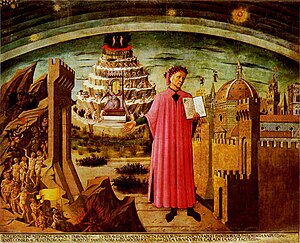
Wednesday, 22 January 2014

The Divine Comedy Part 3


The Divine Comedy: Part 3
Origin and structure of the poem and something of the sources that Dante drew on: Virgil, Saint Paul, Aristotle, Saint Thomas Aquinas, and with a passing reference to Plato and Saint Augustine

Recently we had a discussion here about the impact of the Kindle: as to whether or not its arrival heralds the death of books; and I am happy to tell you that the result was two to one against. But if you care to argue that the death of books has arrived, The Divine Comedy would be a good place to start.

In my copy, of the 741 numbered pages, there are 234 pages of notes; so, as they would say on celebrity TV, "I can now reveal, that, - - - the poem is, - - - - - -  452 pages long." From these numbers you will know, that The Divine Comedy is not for the faint-hearted; but that doesn't make it inevitable that we should feel excluded, or, that we have to have some exceptional literary skills to gain some appreciation of it.

As is the case with any great work of literature, we can, if we wish, begin by taking Dante's Comedy in small doses, focusing on those areas that interest us. In my own case and in the context of these blogs, my primary interest is in the human and spiritual aspects of the story, while at the same time wanting to acknowledge, as is conveyed in Harold Bloom's essay The Strangeness of Dante Ulysses and Beatrice, that there is a vigorous debate as to what the poem is actually about. As to whether or not, (in the context of literary criticism), the poem holds up as being what most people suppose it to be, an account of the journey of the soul to God, or, because of the extent to which Dante defies the conventions associated with such literature, it is about something else: a case of Dante promoting Dante. As represented by Harold Bloom, it is a serious and intriguing debate, but one that has to be passed over, as a luxury, at my time of life.

The Structure of the Poem
To begin with, the story of Dante's journey through Hell, Purgatory, and Paradise, is told in the first person, with Dante at times, breaking off from his narrative to address the reader directly; an informality that is as deliberate as the rest of the poem is structured; a case in point being, Dante's cosmology, or preoccupation with the heavens.

In Medieval thought, astronomy and philosophy were closely allied, with the heavens evoking a sense of wonder and perceived to be a manifestation of the Divine. So in terms of understanding the significance of Dante's cosmology, it is worth noting how it is structured within the poem. Each of the three Cantata (sections), begin and end with reference to the heavens; (or as commentaries seem especially keen to note), how the last line in each of the Cantata's ends with a reference to "stars". But Dante also uses the heavens to indicate time and place within the poem. As when, having passed through Hell and emerged, (on Easter Sunday) on the shore of the mountain of Purgatory, Dante, facing a daunting climb to Purgatory's narrow entrance, persuades Virgil to rest on an East facing ledge. Gazing at the sun, he is perplexed and turns to Virgil for advice, for he has noticed that the sun is moving, not to the right, but left to the north, an observation that on reflection, tells him that his arduous journey through Hell, had taken him through the centre of the earth and out into the oceans of the southern hemisphere, to Purgatory, that sits as an island at the opposite point to Jerusalem that is at the centre of the northern hemisphere.

Now if Dante's cosmology, (which I will return to in the context of Paradise), is important, so too is the evidence of an equally purposeful numerical framework to the poem; though it is worth saying, that from a critical point of view, (and possibly a lack of understanding on my part ?), I am not as confident about some of the assertions made, as I am about others. Be that as it may, a few observations on the significance of numbers.

Set in the period of Easter 1300, the poem begins with these words:

Half way along the road we have to go,
I found myself obscured in a great forest,
Bewildered, and I knew I had lost the way.

Based on the biblical idea of longevity, (Psalm 90), this was Dante's way of disclosing his age, that he is 35; though the Psalm does allow for the possibility that as an exception, the strong might live until they are eighty.

Written in the vernacular, Italian, The Divine Comedy is comprised of three cantata, or books, one for each of the themes of Hell, Purgatory and Paradise. In total there are a hundred cantos and with some commentaries discounting the first of these, (treating it as a preamble to the poem) they attach significance to the fact that 33 cantos are allocated to each section of the poem; 33 being the age at which Christ died. And though the cantos are uniform, in that they are made up of tercets, (three lines of interconnecting rhyming verse), the length of each canto, (passage or chapter), can vary, as in Canto VI (6) in Hell, where there are 115 lines of poetry, as compared to 155 in Canto XXXIII (33). Of themselves, these numbers don't matter; but what binds or holds the whole process together, is the rhyme scheme.

Attributed to Dante, it is known as terza rima, or, a "third rhyme" scheme and here too, in the context of numbers, the suggestion is that Dante's terza rima is symbolic of the Trinity. Expressed as aba, bcb, cdc, etc,.this code identifies the rhyming scheme, which is, that the rhyme for each succeeding tercet is picked up from the middle line of the tercet that preceded it. So if "aba" represents the first three lines of the poem, the middle line "b" sets the rhyme pattern for lines 4 and 6 and with the middle or 5th line  "c" setting the rhyme pattern for the first and third lines, (7 and 9) of the next tercet, and so on until the end. But it is also a feature of terza rima that every canto ends on a single line of poetry.

Now just to make it a little bit more interesting, have a think about this passage and feel free to feel confused.:Why? Because in the translation from Italian into English, the rhyme scheme has been abandoned. I have though added in the rhyming permutation for effect.

    When people come away from a game of dice,                         a
      The loser stays on the spot, full of regrets,                               b
      Going over the throws, and is sadder and wiser:                      a

4    Everybody else goes off with the winner;                                 b
      One walks in front, another holds him back                             c
      Another at his side says "Don't forget me":                              b

7    He does not stop, and listens to this one and that;                       c
      When he holds out his hands to someone, no more pressure;   d
      And in this way he escapes from the crowd.                                c

10  This is what I was like in the dense mob,                                 d
      Facing first in one direction and then in another;                     e
      And by promises managed to get away.                                  d


Clearly "dice" and "wiser" don't rhyme, any more than do "regrets, "winner" and "me".

Now here is the same portion of the poem Purgatory, (Canto VI (6) 1-12) in Italian, (minus the accents); and even if like me, you have have no knowledge of the language, you cannot but see the rhyming scheme:

1   Quando si parte il gioco de la zara                    a
     colui che perde si riman dolente.                       b
     repetendo le volte, e tristo impara;                    a

4   con I ' altro  se ne va tutta la gente;                  b
     qual va dinanzi, e qual di dietro il prende,         c
     e qual dallato li si reca a mente;                       b

7   el non s ' arresta, e questo e quello intende;      c
     a cui porge la man,  piu non fa pressa;              d
     e cosi da la calca si difende.                              c

10 Tal era io in quella turba spessa,                       d
     volgendo a loro, e qua e la faccia,                     e
     e promettendo mi sciogliea da essa                   d

"zara" rhymes with "impara" as does "dolente" with "gente" and "mente".

And something else, in respect of Dante's terza rima, that is not reflected in my Oxford Classics Translation, is the number of syllables in each line. In Dante's original there were eleven, but in this translation, not only has the rhyme scheme gone, but the number of syllables in each line vary, the original idea having been sacrificed in favour of accuracy in representing Dante's Comedy in verse translation.


Now someone who took a different approach to my Oxford Classics, was Dorothy L Sayers, who regrettably died before she had finished her translation. But she did complete the cantos on Hell, and Purgatory, and in doing so, she stuck faithfully to the original terza rima, rhyming scheme. So to that extent, she was faithful to Dante. But this approach has led to her translation being described as "idiosyncratic" (Wikipedia) So here, by way of comparison, are the opening stanzas of the poem, first as translated by Dorothy L Sayers, and then by C. H. Sisson as it appears in the Oxford Classics:


    Midway this way of life we're bound upon,
        I woke to find myself in a dark wood
        Where the right road was wholly lost and gone.


4   Ay me! how hard to speak of it - that rude
        And rough and stubborn forest! the mere breath
        Of memory stirs the old fear in the blood;

7   It is so bitter, it goes nigh to death;
        Yet there I gained such good, that, to convey
        The tale, I'll write what else I found therewith.
__________

    Half way along the road we have to go,
     I found myself obscured in a great forest,
     Bewildered, and I knew I had lost the way.

4   It is hard to say just what the forest was like,
     How wild and rough it was, how overpowering;
     Even to remember it makes me afraid.

7   So bitter it is, death itself is hardly more so;
     Yet there was good there, and to make it clear
     I will speak of other things that I perceived.


Now though Dorothy Sayers' translation, self-evidently replicates Dante's terza rima, rhyming scheme, there is a subtle, (not so obvious difference). Whereas Dante used what is known as a hendecasyllabic line, (a line of 11 syllables) Sayers reflecting an earlier English adaptation of terza rima, (appears to me) to use pentameter, that adds up to 10 syllables in each line. I say "seems to me" noting that on Wikipedia and referencing Umberto Eco he is quoted as saying that of all the English translations Sayers "does the best in at least partially preserving the hendecasyllables and the rhyme."

And a last thought on the question of translation and representation.

As the Internet is awash with information about The Divine Comedy, don't be surprised if you come across what passes as authoritative versions of the poem translated as prose. One explanation given for this, is, that the translator is solely concerned with focusing on Dante's ideas. Be that as it may, Dante wrote The Divine Comedy in terza rima.

Sources and Influences in The Divine Comedy:

Now as nothing that happens in The Divine Comedy has come about by accident and allowing for the impossibility of discussing the poem in all its aspects, at this point it is worth stopping to consider some of the principal sources and influences that Dante draws on and why.

First among them has to be Virgil, who, as Dante's guide accompanies him through Hell and Purgatory, and there is no mistaking the high regard in which Virgil is held:

79   "Are you indeed that Virgil, are you the spring
       Which spreads abroad that wide water of speech?"
       When I had spoken, I bowed my head for shame.

82   "You are the honour and light of other poets;
       My long study and great love give me strength
       Now, as they made me pore over your book.

84   You are my master and indeed my author;
       It is from you alone that I have taken
       The exact style for which I have been honoured."

                                                       Hell. (Canto, 1, 79-86)

As fellow Italians and poets, Virgil and Dante are kindred spirits. But as we will come to appreciate later, it is highly significant that Virgil, (70-19 BC), takes us back to the era of the Roman Empire; and the work that Dante found compelling and drew on when constructing his Comedy, was Virgil's epic poem, Aeneid. 

Modelled on Homer's poems Iliad, and Odyssey, the Aeneid tells the story of Aeneas, a Trojan refugee, as he struggles to fulfil his destiny, which is to arrive on the shore of Italy where he will found a new civilization, that in mythological terms, represents the founding of Rome itself. In particular, Aeneas visits Hades to meet the shade (or soul) of his father, so as to learn of future events on his journey, and to have revealed to him, future events in the history of Rome. In this encounter there is a direct parallel with Dante, who, as mentioned in Part 2, met his great-great-grandfather Cacciaguida, in Mars, (that region of Paradise where holy warriors dwell) and who, in terms of his own destiny, was told of his future banishment from Florence. But in the context of the poetic craft, something else is going on that helps Dante to sustain the link between the present and the past.

In The Divine Comedy, Dante is seeking to surpass Virgil, who in his Aeneid, was seeking to surpass Homer, from whom he transposed the character of Aeneas. Dante on the other hand, goes further, for besides Aeneas, he lifts a number of other mythological creatures, and some landmarks, (rivers) from the Aeneid, and re-presents them in his own work: among them Charon, whose unrelenting task is to ferry the souls of the damned gathered on the banks of the Acheron, across the river to Hell; and the grotesque Minos, who, at the entrance to the second circle of Hell, (Hell proper), judges the damned before consigning them according to their sins, to the appropriate circle and form of punishment.

We are first introduced to Aeneas at that point in the poem where Dante is wavering in his resolve to accompany Virgil on the journey; and not withstanding that he is a mythological figure, Dante links Aeneas with St. Paul; but not before he accuses himself of behaving like one who, "shilly-shallies", and whom Virgil in turn, likens to a coward, a condition that as Virgil puts it:

46   Lies like a load on men, and makes them flag
       So that they turn back from the fittest task,
       Like an animal which mistakes what it looks at.

                                                       Hell (Canto II (2) 46-48)


This linking of St. Paul with Aeneas, is more than a case of establishing a link between the present and the past. At the outset it is Dante's way of pointing to the future, to Paradise and to the nature of the claims that he would make in respect of his own spiritual experiences, happenings that he would elevate to those of St. Paul, who, in a vision and transposed to Paradise, saw and heard things, that man was forbidden to speak of:

"I know a person in Christ who fourteen years ago was caught up to the third heaven - whether in the body or out of the body I do not know; God knows, was caught up into Paradise and saw things that are not to be told, that no mortal is permitted to repeat."   (2 Corinthians, 12, 2-4).

But in the broader context of Dante's politics, St. Paul is also a potent symbol of Dante's belief in Virgil's ancient Rome, from which Dante, (without evidence) claimed ancestry: a Rome which he believed was destined to pave the way for Christianity. And in particular, in his time of crisis, his belief in the Holy Roman Empire, and the political autonomy of the city state, as opposed to the over arching claim of the papacy to both temporal and spiritual power.

Now before they can reach Hell, Virgil and Dante have to pass through Limbo, where the souls of the unbaptised and virtuous pagans reside. At its centre is the great castle of the famed, from which Dante will have a panoramic view of the souls gathered there. But before passing into the castle, and without inhibition, (and perhaps, even with a degree of humour), Dante, leaves us in no doubt as to the extent of his poetic ambition. after which, and once inside the castle, we are presented with a litany of what we might loosely call "the great and the good". Among them is Aristotle, who is the source most quoted by Dante after the Bible, and who, in terms of Dante's overriding objective, is inextricably linked to St. Thomas Aquinas. But before getting to that point, let's have a look at how the unabashed Dante represents himself:

79   Meanwhile, I heard a voice: ""Do honour," it said,
       To the magnificent poet, for his shade,                             [Virgil]
       Which had departed, is with us once again."

82   And when the voice had stopped and all was quiet,
       I saw four immense shadows come towards us:
       They had no appearance either of grief or happiness.

85   The good master opened his mouth to speak:              [Virgil]
       "Observe the one who, sword in hand, comes first,
       In front of the three others, as their chief.

88   That is Homer, there is no poet above him;
       The next who comes is Horace, the satirist;
       Ovid is the third, then last of all comes Lucan.

91   Because they are all poets as I am;
      It was our common name the voice called out;
      They welcome me, and in that they do well."

94   And so I saw together that excellent school
      Of those who are masters of exalted song
      Which, like an eagle, flies above the others.

97   When they had talked together a little while,
      They turned towards me with signs of recognition;
      And my master smiled to see them do so.

100 And then they did me still greater honour;
      They took me as a member of their company,
      So that I was a sixth [including Virgil] among those great intellects.

                                                        Hell. (Canto IV (4) 79-102)
__________

Now moving on to the worlds of philosophy and theology and in terms of the interconnectedness of the relationship between the philosopher Aristotle, (384-322 BC), and St. Thomas Aquinas, (1224-1274), this is a point in the poem where we can usefully go beyond the page, and in doing so it helps us to come to a fuller appreciation of The Divine Comedy in its contemporary setting: a time of change and revolutionary thought and with Dante in the thick of it.

In making the connection between Aristotle and Thomas Aquinas, Dante was putting himself at odds with those who drew their inspiration from the metaphysical reasoning's of Plato, (d. 348/347 BC) and Saint Augustine, (354-430 AD)  as compared to that of Aristotle and Aquinas, grounded as their reasoning was in the concrete. It is an important distinction, because as we will see, it lead to a difference of view between Augustine and Aquinas as to how they developed their proofs for the existence of God, or put another way, as to their understanding of what is intrinsic in the nature of man. .

For St. Augustine, God's presence in man was innate, or instinctive, hence from his Confessions, we have the words: "You have made us for yourself, Lord, and our hearts are restless until they rest in you." For Thomas Aquinas, God was not present in man in that sense..For him, what was innate was man's need to aspire to his highest good, without knowing what that highest good was. But as Aquinas dealt in the concrete he was at one with Aristotle, who, through his observations of the heavens had come to know of the existence of God: of a first cause or mover that of necessity had to be eternal. What Aquinas did, was take Aristotle's reasoned proof for the existence of God, (though ill defined), and link it to the Jewish and Christian scriptures as evidence of God having made himself known to man.

Described by Dante as, "The master of those who know," we first encounter Aristotle in Hell, in the First Circle, Limbo, where he appears at first among a group of shades known for their outstanding intellectual achievement:

130  And, when I raised my eyes a little higher,
        I saw the master of knowledge, Aristotle
        Sitting there, with a company of philosophers.

133  All looked to him, and they all did him honour:
        I saw there, Socrates, as well as Plato,
        The two who stood out and were nearest to him;

136  Democritus, who thought the world came by chance,
        Diogenes, Anaxagoras and Thales;
        Empedocles, Heraclitus, and Zeno;

                                                     Hell (Canto 4, 130-138)

And having previously mentioned that Aristotle is the source most quoted by Dante after the Bible, and bearing in mind the tensions that existed between the differing schools of thought, the Platonic-Augustan v Aristotle-Aquinas, it should not come as a surprise to discover that Aristotle maintains a subtle presence within the poem, as here in Paradise, where we are introduced to Charles Martel. Charles was a just ruler, whom Dante had met in Florence in 1294, but who died prematurely at the age of 24. Overjoyed at their reunion, Charles reflects on what might have been, in particular, with regret at the parsimonious rule of his brother Robert; and that in turn prompts Dante to wonder: "How sweet seed can produce something so bitter." (How in this case, such diverging natures can exist within the same family). What follows is Charles' response, which you might want to read a few times, if the phrasing seems difficult:

94   So I to him; and then he to me:
       "If I can show you a truth, what you are asking
        Will be before you, as now it is at your back.

97    The good which moves and pleases the whole kingdom
        Through which you are climbing, makes its providence         [the heavens]
        A virtue in these immense bodies.

100  And not only are the natures provided for
        In that mind which itself is perfection                                     [God]
        But provision is made also, for their well-being:
     
103  So that whatever arrow leaves the bow
        It falls ready for a foreseen object,
        Like something that is directed to its mark.

106  If it were not so, this heaven where you re travelling
        Would bring its effects about in such a manner
        That they would be not constructions but ruins;

109  And that could not be, unless the intellects                        [angels]
        Which move the stars were not themselves defective,
        The primal intellect too, which had not perfected them.      [God]

112   Do you want further light on this truth?"                            [Charles Martel]
         And I, "No, I see it is impossible                                       [Dante]
         That nature should tire, where there is need for her."

115  And he again: "Now say, would it not be worse
        For a man on earth, if he were not a citizen?"
        "Yes," I replied, "no need to explain that."
      
                                                    Paradise (Canto 8,  94-117)

Now what is interesting here in the context of Dante's personal circumstances: his unjust exile from Florence and the political world with which he has to contend, is that through the virtuous Martel, Dante is promoting the teachings of Aristotle. His conclusion, that manifest in the physical universe is an intelligence that created it, and that of necessity has to be greater than the thing itself so as to sustain it, otherwise it would collapse in on itself and so cease to exist, as well as his belief that man, (as represented in the image of the archer), is integral to it, and has a purpose, towards which he is pointed. And very significant is Martel representing man as a social being. If he is to achieve his "highest good," then again, and echoing Aristotle, he needs to be able to live and function as a "citizen," something of which Dante, by his exile, has been deprived, and which is the driving force behind his poetic endeavour.

Well having made the acquaintance of Charles Martel in Venus: that place in Paradise where Ardent Lovers dwell, we have to move on to the Sun before making the acquaintance of Thomas Aquinas: a Dominican priest and one of the foremost thinkers of the Middle Ages, and still very much to the forefront today as a philosopher and theologian. And that being the case, one can't help but wonder what additional impact he might have had on Dante, had their paths crossed. But Dante was nine years old when Aquinas died in 1274, and Dante's own death came just two years before Aquinas was canonized in 1323. And it is Aquinas' link with the philosophy of Aristotle, that has lead to him being variously described  as a proponent of "natural theology", "natural reason" and "speculative theology." And as is the case with Aristotle, Aquinas too maintains an unspoken presence in the poem, in respect of everyday concerns: on suicide, on prayer, on pride, and free will, on the nature of religious vows, and in Paradise, on the vexed question of predestination, on angels, and on geometry. And of the various areas that we might look at, where Aquinas has a presence, the most pertinent is that of free will, a subject that Dante deliberately places at the mid point of the poem; and having dealt with the subject at a personal or individual level, he turns his attention to politics; in particular, to the corrupting conflict of interests within the church.

We are in Purgatory, (Canto XVI (16), with Dante and Virgil making their way with difficulty through thick smoke, for they are among those who are atoning for their sins of wrath, when they meet Marco Lombardo. In life, Marco appears to have been of no particular consequence, but none the less, and perhaps on that account, Dante sees fit to use him for this important debate. After some exchanges between them,  Dante seeks his advice as to what is wrong with the world, so that on his return to earth, he can warn others; and what follows below, is a portion of what is a lengthy response:

61     "But I beg you to indicate the reason,
        So that I see it and point it out to others;
        Some say it is in the stars, some, here below."      [to natural causes]

64    He first gave a deep sigh, which my grief compressed
        Into a sort of "Whew!", then he began:
        "Brother, the world is blind, and you are of it.

67    You who are living attribute all causes
        To the stars above, as if everything there is
        Had of necessity to move with them.

70    If it were so, that would mean the destruction
        Of your free will, and it would not be just,
        For good to be rewarded, and sinners punished.

73    The stars may initiate your movements;
        I do not say all of them, but suppose I should say so,
        There is a light to tell good from evil

76    And free will, which, if it makes an effort
        Throughout the first battles with the stars,
        Will be victorious, if it is well nourished.

79    Free as you are, you are subject to a greater law
       And a better nature, and that creates in you
       The mind the stars do not have in their charge.

82   So, if the present world is going off course,
      The reason is in you, and should be sought there;
      And I will tell you truly how the land lies . . . "

                                                  Purgatory (Canto XVI (16)  61-84)
__________

Apart from the rejection of astrological determinism in the context of free will, at (lines 67-71) , 73 reflects Aquinas' acceptance, in his great work Summa Theologica, of the fact that man, in terms of his sensitive appetites, might, in the first instance, respond to the heavenly bodies, but that his "intellectual function of will and reason remain essentially unaffected." (Higgins). And what is important about the reinforcement of the point at 76-9, is, that it reflects Dante's support for Aquinas in his own earlier work, De Monarchia, in which he deals with issues pertaining to secular and religious power. And the discussion is ongoing, for we have this from Virgil to Dante, just a few cantos along, at XVIII. (18):

 67   "Those who went to the root of things with their reasoning,
        Became aware of this innate freedom;
        And so left a theory of morals to the world.

70    So, even supposing every love that is kindled
        In you, arises out of necessity;
        The power to entertain it is in you.

73    This noble virtue is what Beatrice
        Understands by freewill; bear it in mind
        In case she chooses to speak to you about it."

                                             Purgatory (Canto XVIII (18) 67-75)

Now I could have said much more about Thomas Aquinas, that would have been interesting though not necessarily relevant, but we will be meeting him again in subsequent blogs. But for now, what matters, is Dante's clearly stated belief that the world, is as it is, either because of the choices we have made, or failed to make, at any given time. For him, man's relation to God is individual and therefore personal, and one of accountability, hence; Hell, Purgatory, and Paradise.

_______________
© Cormac McCloskey

Note: The next in this series of blogs will appear on Wednesday nest the 29th
The Divine Comedy Part 4 :
Pride, treachery and the inescapable logic of Hell. Purgatory, repentance and the structure and nature of punishment. Hypocrisy and the Wastrel Friars; and some good news. And raw politics: De Monarchia and Unam Sanctam. And the spiritual: Faith and free will.

The sources listed below were referenced, and in most instances, used, in the composition of these blogs:

The Divine Comedy
Translated by C.H. Sisson
Introduction and Notes: David H. Higgins
(Oxford World's Classics)
Oxford University Press (2008)
ISBN: 978-0-19953564-4

Dante: The Divine Comedy
I: Hell
Translated by Dorothy L. Sayers
Penguin Classics (1953) edition

The Complete Danteworlds
A Reader's Guide to the Divine Comedy
Guy P. Raffa
University of Chicago Press (2009)
ISBN:10: 0-226-70270-7

The De Monarchia Of
Dante Alighieri
Edited With Translation And Notes
by Aurelia Henry (1904)
Printed in Great Britain
by Amazon.co.uk Ltd

Encyclopedia Britannica, Vol's 1,3,7,11,14 and 28
in respect of a variety of related topics  (1991 edition)
Vol 14: Aristotle. 28: Thomas Aquinas

Aristotle
A very Short Introduction
by Jonathan Barnes
Oxford University Press (2000)
ISBN: 978-19-285408-7

BBC Radio 4 archive
In Our Time, 17th September 2009
"Melvyn Bragg discusses the life, works and enduring influence of the medieval philosopher and theologian St. Thomas Aquinas, with Martin Palmer, John Haldane and Anabel Brett."  here

Dante Alighieri
Bloom's Modern Critical Views
Editor, Harold Bloom
Chelsea House Publishers,
Philadelphia U.S.A. (2004)
ISBN: 0-7910--7658-X

The Poetics of Conversion
by John Freccero
Harvard University Press
Cambridge, Massachusetts
and London England (1986)
ISBN: 0-674-19225-7 (alk, paper (cloth)
ISBN: 0-674-19226-5 (paper)

Saint Augustine
City of God
Penguin Books 2003
ISBN-13: 978-8-14-044894-8

Evangelii Gaudium
The Joy of the Gospel
Pope Francis
The Word Among Us press 2013
ISBN : 978-1-59325-262-5

(1)    Wikipedia  unam sanctam
         Virgil (40-19BC) Regarded as one of Rome's greatest poets
(2)     Wikipedia, for an excellent broad sweep of The Divine Comedy, go here

(3)     De Monarchia:

Boo II: XIII In the chapter headed "Christ in dying confirmed the jurisdiction of
the  Roman Empire over all humanity" Dante argues the case for the Roman Empire being the  lawful authority by which Christ was put to death (lawful, in the sense of being ordained by God) and at XIII.4 he writes "Wherefore let those who pretend they are sons of the Church cease to defame the Roman Empire, to which Christ the Bridegroom gave his sanction both at the beginning and at the close of his warfare. And now I believe, it is sufficiently obvious that the Roman people appropriated the Empire of the world by Right."

Wednesday, 15 January 2014

The Divine Comedy Part 2


The Divine Comedy Part - 2
Who was Dante and what was doing on in his world?

For weeks now I have been on the road, travelling with my companions, Dante and Virgil, on a journey that took us first into the very depth of Hell, after which we climbed the mountain of Purgatory. At its summit and unable to travel further, (because he predates the Christian era), Virgil was replaced by Beatrice, a girl whom Dante had loved, but not married, since first setting eyes on her when he was twelve and she was nine. From here we travelled through the heavens, stopping off at the Moon, Mercury, Venus and the Sun, before heading on to Mars, Jupiter and Saturn and passing on through the Fixed Stars and Primum Mobile before arriving at Empyrean, the place where God dwells. And no less remarkable was the fact, that at every stage in this journey, we were travelling through parallel worlds: the spiritual landscape of the soul and of life here on earth: as it is to be found in the Bible, in ancient classical literature, the Church and politics, as well as in the broader complexities, both noble and ignoble, of everyday life.

Of course, and as the title makes clear, I have been reading The Divine Comedy, a vast work of Italian literature, that was composed by Dante Alighieri, (otherwise known as Dante). Begun around 1308 and completed shortly before his death in 1321; and not withstanding the reputations of Chaucer, Shakespeare and other great men of letters, The Divine Comedy is generally regarded, as one of, if not the greatest, work of literature, ever. But, a note of caution.

The Divine Comedy is not something that we can just read. If we are to come anywhere close to developing a sense of the poem's potential, it has to be studied: to be seen in context, (the age in which it was written), and that means trying to acquire some knowledge of the people and places that we encounter along the way, to say nothing of the very considerable resources, (both lay and religious), that Dante drew on, in developing his allegory. But don't let that discourage you, and here's why.  

"Although Dante's answers may not be our answers, issues raised in the Purgatorio (Purgatory) [the middle section of the poem], remain significant in the world today; justice, (punishment and rehabilitation), political oppression and war, love and sexuality, church-state relations, pride and fame, art and censorship, free will, individual responsibility, and leadership, to name a few......" 

This quotation is taken from Danteworlds, a commentary on the poem by Guy P Raffa, that I used, along with others. As such, it goes well beyond the literal, and so, besides providing quick points of reference, it offers the reader the opportunity to dig deeper, should they feel the need.

Now apart from the reasons given by Raffa, as to why we might want to study The Divine Comedy, to say nothing of its literary merit, I had another reason for being interested. For me, (and without intending any morbidity whatever), every day is a preparation for death, and in that context, I was, in some respects, confronting my past. But in telling you this, I must tell you also, that I accept, without qualification, that The Divine Comedy does not represent, "revealed truth." Instead, it is a work of fiction, that for Dante, was rooted in things personal, and that, in the final analysis, for him represented the return of the soul to God.

And how could it have been other than a work of fiction, when Dante, who has been busy assigning souls to Hell, to Purgatory and to Paradise, (including some of his contemporaries), cautions us against presuming to know who is saved and who is damned.

In Paradise, (in Jupiter), we are made aware of the presence of souls from the pre-Christian era, men such as the Roman Emperor Trajan, and Ripheus, who lived a thousand years before Christ. Through their practice of virtue, Dante has placed them among the "Just Rulers", and asserted that Ripheus was Baptized in Christ. It is a complex passage, that deals with the vexed question of predestination; in which Dante, in support of his point of view, draws on no less an authority than that of Thomas Aquinas. And having made his case on behalf of those, born before the time of Christ, who were redeemed, Dante, in this tercet, is reminding us of a truth that applies as much to himself, as to the rest of us:

"And you, mortals, hold yourselves back
From giving judgement's; for we, who see God,
Do not yet know who all the elect are;"

                                                   (Paradise.XX: (20) 133-35)

And almost by way of an aside, (and again taken from Raffa), is this, a small detail in support of The Divine Comedy, that is as profound as it is ironic It is to the effect that the celebrated nineteenth century Italian poet, Giouse Carducci, expressed surprise, that no-one among his fellow countrymen, had got around to erecting a marble statue to Cante de Gabrielli, in one of their piazzas. Why? Because it was Cante, who, on a contrived charge of corruption, had Dante, (in his absence), exiled from Florence, with the proviso that were he ever caught within the city, he would be burned at the stake. An unjust act, the consequences of which, not even Dante could have foreseen: The Divine Comedy; his masterpiece, and hard won triumph over adversity.

dek
And all this came about at a time when Italy was an amalgam of provinces and city-states, with the events that led to Dante's banishment, just another chapter, in the long struggle for political power and supremacy, that involved, not just the obvious civil powers, but the papacy; and in particular that of Pope Boniface VIII, whom Dante held personally responsible for his own misfortune and that of Florence. Hence, and by a literary slight of hand worthy of Boniface himself, Dante, having set the Comedy in the period of Easter 1300, (when Boniface was still alive), foretells his arrival in Hell and, of a like fate for his successor, Pope Clement V.


When Dante stops in Hell to converse with Pope Nicholas III, a simonist, (who is upside down in a hole with his feet on fire), Nicholas mistakenly thinks that Dante is Boniface. As for Pope Clement V, originally from Bordeaux, it was he who moved the papacy from Rome to Avignon. And each new arrival, we are told, will push those already there and upside-down, deeper into the hole:-

Then we came to the fourth embankment;
Turned and went down along the left side
To the narrow, perforated strip at the bottom

The benign master [Virgil] did not set me down
From his side, until we had reached the opening
Of the one who waved his legs so much in torment.

"Whoever you may be, unhappy spirit,
Who, upside-down are stuck in like a stake"
I began, "say something if you can."

I stood there like the friar who confesses
The treacherous killer who, fixed in position,
Calls him back so that death may be delayed.

And he cried: "Are you standing there already?
Boniface, are you already standing there?
My information was out by several years.

Are you so sated with your wealth
For the sake of which you shamefully and deceitfully
Took the beautiful lady [the Church] and made havoc of her?"
                                       
                                               (Hell. Canto XIX: (19) 40-57)
__________

And in respect of Pope Clement V, this, from the upside-down Nicholas:

Because after him will come from towards the west [France]
From uglier malefactions, a lawless shepherd
Who will be fit to cover both of us.

                                            (Hell. Canto XIX: (19) 82-84)

__________


thumbnail of Cacciaguida by Gustave DoreSo, who then was Dante, and what was going on in his life?

Cacciaguida
In Paradiso, (Paradise) Cantos XV-XVIII (15-18), we are introduced to Dante's great-great-grandfather Cacciaguida, he is in Mars, that region of Paradise reserved for Holy Warriors. From him we learn, among other things, that the family name Alighieri came from his wife, that he was baptized at the baptistery in Florence, and that he fought and was killed in the ill fated, Second Crusade, under Emperor Conrad III; and given the other details that Cacciaguida provides, this takes Dante's known ancestry back to somewhere between 1091 and 1100. But Dante has another use for him also, for Cacciaguida foretells Dante's fate:

"Contingency which does not stretch beyond
The limits of your material world,
Is all set out before the sight of God:

But does not on that account become necessity
Any more than a ship which is drifting downstream
Drifts as it does because a man sees it.

From God there comes into sight for me,
As sweet organ music comes to the ear,
The time which is in preparation for you.

As Hippolytus was driven out of Athens
By his implacable and perfidious stepmother,
So it will be with you, who must leave Florence.

This is willed and is already plotted,
And soon will be brought about by him who devises it
In the place where Christ is bought and sold every day.          [Rome]

It will as usual be the injured party
Which gets the blame; but when vengeance comes
It will bear witness to the truth which orders it.

You will leave everything you love most dearly;
This is the arrow which is loosed first
From the bow of exile.

You will learn how salt is the taste
Of other people's bread, how hard the way
Going up and down other peoples stairs."

                              (Paradise. Canto XVII: (17) 37-60)
________

This final tercet is especially poignant, foretelling as it does, how Dante, an exile and having no home of his own, will be dependent on the good will and patronage of others, an experience that will be tinged with bitterness, "salt", and lonely, in the context of other people's "stairs". By contrast, the opening tercet reminds us that while God sees all, there is nothing inevitable about what happens to us; that in general, and in the context of free will, what happens is determined by the choices we make. And in the allusion to Pope Boniface VIII, "in the place where Christ is bought and sold every day," clearly, he will be held accountable for his actions. And though in the first instance, Dante might get the blame, in the end, (justice), will prevail.

Beatrice
But without doubt, the most significant thing in the unfolding of The Divine Comedy was, that Dante, at the age of twelve fell in love with Beatrice who was nine; a truth borne out when Beatrice takes the place of Virgil in Purgatory and accompanies Dante through the regions of Paradise, at one point chastising him, while at others, prompting and guiding him, and appearing ever more beautiful as they progress toward the Empyrean: to the presence of God.

About 1285 Dante married Gemma di Manetto Donati. As was the custom, he had been promised to her at the age of 12 and though they went on to have four children, it was Beatrice who became pivotal to his poetry. So distraught was he at Beatrice's death in 1290, that Dante threw himself into the study of Latin literature, as well as the writings of St. Bonaventure and Saint Thomas Aquinas, (Franciscan and Dominican monks respectively). In all of this, Beatrice was the driving force; and as his love for her was spiritual, it is suggested, that what he was doing in Italian poetry was developing the concept of courtly love; an idealized view of love, personified in Beatrice; an idea that already existed in France and Provance, and that would later find its way into Elizabethan English literature.

In The Divine Comedy, we are first made aware of Beatrice in "Dark Wood," (Hell. Canto II (2)) but not before we have made the acquaintance of Dante, who, "Half way along the road we have to go," [of life] is "Bewildered," "lost," and vulnerable, to the wild beasts that he is encountering along the way. Seeing Virgil, though he does not yet know who or what he is: (human or a shade), Dante cries out "Have pity on me..." And it is at this point and from Virgil that we learn of the journey that Dante will have to make to be saved:

The course I think would be the best for you,
Is to follow me, and I will act as your guide,
And show a way out of here, by a place in eternity,

Where you will hear the shrieks of men without hope
And will see the ancient spirits in such pain
That every one of them calls out for a second death;

And then you will see those who, though in the fire,             [Purgatory]
Are happy because they hope that they will come,
Whenever it may be to join the blessed;

Among whom you may climb [towards Heaven] but if you do,
It will be with a spirit more worthy than I am;              
With her I will leave you, when I depart:

                                                  [Hell, Canto 1:112-123}

But fearing that he might not be up to the task, (Inferno, Canto 2), Dante seeks reassurance from Virgil, who, recognizing that his spirit is "touched by cowardice," tells him, that he has been sent by Beatrice.

Fearing that Dante might be lost forever, Beatrice comes to Virgil in Limbo and not above the use of flattery, compliments him on his earthly renown as a poet, after which, and appealing to his patriotic spirit, she reminds him that besides being fellow poets they are both Italian. And continuing in the same vein, and perhaps with a degree of humour, Dante let's it be known that it is not just one woman in Heaven who is worried about him, but three: the Virgin Mary, (though she is alluded to rather than named), who summoning St. Lucy, had sent her to Beatrice, and who, when she confronted her, was in chastising mood:

She said: "Beatrice, you who are a glory of God,
Why do you not help him who loved you so greatly
That for your sake he left the common crowd?

Do you not hear his pitiful complaint?
Do you not see the death he is struggling with
By that river over which the sea is powerless?"

                                            (Hell, Canto II: [2] 103-108).

__________

Brunetto Latini
Now in developing an understanding of who Dante was, and what was going on in his world, we cannot overlook the influence of Brunetto Latini. He is in Hell, among the sodomites, but when Dante meets him, his response is not judgemental, but one of fellow feeling, compassion and a willingness to acknowledge the debt of gratitude that is owing to his former guardian, and mentor:

When we encountered a troop of spirits
Who came along the bank, and each one of them
Looked at us, just as one might do at nightfall,

Looking at someone under a new moon;
And narrowed their eyes, which were turned in our direction,
As an old tailor does, threading a needle.

Eyed in this way by this company,
I was recognized by one of them, who seized me
By the edge of my cloak, and cried: "How marvellous!"

And, when he stretched out his arms to me,
I fixed my eyes upon his scorched appearance
So that his burnt face should not prevent

The recognition of him by my intellect;
And, bending my face towards his,
I answered him; "Are you here, ser Brunetto?"

And he: "O my dear son, be not displeased,
If Brunetto Latini comes back with you
A little way, and lets the file [other shades] go on."

I said to him: "With all my heart, I beg you;
And if you want me to sit down with you,
I will, if he who goes with me [Virgil] is content."

"O my dear son," he said, "if one of this troop
Stops for a moment, he lies for a hundred years
Without protection from the fire that strikes him.

So go on: and I will follow below you;
Then I will go back to my band,
Who go weeping for their eternal losses."

                                                   (Hell, Canto XV: [15] 16-42)

And later:

"If I had my way entirely," so
I answered him, "you would not yet have been
Put under ban from natural humanity;

For my mind is transfixed, and my heart stabbed,
By the dear, kind, paternal image of you,
When you were on earth, and time and again

Instructed me how man may be eternal:
And what pleasure I had in that, as long as I live,
It is appropriate that my tongue should show."

                                       (Hell, Canto XV: [15] :79-87)

And just as it is implied in this last tercet, that Dante can gain immortality in his poetry, ["be eternal"] that sentiment is echoed by Brunetto Latini, who, as they part, reminds Dante of his great encyclopedic work, Li Livres dou Trésor, ("The Treasure"), in which he too lives, and from which Dante had gained, and can still gain so much.

At a different level in this canto, Dante is speaking not just for himself, but for a younger generation of Florentine's, who were indebted to Brunetto Latini, not just for the breadth of his knowledge, but for making it accessible. An exile in France and Spain, Latini returned to Florence in 1266, and though he was an accomplished citizen in other respects, as a leading intellectual, he sought to inspire a younger generation, of whom Dante was one, in a new approach to literature: one that would be thought provoking, and ultimately, as good literature should be, to the benefit of Florence. Or put another way, so as to make Florence great; an idea of usefulness encapsulated in the writings of the Roman philosopher Cicero (106-43 BC): who was of the view that eloquence, whether it be in speaking or writing, was only useful to society to the extent that it was accompanied with wisdom. And the fact that Brunetto Latini's Trésor, "Treasure", was a a repository of classical citation, and written in a vernacular language, (French, as opposed to Latin or Greek), gave Dante access to the works of other great literary figures such as the Greek philosopher Aristotle, and the Roman  polymath, Seneca. And interestingly, as Raffa explains to his students, Dante was indebted to Brunetto for "the allegorical poem in Italian, Il tesoretto ("The Little Treasure") " many of the features of which, found their way into The Divine Comedy.

Political factions: Guelphs and Ghibellines and Pope Boniface VIII
Now if we are to continue asking the question; Who was Dante and what was going on in his world? we have to turn to politics, and in particular to the principal protagonists, the Guelphs and Ghibellines. The Guelph were artisans and merchants from the cities, who supported the papacy in its claim to the rightful exercise of absolute power, that is, authority in matters temporal as well as spiritual; an idea fiercely resisted by the nobility: those powerful rural families who made up the Ghibellines.

As for Pope Boniface VIII, from his point of view, there was no doubt whatever as to where power lay, as he made clear in Unam Sanctam, a bull, (proclamation), published in 1302, in which he asserted that, "It was absolutely necessary for salvation that every human creature be subject to the Roman pontiff." So concerned was Dante about this claim, that several years after Boniface's death in 1303, he wrote De Monarchia, a treatise refuting Boniface's claim, and upholding the rights of monarchy. So, if we are to understand how it was that Dante, a Guelph, with the Guelph tradition of allegiance to the papacy, ended up, (so to speak), on the wrong side of the argument, we must take a step back.

When the Guelphs having defeated the Ghibellines, came to power in Florence in 1266, and continued in power there (with some qualification), until 1301, their victory was as the result of a military alliance between France and the papacy. So it would seem somewhat ironic, that their defeat, when it came in 1301, was as the result of yet another alliance between France and the Pope; in this instance involving the ambitious Charles of Valois, (brother of King Philip IV of France) and Pope Boniface VIII. As for the qualification, having defeated the Ghibellines for a second time in 1289, the Guelphs in the late 1290's split into factions, that became known as White and Black. At the heart of this divide (and though it was expressed in terms of rival Florentine families), was the political ambitions of the Pope. What the White Guelphs (Dante was now one of them), wanted, was a return to the old Roman idea of political power residing in the Emperor and in the city-state, a system that in turn, would recognize the spiritual authority of the pope. And in coming to this, the White Guelphs were taking a stand not just against the political ambitions of Boniface, but also against the ruthless nature of that ambition.

For a large part of his life, Boniface, who had lived in and around the papacy, functioned as something of an aid, diplomat, and enforcer in the service of several popes, during which time he had travelled and acquired personal wealth through the acquisition of benefices. Regarded as ambitious, he was also implicated in the abdication of Pope Celestine V, who, on succeeding him as Pope, Boniface had imprisoned in the Castle of Fumone, where he died a year later at the age of 81. And as someone who was in dispute with a number of rulers, and the Colonna family of Rome in particular, he was remembered for his ruthlessness: for his destruction in 1298 of the city of Palestrina, the home of the Colonna family. Having given an assurance that the city would be spared if it surrendered peacefully, which it did, he had it razed to the ground and covered in salt, just as the Romans had done to Carthage 1500 years previously. As for the White Guelphs: with all this known to them, and Florence placed under papal interdict, and a request that Charles of Valois be allowed to enter the city, supposedly to help to resolve the dispute between the warring factions, the White Guelphs were alarmed.

It was against this broad background that Dante, a prior, (one of twelve magistrates  who governed Florence), set off as part of an embassy to Rome, in the hope that through negotiation they might steer Florence clear of the Pope's wider political ambitions; but to no avail. Recognizing Dante's stature, Pope Boniface VIII detained him in Rome, while the rest of the delegation returned to Florence, by which time all was lost. Charles of Valois had entered Florence, and with the Black Guelphs, (the Pope's allies), taking control in the city; they took their revenge on the White Guelphs and Dante, tried in his absence, was exiled from Florence.

A complex allegory, central to The Divine Comedy, is Dante's religious faith, his loathing of corruption and injustice, and his love and concern for Italy, all of which are reflected in his outpouring against the demise of Italy, when he observes the joyful reunion, in Purgatory, between Virgil and Sordello, a fellow poet, who also came from Mantua, Virgil's birthplace..

But before we get to Dante's invective, at a point where he is discussing with Virgil the value of prayers of intercession, we are reminded of some of those who have died violent deaths. Among them, Ghino di Tacco, a notorious bandit of noble blood, who had assassinated a judge, probably Benincasa da Laterina, who had sentenced one of his relatives to death in 1297. And Count Orso degli Alberti, murdered by his cousin. And not forgetting Sordello himself, a troubadour poet, with a chequered career, who is thought to have died violently.

As for the images that Dante uses to describe his beloved Italy, they are stark: a ship without a master in a storm, a brothel, and a place that has squandered its inheritance, by failing to build a just and civil society on the foundations laid by the Roman Emperor Justinian, (d, 565 AD) who had taken on the monumental task of codifying Roman law. Instead, Italy carries on like a riderless horse, out of control and with no sense of purpose or direction. This, the image of the empty saddle, it is suggested, is an oblique reference to the absence from Italy of the Holy Roman Emperor Albert of Hapsburg, (a moral deficit for Italy if you like), who like his father Rudolph 1, ignored tradition and never came to Italy to be crowned. And if we read the tercets below carefully, it is clear that Dante makes the connection between the ineffectiveness of the law, the absence of the Emperor, and the ambition of the Church, as all contributing to the malaise. There are other pertinent reference in the passage, but none, perhaps, in the context of violent death, more stark, than where Dante appears to be alluding to the assassination of Albert's oldest son, Rupert, in 1307 and his own murder by his nephew in 1308 (Lines 100-02) which I have highlighted:

O enslaved Italy, a place of grief,
A ship without a master in a great storm,
Not mistress of provinces, but a brothel!

That noble mind was so ready,
Merely on hearing the sweet name of his city,
To give a welcome to his fellow citizens;

And now your living children are always at war;
People thrown together within the same wall and ditch
Cannot live without biting one another.

Wretched country, look around your shores,
On every coast, and then into your heart
And see if any part enjoys peace.

What is the good of the Justinian code
To rein you in with, if the saddle is empty?              [the Emperor's
There would be less shame if you were without it.   absence]

And you people, who are supposed to be devout   [rulers of the Church]
And to let Caesar sit well in his saddle,
If you understand properly what God prescribes,    [Matthew 22, 21]

Observe how this animal has grown vicious          
For not having been corrected with spurs              
Since you laid your hands upon the bridle.            

O Albert the German, you who have abandoned
Her who has become untamed and wild,                  [Italy]
When you should have been astride the saddle,

May a just judgement fall from the stars above    
Upon your blood, strange and for all to see,
Such that it may be feared by your successor:

Because you and your father, preoccupied
By your greed there in Germany, have permitted
The garden of the empire to be turned into a desert.

Come and see, you who are negligent,                     [Feuding families]
Montagues, and Capulets, Monaldi, and Filippeschi:
One lot already grieving, the other in fear.

Come, you are cruel, come and see the distress
Of your noble families, and cleanse their rottenness,
And you will see how dark Santafior is.

Come and see your Rome, which is in tears,
 Widowed and alone, and calls day and night:
"My Caesar, why do you not bear me company?"

Come and see how the people love one another!
And if you are unmoved by pity for us!
Come and see what shame you have incurred.

And if it is allowed me, supreme Jove,
You who were crucified for us on earth,
Are your just eyes turned in another direction?

Or is it preparation in the depth
Of your counsel, for some future good
Which is quite hidden from our understanding?

For all the cities of Italy are full
Of Tyrants, and any lout who chooses
To play with parties can become Marcellus.      [a demagogue]

My Florence, you may be well content            
That this digression has nothing to do with you,
Thanks to your people who exert themselves so.

Many have justice in their hearts and keep it there,
So that they don't let fly without reflection;
But your people have it on the tip of their tongues.

Many refuse to take public appointments;
But your people answer the call eagerly
Without being asked, and cry, "I am ready to serve!"

Now rejoice, for you certainly have good reason:
You who are rich, at peace and so judicious:
If I speak truth, the facts are plain enough.

Athens and Sparta who were law-givers
In ancient times,  and were so civilized,
Gave only a faint hint how to do things,

Compared with you, who make so many clever
Arrangements that, by the middle of November,
You have used up all you earned in October.

How many times in the years that you remember,
Have you changed laws and coinage, offices, customs,
And even brought in new inhabitants.

And if you see yourself in a clear light,
You will see that you resemble a sick woman
Who cannot stay quiet upon her bed.

But twists and turns all the time to ease her pain.

                                                       (Purgatory, Canto: VI: [6] 76-151)

_______________
© Cormac McCloskey

Notes: In The Divine Comedy Limbo is in the First Circle of: Hell, but it is a place set apart from Hell proper: that place to which the damned have been consigned in a condition of eternal damnation and suffering. Virgil comes from Limbo. With its, "tranquil pleasant atmosphere", it is "the eternal abode of spirits from the pre-Christian world who led honourable lives, as well as other worthy non-Christian adults and the souls of unbaptised children . . ." (Raffa).

Note: "Revealed truth" In saying that The Divine Comedy does not represent "revealed truth" I am         saying that while Dante makes various claims in respect of Divine involvement and about the nature of his actual spiritual experience, these claims, if they have any actual merit, are private revelation, and not on a par with the Bible and the teaching authority of the Church, to whom the fullness of truth has been given by God and whose task it is, to preserve it, in its fullness, and to pass it on, in its entirety, to future generations until the end of time.

The Divine Comedy Part 3 on Wednesday next 22nd :
Origin and structure of the poem and something of the sources that Dante drew on: Virgil, Saint Paul, Aristotle, Saint Thomas Aquinas, and with a passing reference to Plato and Saint Augustine
__________

The sources listed below were referenced, and in most instances, used, in the composition of these blogs:

The Divine Comedy
Translated by C.H. Sisson
Introduction and Notes: David H. Higgins
(Oxford World's Classics)
Oxford University Press (2008)
ISBN: 978-0-19953564-4

Dante: The Divine Comedy
I: Hell
Translated by Dorothy L. Sayers
Penguin Classics (1953) edition

The Complete Danteworlds
A Reader's Guide to the Divine Comedy
Guy P. Raffa
University of Chicago Press (2009)
ISBN:10: 0-226-70270-7

The De Monarchia Of
Dante Alighieri
Edited With Translation And Notes
by Aurelia Henry (1904)
Printed in Great Britain
by Amazon.co.uk Ltd

Encyclopedia Britannica, Vol's 1,3,7,11,14 and 28
in respect of a variety of related topics  (1991 edition)
Vol 14: Aristotle. 28: Thomas Aquinas

Aristotle
A very Short Introduction
by Jonathan Barnes
Oxford University Press (2000)
ISBN: 978-19-285408-7

BBC Radio 4 archive
In Our Time, 17th September 2009
"Melvyn Bragg discusses the life, works and enduring influence of the medieval philosopher and theologian St. Thomas Aquinas, with Martin Palmer, John Haldane and Anabel Brett."  here

Dante Alighieri
Bloom's Modern Critical Views
Editor, Harold Bloom
Chelsea House Publishers,
Philadelphia U.S.A. (2004)
ISBN: 0-7910--7658-X

The Poetics of Conversion
by John Freccero
Harvard University Press
Cambridge, Massachusetts
and London England (1986)
ISBN: 0-674-19225-7 (alk, paper (cloth)
ISBN: 0-674-19226-5 (paper)

Saint Augustine
City of God
Penguin Books 2003
ISBN-13: 978-8-14-044894-8

Evangelii Gaudium
The Joy of the Gospel
Pope Francis
The Word Among Us press 2013
ISBN : 978-1-59325-262-5

(1)    Wikipedia  unam sanctam
         Virgil (40-19BC) Regarded as one of Rome's greatest poets
(2)     Wikipedia, for an excellent broad sweep of The Divine Comedy, go here

(3)     De Monarchia:
Boo II: XIII In the chapter headed "Christ in dying confirmed the jurisdiction of
the  Roman Empire over all humanity" Dante argues the case for the Roman Empire being the  lawful authority by which Christ was put to death (lawful, in the sense of being ordained by God) and at XIII.4 he writes "Wherefore let those who pretend they are sons of the Church cease to defame the Roman Empire, to which Christ the Bridegroom gave his sanction both at the beginning and at the close of his warfare. And now I believe, it is sufficiently obvious that the Roman people appropriated the Empire of the world by Right."

         Wikipedia

         Image of Pope Boniface VIII from Time Lists

Wednesday, 8 January 2014

The Divine Comedy" Part 1


The Divine Comedy Part 1
A Health Warning

  If ever a proverb were made to fit an occasion, it is that coined by the poet Alexander Pope, in his Essay on Criticism, that, "fools rush in where angels fear to tread"; and it applies to me; for the more I persist in trying to gain some insight into Dante Alighieri's masterpiece, the more it becomes apparent that I am out of my depth.

It's not that I have been living in a fool's paradise, it's simply that the deeper I dig, the more I sense the limits of my understanding, and the certainty that, for all my endeavour, I will never tarnish the gloss, let alone, "scratch the surface", of this literary masterpiece; a belief reinforced by the fact that I have just finished reading Dante Alighieri: a compilation of writings by distinguished authors, published under the heading Bloom's Modern Critical Views: men and women who, besides being familiar with the Dante canon, are also versed in the literature that went before and has come after; to say nothing of what other like-minded scholars have had to say on the subject.

And just as challenging as I turned the pages, was the greater or lesser sympathy that these contributors had for the reader: where, quotes in the vernacular, Italian, were not guaranteed a translation. And in this context, there is nothing better calculated to put you in you place, than assumptions by the writer, about the reader, that you know were not intended to apply to you.  So where they wrote about Dante's Convivio and linked it to The Divine Comedy, not only was I reminded of the limits of my knowledge, but I know also that I had no intention of reading Convivio, or any other work of Dante, as I have several times, in whole and in part, The Divine Comedy. But there is one exception to this belligerence, for I have read in full, and at times been irritated by, Dante's De Monarchia, which is his rationale for supporting the role of the Holy Roman Emperor, as the lawful and divinely ordained authority in things temporal, (politics), thereby refuting the claim of Pope Boniface VIII, who, in his bull Unam Sanctum, stated, that, "It is absolutely necessary for salvation. that every human creature be subject to the Roman pontiff." (1)

And furthermore, in the light of some of the arguments posited in Bloom's collection, I found myself wondering as to whether or not, in attempting to interpret The Divine Comedy, my Catholicism, (with its inherent assumptions) might, in some respects, have been a hindrance.

And something else that occurred to me while reading the various contributors, is, that I may have made a mistake in refusing to read The Divine Comedy as prose.

In the third of these blogs I have something to say about the structure of the poem, and about the difficulties that are experienced when translating it into English. So some, who were not so much concerned with the poetics of The Divine Comedy, as they were with accurately conveying Dante's thoughts, have presented their translations as prose rather than poetry. And this is a salient point, because not only is The Divine Comedy not a lyrical piece in translations, (as popularly understood), but it is even less so, where stanzas in translation, are at times littered with Italian place and family names.

So why, you might wonder, have I bothered? and, What was the point in wading through Bloom's Modern Critical Views on Dante Alighieri?

Well rather than answer the first question directly, I will content myself with the hope that the answer will become apparent as you read the blogs. As for the second, it goes like this.

I don't deliberately seek out complex texts, but when I come across them and if the subject is important enough, I persevere. And as I write for a global audience and as this poem is unprecedented, it seemed especially important that I should not mislead the reader, but instead, try to explain to the unsuspecting, just how inadequate these blogs are. The fact that they are inadequate, does not mean that they are not worth while, for I use the word inadequate, in recognition of  Dante's stature and my own limitations.

So what did I get from Bloom's Modern Critical Views, that you can set alongside my blogs, and know, for certain, that, "A Health Warning" is justified.

Well, here are a few pointers in that direction

1)   A consideration of Dante in a broad literary context, and judged by the highest standards, those of his peers.

In that context, Harold Bloom offers this as a general assessment of Dante's significance, and compounds the compliment, by reminding us, that these eminent parsons are not necessarily in agreement with one another:

"Dante's progeny among the writers are his true canonizers, and they are not always an overtly devout medley: Petrarch, Boccaccio, Chaucer, Shelley, Rossetti, Yeats, Joyce, Pound, Eliot, Borges, Stevens, Beckett. About all that dozen possesses in common is Dante, though he becomes twelve different Dante's in his poetic afterlife." To which he adds. "This is wholly appropriate for a writer of his strength; there are nearly as many Dante's as there are Shakespeare's".

2)   On Dante, with regard to the development of language, and national consciousness, 

Again, from Harold Bloom:

"One cannot discuss genius in all the worlds history without centering upon Dante, since only Shakespeare of all geniuses of language, is richer. Shakespeare to a considerable extent remade English: about eighteen hundred words of the twenty-one thousand he employed were his own coinage, and I cannot pick up a newspaper without finding Shakespearean turns of phrase scattered through it, frequently without intention. Yet Shakespeare's English was inherited by him, from Chaucer and from William Tyndale, the principal translator of the Protestant Bible. Had Shakespeare written nothing, the English language, pretty much as we know it, would have prevailed, But Dante's Tuscan dialect became the Italian language largely because of Dante. He is the National poet, as Shakespeare is wherever English is spoken, and Goethe wherever German dominates. No single French poet, nor even Racine or Victor Hugo, is so unchallenged in eminence, and no Spanish-language poet is so central [a]s Cervantes. And yet Dante, though he essentially founded literary Italian, hardly thought of himself as Tuscan, let alone Italian. He was a Florentine, obsessively so, exiled from his city in the last nineteen of his fifty-six years."

3)   Interpreting the poem.

To begin with, here is a synopsis of The Poetics of Conversion: a commentary on The Divine Comedy, by John Freccero, whose work also features in Bloom's compilation: a summary that I have taken from Google Books, rather than from my own 1986 edition:

"John Freccero enables us to see the "Divine Comedy" for the bold, poetic experiment that it is. Too many critics have domesticated Dante by separating his theology from his poetics. Freccero argues that to fail to see the convergence of the letter and the spirit, the pilgrim and the poet, is to fail to understand Dante's poetics of conversion. For Dante, body and soul go together and there is no salvation that is purely intellectual, no poetry that is simply literary. . . .Thanks to Freccero we readers have the "Comedy" whole again. Freccero calls upon medieval philosophy,  cosmology, science, theology,  and poetics to enable us to traverse Dante's moral landscape without losing our way in the confusions of minute exegeses. [critical interpretation] In a secular age Freccero enables us to see the poem as what it is, something wholly other than what we might believe or write. In doing so he shows us the most that language can achieve in any age, secular or not."

Now following from this, and still in the context of interpretation, Harold Bloom, in his chapter entitled: The Strangeness of Dante: Ulysses and Beatrice, takes us into that very area of exegesis, when he questions as to whether or not, (as it has been claimed by at least one author), that The Divine Comedy consciously seeks to imitate life.

But before we get to that, and as she figures in Bloom's remarks, I need to say a few words about Beatrice.

In the opening stanzas of the poem, Dante, having strayed from the right path, is lost in a "dark wood" when he meets a stranger, Virgil, who offers to lead him on the right way. But it is not until he convinces Dante that he has been sent by Beatrice, who was concerned about him, that Dante agrees to accept Virgil as his guide.

Elsewhere, Dante tells us that he first set eyes on Beatrice and fell in love with her when he was twelve and she was nine. And though there are those who tell us that "nine" is symbolic, rather than literal, we know that she died in her early twenties, and that Dante, though their relationship was platonic, was so distraught that he sought to console himself by studying the classics.

Now what is significant, in the passages below, in the context of The Divine Comedy "imitating life" is, that Beatrice, who is Dante's creation, comes as it were packaged. We know nothing of the details of her life, or her death. She comes from Heaven, and not withstanding the saints that we meet along the way, her role in the poem is preeminent: she takes over from Virgil in Purgatory and accompanies Dante through the Heavenly spheres to the Empyrean, (the place where God dwells); and all this raises huge question for Harold Bloom, when it comes to interpretation; and if I have understood him correctly ? leads him to conclude that the poem is more about Dante, than about the journey of the soul to God, for he has much to say about Dante's presence in The Divine Comedy, as compared to the absence of Shakespeare, in his works.  

"The Purgatorio, in Dante's overt scheme, explores the Catholic argument that desire for God, having been displaced into wrong channels, must be restored through expiation. Dante's boldest assertion throughout his work is that his desire for Beatrice was not a displaced one but always led on to a vision of God. The Comedy is a triumph, and so presumably must be the supreme Western instance of religious poetry. It is certainly the supreme example of a wholly personal poem that persuades many of its readers to believe that they are encountering ultimate truth. Thus even Teodolinda Barolini, in a book professedly written to detheologize Dante, allows herself to say that " the Commedia, perhaps more than any other text ever written, consciously seeks to imitate life, the conditions of human existence."

"The judgement is puzzling. Do the Inferno and the Purgatorio, let alone the Paradiso, seek to "imitate life" more consciously than King Lear or the even the Dante-influenced Canterbury Tales? Whatever Dante's realism may be, it does not give us what Chaucer and Shakespeare bestow upon us: characters who change, even as actual human beings change. Only Dante changes and develops in the Comedy, everyone else is fixed and immutable. Indeed they have to be, because the final judgement has been made upon them. As for Beatrice, as a character in a poem, which is truly all she can be, she is necessarily even more removed from the imitation of life, for what has she to do with the conditions of human existence? Charles Williams, despite his gurulike attitudes, is sounder on this subject than the Dante scholars begin to be, when he observes of the Comedy, "Even that poem was necessarily limited. It does not attempt to deal with the problem of Beatrice's own salvation, and Dante's function there."

4)   The Divine Comedy and the question of Truth.

In my Dante moments, (those few thought processes that are outside the norm), and in the context of a desire to know what is true, I have found myself wondering about the nature of the relationship between Christ and Pontius Pilate, and I can't help feeling that in other circumstances they might have been friends. Certainly Christ spoke to Pilate in respectful terms and patiently answered his questions; and Pilate, in asking the question, "What is truth?" (however casually), seems to have had some sense of mystery, of possibilities that lay beyond the limits of his own power and authority, hence a concern to know "What is truth?" So bearing in mind the nature of Christ's response to Herod, and not withstanding the fact that Pilate finally handed Christ over to his executioners, a part of me lives in the hope that Pilate, (who had not been a witness to Christ's teachings, or miracles), is among the redeemed.

Be that as it may, for those who have the religious faith that Dante had, belief in God is the ultimate Truth. Of course it is not a scientific truth, but a personal truth, born of faith and experience. And in respect of his poem, and as a justification for his judgements, Dante claims that it is a divinely inspired prophetic work. Now as to whether or not for Dante, that was a literal truth, or a device calculated to cause the reader to sit up and pay attention, is a matter for speculation, but what we can say for certain is, that the question of what is Truth, for Dante, is a recurring and many layered theme, that at times, draws us in to the philosophical and theological worlds of Aristotle and Thomas Aquinas, and into the sphere of politics.

One such layer, is that moment of self awareness in Purgatory, when, Dante, under relentless questioning from Beatrice  is reduced to tears. It is part of that necessary process of cleansing, from the consequences of sin, that Dante, (who is still a mortal), has, like the souls in purgatory, to undergo, before he can pass with Beatrice into Paradise.

A second such layer, has to do with Dante's exile from Florence and his view of the lawful exercise of temporal power, an issue, that as previously mentioned, put him at odds with Pope Boniface VIII. In this regard, it is worth returning to De Monarchia, where Dante, in making his case, argues that the Roman Empire was the lawful authority, (ordained by God), by which Christ would be put to death, from which he extrapolates the view, (supported by scripture)! that the lawful exercise of temporal power resides in the Holy Roman Emperor, to whom lesser rulers must defer, and all of whom, in turn, must recognize the lawful, spiritual authority of the pope. (3)

And a third, among these many layers, (and one that brings us back to an earlier point), comes in the from of a challenge from Teodolinda Barolini, (another contributor to Bloom's Modern Critical Views), who, in characterizing Dante's approach to the pursuit of truth as, "aggressive," identifies what she sees as his awareness of the poem's, "Achilles' heel." In summary, she argues, that Dante's credibility rests on his claim, and the readers willingness to accept it as true, or at least as sincerely held, that the poem is: "a true prophecy vouchsafed by God"; otherwise, he leaves himself open to the charge of being "self-deluded" or "self-promoting" and guilty in his judgements of the very presumption that he is cautioning the reader against: that of claiming to know, "what cannot be known."

And fourth, and last, for now, and still in the context of truth, (and paraphrasing), some observations on the question of truth in interpretation, taken from William Franke's contribution to Bloom, in a chapter headed, Dante's Interpretive Journey: Truth Through Interpretation. 

In the context of literature and culture n Dante's day, Franke reminds us that the objective was to affirm the established ultimate truth, from the ultimate source, the Bible, a truth that affected humankind from its beginning to its end. No one, he tells us, was looking for new horizons or "continents" and such was the power of this literary and cultural objective, that it was not unknown for copies of commentaries or revered works to be "substantially augmented" to that end. As for Dante, the fruit of his interpretative journey as expressed in The Divine Comedy, was the affirmation of that truth, to the extent of total submission to the will of God: so as to be in harmony with the cosmos: the Divine plan, as expressed in the final tercet of the poem:

"but already my will and desire were being revolved
      as a wheel which is moved uniformly
      by the love that moves the sun and the other stars.

From there Franke brings us to the present day, with our sense of history and scientific understanding and asks, is it possible, in the context of our interpretative journey, to find common cause with him, or is it simply the case that Dante is a dogmatist, with whom no dialogue is possible?

Such a conclusion, he suggests, "would be the case only for a shallow or at any rate unsophisticated understanding of faith." And having first asked the question as to whether or not Dante's metaphysical theology might not have been undermined by his subjective, and at times, highly biased interpretation of history, he suggests a link: a starting point, by reminding us of how much of what we believe to be true, is still based on faith: a faith that may or may not be rational, and that, despite the advance in scientific understanding and our historical sense of place in time.

There are so many truly interesting angles from which this poem has been approached, that I am tempted to list more of them here, but as my purpose in this Introduction has been to persuade the unsuspecting, not to attach too much importance to these blogs, something that I hope I have achieved, I will stop here. The blogs, which are a sharing of my experience, are here to be enjoyed and provide some small insight, and maybe, for the uninitiated, a desire to know more. That said, I will conclude by borrowing from St. Paul, from his letter to the Ephesians, 3:18, on the knowledge and love of God, and apply them to Dante, for there is truly a "breadth and length and height and depth" to his work, that I lack both the capacity and time to exploit, in any truly meaningful sense.
__________
© Cormac McCloskey

Sources used in the composition of these blogs:

The Divine Comedy
Translated by C.H. Sisson
Introduction and Notes: David H. Higgins
(Oxford World's Classics)
Oxford University Press (2008)
ISBN: 978-0-19953564-4

Dante: The Divine Comedy
I: Hell
Translated by Dorothy L. Sayers
Penguin Classics (1953) edition

The Complete Danteworlds
A Reader's Guide to the Divine Comedy
Guy P. Raffa
University of Chicago Press (2009)
ISBN:10: 0-226-70270-7

The De Monarchia Of Dante Alighieri
Edited With Translation And Notes
by Aurelia Henry (1904)
Facsimile edition
Printed in Great Britain
by Amazon.co.uk Ltd

Encyclopedia Britannica, Vol's 1,3,7,11,14 and 28
in respect of a variety of related topics  (1991 edition)
Vol 14: Aristotle. 28: Thomas Aquinas

Aristotle
A very Short Introduction
by Jonathan Barnes
Oxford University Press (2000)
ISBN: 978-19-285408-7

BBC Radio 4 archive
In Our Time, 17th September 2009
"Melvyn Bragg discusses the life, works and enduring influence of the medieval philosopher and theologian St. Thomas Aquinas, with Martin Palmer, John Haldane and Anabel Brett."  here

Dante Alighieri
Bloom's Modern Critical Views
Editor, Harold Bloom
Chelsea House Publishers,
Philadelphia U.S.A. (2004)
ISBN: 0-7910--7658-X

The Poetics of Conversion
by John Freccero
Harvard University Press
Cambridge, Massachusetts
and London England (1986)
ISBN: 0-674-19225-7 (alk, paper (cloth)
ISBN: 0-674-19226-5 (paper)

Saint Augustine
City of God
Penguin Books 2003
ISBN-13: 978-8-14-044894-8

Evangelii Gaudium
The Joy of the Gospel
Pope Francis
The Word Among Us press 2013
ISBN : 978-1-59325-262-5

(1)    Wikipedia  unam sanctam
         Virgil (70-19 BC) Regarded as one of Rome's greatest poets
(2)     Wikipedia, for an excellent broad sweep of The Divine Comedy, go here

(3)     De Monarchia Book II: XIII (13). In the chapter headed "Christ in dying confirmed the jurisdiction of the Roman empire over all humanity", Dante argues the case for the Roman Empire being the lawful authority by which Christ was put to death, (lawful in the sense of having been ordained by God), and at Book II: XIII.4, (13.4) he writes: "Wherefore let those who pretend they are sons of the Church cease to defame the Roman Empire, to which Christ the Bridegroom gave his sanction both at the beginning and at the close of his warfare. And now I believe, it is sufficiently obvious that the Roman people appropriated the Empire of the world by Right."

The next blog in this series will be posted on Wednesday nest 14th Jan.

Wednesday, 1 January 2014

Looking ahead

The Divine Comedy
by Dante Alighieri


Florence, from the Boboli Gardens       

   In the coming weeks and at weekly intervals, I will publish a series of blogs on The Divine Comedy, by Dante Alighieri. Born in Florence in 1265, Dante died in exile at Ravenna in 1321. A long narrative poem, The Divine Comedy is Dante's testament; and today it stands as one of the greatest works in world literature. And perhaps because it records a personal spiritual journey set against the backdrop of corruption, political intrigue and a struggle for power between the Church and civic society, it has the distinction of having been, (for several centuries), on the Church's index of banned books. But altogether more relevant, is the fact, that The Divine Comedy has endured and today is an object of fascination and study across cultures and by believers and non believers alike.

   These blogs are my response to this great work, from both a literary and personal point of view; and as you will discover in the opening blog, I argue the case, as to why you should not attach too much importance to what I have to say. For my contribution is not an academic treatise. Put simply, my interest, besides being literary, is spiritual and hence a journey into the unknown.
_______________


The Divine Comedy Part - 1

Introduction:
A Health Warning
If ever a proverb were made to fit an occasion, it is that coined by the poet Alexander Pope in his Essay on Criticism, that, "fools rush in where angels fear to tread"; and it applies to me. For the more I persist in trying to gain some insight into Dante Alighieri's masterpiece, the more it becomes apparent that I am out of my depth.

It's not that I have been living in a fool's paradise, it's simply that the deeper I dig, the more I sense the limits of my understanding and the certainty, that for all my endeavour, I will never tarnish the gloss, let alone, "scratch the surface", of this literary masterpiece . . . . .

_______________


The Divine Comedy Part - 2
Who was Dante and what was doing on in his world?

For weeks now I have been on the road, travelling with my companions, Dante and Virgil, on a journey that has taken us first, to the very depth of Hell, after which and together, we climbed the mountain of Purgatory. At its summit and unable to travel further, (because he predates the Christian era), Virgil was replaced by Beatrice, a girl whom Dante had loved, but not married, since first setting eyes on her when he was twelve and she was nine. From here we travelled through the heavens, stopping off at the Moon, Mercury, Venus and the Sun, before heading on to Mars, Jupiter and Saturn and passing on through the Fixed Stars and Primum Mobile, before arriving at Empyrean, the place where God dwells. And no less remarkable was the fact, that at every stage in this journey, we were travelling through parallel worlds: the spiritual landscape of the soul and of life here on earth: as it is to be found in the Bible, in ancient classical literature, the Church and politics, as well as in the broader complexities, both noble and ignoble, of everyday life. . . . .

_______________


The Divine Comedy Part - 3
Origin and structure of the poem and something of the sources that Dante drew on: Virgil, Saint Paul, Aristotle, Saint Thomas Aquinas, and with a passing reference to Plato and Saint Augustine

Recently we had a discussion here about the impact of the Kindle: as to whether or not its arrival heralds the death of books; and I am happy to tell you that the result was two to one against. But if you care to argue that the death of books has arrived, The Divine Comedy would be a good place to start.

In my copy, of the 741 numbered pages, there are 234 pages of notes; so, as they would say on celebrity TV, "I can now reveal, that, - - - the poem is, - - - - - -  452 pages long.". . . . .

_______________


The Divine Comedy - 4
Pride, treachery and the inescapable logic of Hell. Purgatory, repentance and the structure and nature of punishment. Hypocrisy and the Wastrel Friars; and some good news. And raw politics: De Monarchia and Unam Sanctam. And the spiritual: Faith and free will.

As a small boy at school I learned of the "seven deadly sins" and as is the case with things taught by rote, I remember them still. They were: pride, covetousness, lust, anger, gluttony, envy, and sloth. And as in those far-off times, we distinguished between sins that were "mortal" and sins that were "venial", what made them mortal, ("deadly"!) was, that if the offence was sufficiently grave, you could go to Hell, "for all eternity.".But don't despair about my childhood, because from a religious point of view, forgiveness was always just around the corner, which was probably why we paid more attention to being naughty, than fretting about the Catechism. And without doubt, our teachers understood that they were imparting truths for the long term . . . . .

_______________

. . . .

The Divine Comedy - 5 
Eden: as God had intended it. The composite figure of Matelda and the apocalyptic arrival of Beatrice. And the breadth, depth and purpose of Dante's narrative.

Recently while reading an article I was struck by the inadequacy of the language used. Variously, the event was described as "a key milestone", "a major milestone", "big" and "really impressive." And as the article progressed, another scientist doing his best to give expression to his feeling of incredulity, said: "It's utterly astonishing that this fragile artifact, based on 1970's technology, can signal its presence from this immense distance."

I was, of course, reading about Voyager-1; and the reason why the language seemed so inadequate, was, that the various contributors were struggling to convey a sense of an event that is beyond the experience of all of us; and in that context, a few simple stats will do: Now that Voyage-1 is in interstellar space, (beyond the magnetic field of the sun), it will be another 300 years before it reaches the edge of the solar system; and though travelling at 100,000 mph, it will take 40,000 years, before it approaches the nearest star.

Be that as it may, (and though I will be returning to the astronomy of Aristotle), for now it is back to earth: to the Garden of Eden, situated as it is at the summit of the Mountain of Purgatory . . . . .

_______________


The Divine Comedy - 6

AN INTERMISSION:

Dante's letter to his patron Cangrande della Scala, and what it tells us about The Divine Comedy. And, is it real, or a fake?

When Dante published Paradiso, the last of the three cantata that make up The Divine Comedy, it was prefaced by a letter to his "friend" and political patron Cangrande della Scala. It is lengthy and as you might expect, Dante is careful to observe the niceties, or protocols, deemed appropriate in a subordinate addressing his social superior. But, true to form and anticipating public censure, Dante defended himself from a charge of familiarity, in addressing Cangrande as a "friend." But before we get to the letter and the issues that surround it, a though about poetry more broadly.

When a poem leaves the poet, it belongs to the reader, because in putting it into the public domain, the writer is sharing his or her experience and they have no certainty that the reader, or readers, will see it from their point of view. Why? . . . . .
__________


The Divine Comedy Part - 7

JUSTICE:
from God's point of view. 

Believing as I do that The Divine Comedy is a poem about the journey of the soul to God amid the trials and tribulations of life, a journey whose end is determined by the choices we make, my focus here is on ideas, rather than following exactly, Dante's progress though the heavens.

That said, and in anticipation of the stories that I am going to tell, I am returning briefly to Part 5, to remind us of how Dante distributed the souls among the heavenly bodies. But also, to show how, in some instances, Dante makes the connection between the present and the past, by linking the virtues of particular saints, with Roman mythology. .

__________


The Divine Comedy Part - 8 

Dante's interrogation:  by Peter, James and John, on the theological virtues of Faith, Hope and Love.
Saint Bernard of Clairvaux and the role assigned to him. And Dante's Amen. 

"You have heard, O Virgin, that you will conceive and bear a son; you have heard that it will not be by man but by the Holy Spirit. The Angel awaits an answer; it is time for him to return to God who sent him. We too are waiting, O Lady, for your word of compassion; the sentence of condemnation weighs heavily upon us

"The price of our salvation is offered to you. We shall be set free at once if you consent. In the eternal Word of God we all came to be, and behold, we die. In your brief response we are to be remade in order to be recalled to live. . "

These are not Dante's words, nor do they appear in The Divine Comedy; instead, they are a quotation from Saint Bernard of Clairvaux (1090-1153), who is reflecting on what was and is, the most profound and dramatic moment in the history of our salvation. As the Gospel according to Luke tells us, when the Angel Gabriel first appeared to Mary, she was afraid; and when she learned of the reason for his visit, she was perplexed . . . . .

_______________
©  Cormac E McCloskey
The first in this series of blogs will be published on 8th. January and thereafter at weekly intervals.
The photos of Florence, Auschwitz and the Virgin Mother and Child Jesus, were taken by me