Wednesday, 1 January 2014

Looking ahead

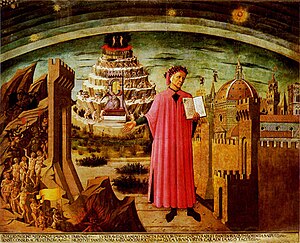
The Divine Comedy
by Dante Alighieri


Florence, from the Boboli Gardens       

   In the coming weeks and at weekly intervals, I will publish a series of blogs on The Divine Comedy, by Dante Alighieri. Born in Florence in 1265, Dante died in exile at Ravenna in 1321. A long narrative poem, The Divine Comedy is Dante's testament; and today it stands as one of the greatest works in world literature. And perhaps because it records a personal spiritual journey set against the backdrop of corruption, political intrigue and a struggle for power between the Church and civic society, it has the distinction of having been, (for several centuries), on the Church's index of banned books. But altogether more relevant, is the fact, that The Divine Comedy has endured and today is an object of fascination and study across cultures and by believers and non believers alike.

   These blogs are my response to this great work, from both a literary and personal point of view; and as you will discover in the opening blog, I argue the case, as to why you should not attach too much importance to what I have to say. For my contribution is not an academic treatise. Put simply, my interest, besides being literary, is spiritual and hence a journey into the unknown.
_______________

The Divine Comedy Part - 1

Introduction:
A Health Warning
If ever a proverb were made to fit an occasion, it is that coined by the poet Alexander Pope in his Essay on Criticism, that, "fools rush in where angels fear to tread"; and it applies to me. For the more I persist in trying to gain some insight into Dante Alighieri's masterpiece, the more it becomes apparent that I am out of my depth.

It's not that I have been living in a fool's paradise, it's simply that the deeper I dig, the more I sense the limits of my understanding and the certainty, that for all my endeavour, I will never tarnish the gloss, let alone, "scratch the surface", of this literary masterpiece . . . . .

_______________


The Divine Comedy Part - 2
Who was Dante and what was doing on in his world?

For weeks now I have been on the road, travelling with my companions, Dante and Virgil, on a journey that has taken us first, to the very depth of Hell, after which and together, we climbed the mountain of Purgatory. At its summit and unable to travel further, (because he predates the Christian era), Virgil was replaced by Beatrice, a girl whom Dante had loved, but not married, since first setting eyes on her when he was twelve and she was nine. From here we travelled through the heavens, stopping off at the Moon, Mercury, Venus and the Sun, before heading on to Mars, Jupiter and Saturn and passing on through the Fixed Stars and Primum Mobile, before arriving at Empyrean, the place where God dwells. And no less remarkable was the fact, that at every stage in this journey, we were travelling through parallel worlds: the spiritual landscape of the soul and of life here on earth: as it is to be found in the Bible, in ancient classical literature, the Church and politics, as well as in the broader complexities, both noble and ignoble, of everyday life. . . . .

_______________


The Divine Comedy Part - 3
Origin and structure of the poem and something of the sources that Dante drew on: Virgil, Saint Paul, Aristotle, Saint Thomas Aquinas, and with a passing reference to Plato and Saint Augustine

Recently we had a discussion here about the impact of the Kindle: as to whether or not its arrival heralds the death of books; and I am happy to tell you that the result was two to one against. But if you care to argue that the death of books has arrived, The Divine Comedy would be a good place to start.

In my copy, of the 741 numbered pages, there are 234 pages of notes; so, as they would say on celebrity TV, "I can now reveal, that, - - - the poem is, - - - - - -  452 pages long.". . . . .

_______________


The Divine Comedy - 4
Pride, treachery and the inescapable logic of Hell. Purgatory, repentance and the structure and nature of punishment. Hypocrisy and the Wastrel Friars; and some good news. And raw politics: De Monarchia and Unam Sanctam. And the spiritual: Faith and free will.

As a small boy at school I learned of the "seven deadly sins" and as is the case with things taught by rote, I remember them still. They were: pride, covetousness, lust, anger, gluttony, envy, and sloth. And as in those far-off times, we distinguished between sins that were "mortal" and sins that were "venial", what made them mortal, ("deadly"!) was, that if the offence was sufficiently grave, you could go to Hell, "for all eternity.".But don't despair about my childhood, because from a religious point of view, forgiveness was always just around the corner, which was probably why we paid more attention to being naughty, than fretting about the Catechism. And without doubt, our teachers understood that they were imparting truths for the long term . . . . .

_______________

. . . .

The Divine Comedy - 5 
Eden: as God had intended it. The composite figure of Matelda and the apocalyptic arrival of Beatrice. And the breadth, depth and purpose of Dante's narrative.

Recently while reading an article I was struck by the inadequacy of the language used. Variously, the event was described as "a key milestone", "a major milestone", "big" and "really impressive." And as the article progressed, another scientist doing his best to give expression to his feeling of incredulity, said: "It's utterly astonishing that this fragile artifact, based on 1970's technology, can signal its presence from this immense distance."

I was, of course, reading about Voyager-1; and the reason why the language seemed so inadequate, was, that the various contributors were struggling to convey a sense of an event that is beyond the experience of all of us; and in that context, a few simple stats will do: Now that Voyage-1 is in interstellar space, (beyond the magnetic field of the sun), it will be another 300 years before it reaches the edge of the solar system; and though travelling at 100,000 mph, it will take 40,000 years, before it approaches the nearest star.

Be that as it may, (and though I will be returning to the astronomy of Aristotle), for now it is back to earth: to the Garden of Eden, situated as it is at the summit of the Mountain of Purgatory . . . . .

_______________


The Divine Comedy - 6

AN INTERMISSION:

Dante's letter to his patron Cangrande della Scala, and what it tells us about The Divine Comedy. And, is it real, or a fake?

When Dante published Paradiso, the last of the three cantata that make up The Divine Comedy, it was prefaced by a letter to his "friend" and political patron Cangrande della Scala. It is lengthy and as you might expect, Dante is careful to observe the niceties, or protocols, deemed appropriate in a subordinate addressing his social superior. But, true to form and anticipating public censure, Dante defended himself from a charge of familiarity, in addressing Cangrande as a "friend." But before we get to the letter and the issues that surround it, a though about poetry more broadly.

When a poem leaves the poet, it belongs to the reader, because in putting it into the public domain, the writer is sharing his or her experience and they have no certainty that the reader, or readers, will see it from their point of view. Why? . . . . .
__________


The Divine Comedy Part - 7

JUSTICE:
from God's point of view. 

Believing as I do that The Divine Comedy is a poem about the journey of the soul to God amid the trials and tribulations of life, a journey whose end is determined by the choices we make, my focus here is on ideas, rather than following exactly, Dante's progress though the heavens.

That said, and in anticipation of the stories that I am going to tell, I am returning briefly to Part 5, to remind us of how Dante distributed the souls among the heavenly bodies. But also, to show how, in some instances, Dante makes the connection between the present and the past, by linking the virtues of particular saints, with Roman mythology. .

__________


The Divine Comedy Part - 8 

Dante's interrogation:  by Peter, James and John, on the theological virtues of Faith, Hope and Love.
Saint Bernard of Clairvaux and the role assigned to him. And Dante's Amen. 

"You have heard, O Virgin, that you will conceive and bear a son; you have heard that it will not be by man but by the Holy Spirit. The Angel awaits an answer; it is time for him to return to God who sent him. We too are waiting, O Lady, for your word of compassion; the sentence of condemnation weighs heavily upon us

"The price of our salvation is offered to you. We shall be set free at once if you consent. In the eternal Word of God we all came to be, and behold, we die. In your brief response we are to be remade in order to be recalled to live. . "

These are not Dante's words, nor do they appear in The Divine Comedy; instead, they are a quotation from Saint Bernard of Clairvaux (1090-1153), who is reflecting on what was and is, the most profound and dramatic moment in the history of our salvation. As the Gospel according to Luke tells us, when the Angel Gabriel first appeared to Mary, she was afraid; and when she learned of the reason for his visit, she was perplexed . . . . .

_______________
©  Cormac E McCloskey
The first in this series of blogs will be published on 8th. January and thereafter at weekly intervals.
The photos of Florence, Auschwitz and the Virgin Mother and Child Jesus, were taken by me

Tuesday, 8 October 2013

A Spiritual Reading 5


St Paul  

   In the context of the Roman Catholic Church, and Christianity more broadly, we are living in troubled times, whether it is to do with the truth about the nature and purpose of marriage, the role of women in the church, or as to whether priests (from a Roman Catholic point of view) should or should not be married. And as if that, together with dwindling congregations, were not trouble enough, we have the unresolved scandals in respect of pedophile priests. But there are more subtle tensions also, in the shape of topics that are not necessarily to the forefront in public consciousness. Pope Francis has expressed concern about career bishops, men who have come to see themselves as administrators, rather than as men appointed to care (in a pastoral sense) for priests, as well as the faithful. And the bishops are complaining about the over-arching hand of the Vatican when it comes to dealing with clergy, who, in one respect or another, are seen as dissident. So, in this context, they are calling for more autonomy and the opportunity to address these complex issues themselves, turning to the Vatican only as a last resort. And some priests are complaining about their bishops, and some of the faithful are asking to have a say when it comes to appointing their bishop. So it is against this background that I offer you this thought provoking excerpt from the apostle Paul's letter to Timothy, which I have taken from the Office of Readings for today:
__________

   "You can depend on this; whoever wants to be a bishop aspires to a noble task. A bishop must be irreproachable, married only once, of even temper, self-controlled, modest and hospitable. He should be a good teacher. He must not be addicted to drink. He ought not to be contentious but, rather, gentle, a man of peace. Nor can he be someone who loves money. He must be a good manager of his own household, keeping his children under control without sacrificing his dignity; for if a man does not know how to manage his own house, how can he take care of the Church of God?  He should not be a new convert, lest he become conceited and thus incur the punishment once meted out to the devil. He must also be well thought of by those outside the church, to ensure that he does not fall into disgrace and the Devil's trap.
   In the same way, deacons must be serious, straightforward, and truthful. They must not overindulge in drink or give in to greed. They must hold fast to the divinely revealed faith with a clear conscience. They should be put on probation first; then, if there is nothing against them, they may serve as deacons. The women, similarly, should be serious, not slanderous gossips. They should be temperate and entirely trustworthy. Deacons may be married but once and must be good managers of their children and their households. Those who serve well as  deacons gain a worthy place for themselves and much assurance in their faith in Christ Jesus.
   Although I hope to visit you soon, I am writing you about these matters so that if I should be delayed you will know what kind of conduct befits a a member of God's household, the church of the living God, the pillar and bulwark of truth. Wonderful, indeed, is the mystery of our faith, as we say in professing it:

"He was manifested in the flesh,
   vindicated in the Spirit;
Seen by the angels;
   preached among the Gentiles,
Believed in throughout the world,
   taken up into glory."

__________
Cormac E McCloskey

Thursday, 1 August 2013

A Spiritual Reading 4


                   Zhu Di

 Recently while writing to a friend in China, whose pet name is that of a bird, and symbolic of a  desire to be free, I had occasion to recall a book that I read some years ago. It was, 1421 The Year China Discovered The World, by Gavin Menzies. A retired submariner, he charts in meticulous detail the voyages of discovery by the Chinese, and especially the journeys of the "treasure fleets", and of how these great adventures came to an abrupt end under Emperor Zhu Di. As a consequence, China became an insular nation and went into centuries of decline. An extraordinary historical turn of events, when we consider, (as Menzies concludes), that the Chinese discovered America before Columbus. 

Well, here are the paragraphs that I shared with my friend. In the first, under the heading "The Emperor's Grand Plan", Menzies sets the stage, or if you prefer, places these voyages in their proper historical context, while the subsequent paragraphs appear under the heading "A Thunderbolt Strikes". Taken together, and in a broader context, I hope you would agree that they are worthy of A Spiritual Reading.

The italics are mine, and intended to indicate when Gavin Menzies breaks from his own narrative to quote from sources

__________   


The Emperor's Grand Plan
"On the 2 February 1421, China dwarfed every nation on earth. On that Chinese New Year's day, kings and envoys from the length and breadth of Asia, Arabia, Africa and the Indian Ocean, assembled amid the splendours of Beijing to pay homage to the Emperor Zhu Di, the Son of Heaven. A fleet of leviathan ships, navigating the oceans with pinpoint accuracy, had brought the rulers and their envoys to pay tribute to the emperor and bear witness to the imagination of his majestic and mysterious walled capital, the Forbidden City. No fewer than twenty-eight heads of state were present, but the Holy Roman Emperor, the Emperor of Byzantium, the Doge of Venice and the Kings of England, France, Spain and Portugal were not among them. They had not been invited, for such backward states, lacking trade goods or any worthwhile scientific knowledge, ranked low, on the Chinese emperor's scale of priorities.

A Thunderbolt Strikes
"On the night of 9 May 1421, two months after Zheng He's armada had set sail, a violent storm broke out over the Forbidden City. 

"On this night by chance a conflagration started . . .lightning struck the top of the palace that had been newly constructed by the Emperor. The fire that started in the building enveloped it in such a manner that it seemed as if 100,000 torches provided with oil and wicks had been lit up therein . . .so much so that the whole city was set ablaze with the light of that conflagration and the fire spreading . . .It burnt down the Ladies' Apartments behind the Hall of Audience . . .about 250 quarters were consumed to ashes, burning a large number of men and women. It continued burning like that until it was day and in spite of all efforts, the fire could not be brought under control until it was afternoon prayer time." (1)

Balls of fire appeared to travel down the Imperial Way itself, along the very axis of the Forbidden City, destroying the Hall of Great Harmony, the Hall of Central Harmony and the Hall of Preserving Harmony -the magnificent palace where Zhu Di had received leaders of the world three months earlier. The emperor's throne was burned to cinders. "In his anguish he repaired to the temple and prayed with great importunity, saying, "The God of Heaven is angry with me, and therefore, has burnt my palace; although I have done no evil act.. I have neither offended my father, nor mother, nor have I acted tyrannically."  (2)

   The shock killed the emperor's favourite concubine. Zhu Di was so distraught that he was unable to make proper arrangements for her burial in the imperial mausoleum.

"He fell ill owing to his anguish and on account of this it could not be ascertained as to in what manner the dead personage was buried. . . .The private horses of the deceased lady were let loose to graze freely . . .on the mountain where the sepulchre was situated. They had also posted about that sepulchre a number of maidens and eunuchs . . .leaving for them provisions to last five years so that after that period when their food got exhausted, they might likewise die there.  (3)

   Chinese emperors believed that they ruled with the mandate of heaven. The manner in which the lightning struck and the severity of the fire that followed could hardly have been more ominous for Zhu Di. An event of this terrible nature could only signal the Gods' demand for a change of emperor. Zhu Di temporarily handed power to his son, Zhu Gaozhi. The illness of the emperor having increased, his son used to come and sit in the audience hall." (4) Struggling to comprehend the nature of the calamity that had befallen him, the emperor then issued an edict to his people:

"My heart is full of trepidation, I do not know how to handle it. It seems that there has been some laxness in the rituals of honouring heaven and serving the spirits. Perhaps there has been some transgression of the ancestral law or some perversion of government affairs. Perhaps mean men hold rank while good men flee and hide themselves, and the good and evil are not distinguished. Perhaps punishments and jailings have been excessive and unjustly applied to the innocent, and the straight and the crooked not discriminated . . .Is this what brought about [the fire] ? Harshness to the people below and above, going against heaven. I cannot find the reason in my confusion . . .If our actions have in fact been improper, you should lay these out one by one, hiding nothing, so that we may try to reform ourselves and regain the favour of heaven. (5)

"This edict unleashed a predictable storm of criticism from the mandarins. Most of it was targeted at Zhu Di's grandiose plans and projects, especially the Forbidden City that the gods had destroyed. Vast areas had been denuded of trees to build the enormous halls, tens of thousands of artisans had laboured for years on the fabulous rooms, huge sums had been invested in marble and jade, the Grand Canal had been rebuilt using a million teaspoons to ferry grain, and the treasury drained to such an extent that peasants had even been reduced to eating grass. And all this toil, suffering and sacrifice had led only to a carpet of ashes and cinders. The fires also coincided with a terrible epidemic of some unknown disease that had been raging in the south for two years. More than 174,000 people had died in the province of Fujian alone and their bodies lay rotting in the fields, for there was no-one to bury them. The epidemic seemed yet another sign of the gods' anger.

   "The mandarin Minister of Revenue, Xia Yuanji, who had managed to find the funds for the Forbidden City, and for Zheng He's great armada, bravely stepped forward to accept personal responsibility for the catastrophe, but to no avail. Frantic efforts were made to pacify the people. Twenty-six high-ranking mandarin court officials were sent on "calming and soothing" missions (6) and, in an attempt to save his throne, Zhu Di issued a series of ill-conceived decrees. A halt was placed on future voyages of the treasure fleets and foreign travel was prohibited."

__________

1421 The Year China Discovered The World
by Gavin Menzies
Bantam Press (2002)
ISBN 2593 050789


Thursday, 25 July 2013

A Spiritual Reading 3


        St. Bridget of Sweden 

Now, I think, is as good a time as any to admit to a prejudice, to the truth that I have an instinctive distaste for anything, that in the representation of a saint smacks of Hollywood. Just recently, I was offended by just such an image of St. Teresa of Avila, as she appears on the front cover of a recent edition of the "Interior Castle." I was so aggravated by it, that my instinct was to paste it out; but I thought better of it, and not from fear of eternal damnation. And most disturbing of all, for me, are effeminate images of Christ. The hallmark of a saint, for me, is that they look lived in: men and women who, (to use a colloquialism), have been, "knocked about a bit": whose features bear the unmistakable signs of hardship: of endless good works and concern for souls.

Well recently I came across just such a person; St. Bridget, not the Irish Bridget, but Bridget of Sweden, who, widowed, brought up her own large family, before going on to found a religious order, and leave for posterity, a rich vein of spiritual writings. She died in 1373, at the age of 70.

What follows, (an excerpt from her writings), is taken from the Office of Readings for July 23; and apart from its obvious spiritual worth, the passage is striking for its focus and energy:
__________

A Prayer to Christ our Saviour     

Blessed are you, my Lord Jesus Christ. You foretold your death and at the Last Supper you marvellously consecrated  bread which became your precious body.  And then you gave it to your apostles out of love as a memorial of your most holy passion. By washing their feet with your holy hands, you gave them a supreme example of your deep humility.

Honour be to you, my Lord Jesus Christ. Fearing your passion and death, you poured forth blood from your innocent body like sweat, and still you accomplished our redemption as you desired and gave us the clearest proof of your love for all men.

Blessed may you be, my Lord Jesus Christ. After you had been lead to Caiaphas, you, the judge of all men, harshly allowed yourself to be handed over to the judgement of Pilate.

Glory be to you, my Lord Jesus Christ, for the mockery you endured when you stood clothed in purple and wearing a crown of sharp thorns. With utmost endurance you allowed vicious men to spit upon your glorious face, blindfold you and beat your cheek and neck with cruellest blows.

Praise be to you, my Lord Jesus Christ. For with the greatest patience you allowed yourself like an innocent lamb to be bound to a pillar and mercilessly scourged, and then to be brought covered with blood, before the judgement seat of Pilate to be gazed upon by all.

Honour be to you, my Lord Jesus Christ. For after your glorious body was covered with blood, you were condemned to death on the cross, you endured the pain of carrying the cross on your sacred shoulders, and you were lead with curses to the place where you were to suffer. Then, stripped of your garments, you allowed yourself to be nailed to the wood of the cross.

Everlasting honour be to you, Lord Jesus Christ. You allowed your most holy mother to suffer so much, even though she had never sinned nor ever even consented to the smallest sin. Humbly you looked down upon her with your gentle loving eyes, and to comfort her you entrusted her to the faithful care of your disciple.

Eternal blessing be yours, my Lord Jesus Christ, because in your last agony you held out to all sinners the hope of pardon, when in your mercy you promised the glory of paradise to the penitent thief.

Eternal praise be to you, my Lord Jesus Christ, for the time you endured on the cross the greatest torments and sufferings for us sinners. The sharp pain of your wounds fiercely penetrated even to your blessed soul and cruelly pierced your most sacred heart till finally you sent forth your spirit in peace, bowed your head, and humbly commended yourself into the hands of God your Father, and your whole body remained cold in death.

Blessed may you be, my Lord Jesus Christ. You redeemed our souls with your precious blood and most holy death, and in your mercy you led them from exile back to eternal life.

Blessed may you be, my Lord Jesus Christ. For our salvation you allowed your side and heart to be pierced with a lance; and from that side water and your precious blood flowed out abundantly for our redemption.

Glory be to you, my Lord Jesus Christ. You allowed your blessed body to be taken down from the cross by your friends and laid in the arms of your sorrowing mother, and you let her wrap your body in a shroud and bury it in a tomb to be guarded by soldiers.

Unending honour be to you, my Lord Jesus Christ. On the third day you rose from the dead and appeared to those you had chosen. And after forty days you ascended  into heaven before the eyes of many witnesses, and there in heaven you gathered together in glory those you love, whom you had freed from.

Rejoicing and eternal praise be to you, my Lord Jesus Christ, who sent the Holy Spirit into the hearts of your disciples and increased the boundless love of God in their spirits.

Blessed are you and praiseworthy and glorious for ever, my Lord Jesus. You sit upon you throne in your kingdom of heaven, in the glory of your divinity, living in the most holy body you took from a virgin's flesh. So will you appear on that last day to judge the souls of all the living and the dead; you who live and reign with the Father and the Holy Spirit for ever and ever. Amen.

_____________

Cormac E McCloskey

Saturday, 22 June 2013

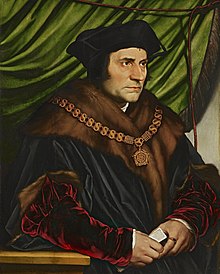
Sir (St.) Thomas More

Hans Holbein, the Younger - Sir Thomas More - Google Art Project.jpg
   Sir Thomas More (1478-1535)

For as long as I can remember I have been moved by the life of Thomas More: Chancellor of England, who, in the end, and because of his refusal to acknowledge King Henry VIII as Head of the Church in England (The Act of Supremacy), or to support him in his wish to divorce his wife Catherine of Aragon (in defiance of the Pope), was finally imprisoned in the Tower of London and later beheaded on July 6th 1535.  His story came to public prominence in the play, "Man For All Season" by Robert Bolt, and later was made into a film of the same name. For me his story has always seemed timeless, a point borne out by the fact that in 2000, Pope John Paul II declared him "the heavenly patron of Statesmen and politicians" (Wikipedia). And though More was a fierce opponent of the Protestant Reformation, (in the context of the age that we live in), it is interesting to note that since 1980, he is celebrated in the Church of England as a Reformation martyr.

Today the Church celebrates the feasts of both John Fisher and Thomas More, both of whom were executed in the same year. The letter below, written to his daughter Margaret, (Meg), from prison, is taken from the Liturgy of the Hours (Divine Office), and while it is obviously an expression of his faith, it is clearly intended to give support and strength to his family, who were suffering on his account. 
__________

Although I know well, Margaret, that because of my past wickedness I deserve to be abandoned by God, I cannot but trust in his merciful goodness. His great love strengthened me until now and made me content to loose goods, land, and life as well, rather than to swear against my conscience. God's grace has given the King a gracious frame of mind toward me, so that as yet he has taken from me nothing but liberty. In doing this His Majesty has done me such great good with respect to spiritual profit that I trust among all the great benefits he has heaped so abundantly upon me I count my imprisonment the very greatest. I cannot, therefore, mistrust the grace of God. Either he shall keep the king in that gracious frame of mind to continue to do me no harm, or else, if it is his pleasure that for my other sins I suffer in this case as I shall not deserve, then his grace shall give me the strength to bear it patiently, and perhaps even gladly.

By the merits of his bitter passion joined to mine and far surpassing in merit for me all that I can suffer myself, his bounteous goodness shall release me from the pains of purgatory and shall increase my reward in heaven besides.

I will not mistrust him, Meg, though I shall feel myself weakening and on the verge of being overcome with fear. I shall remember how Saint Peter at a blast of wind began to sink because of his lack of faith, and I shall do as he did: call upon Christ and pray to him for help. And then I shall trust he shall place his holy hand on me and in the stormy sea hold me up from drowning.

And if he permits me to play Saint Peter further and to fall to the ground and swear and forswear, may God our Lord in his tender mercy keep me from this, and let me loose if it so happen, and never win thereby! Still, if this should happen, afterward I trust that in his goodness he will look on me with pity as he did upon Saint Peter, and make me stand up again and confess the truth of my conscience afresh and endure here the shame and harm of my own fault.

And finally, Margaret, I know this well: that without my fault he will not let me be lost. I shall, therefore, with good hope, commit myself wholly to him. And if he permits me to perish for my faults, then I shall serve as praise for his justice. But in good faith, Met, I trust that his tender pity shall keep my poor soul safe and make me commend his mercy.

And, therefore, my own good daughter, do not let your mind be troubled over anything that shall happen to me in this world. Nothing can come but what God wills. And I am very sure that whatever that be, however bad it may seem, it shall indeed be the best.

__________

Man For All Seasons
A play of Sir Thomas More
by Robert Bolt (1960)
ISBN 0 435 22100 0

The Life Of Thomas More
by Peter Ackroyd
Chatto & Windus, London (1998)
ISBN 1 85619711 5

Man For All Seasons
The film: synopsis - here 

Post by Cormac E McCloskey

Friday, 24 May 2013

A Tale of Woe


Hello

It is cold and wet outside, and this is not strictly a blog; and by this endeavor, I am not trying to lure you to my website under false pretenses. It's simply that I want to right a wrong, so to speak, although that is almost certainly a far too dramatic way of putting it.

When I first published my book of poems under the title, "Who Would be a Girl When You Can be a Boy?" in 2011, I was surprised to find that it was offered for sale on Amazon.co.uk; surprised, because besides being the author, I was also the publisher and distributor, and I hadn't asked Amazon to sell it. On making inquiries, I was told by Nielsen, (who provide the ISBN numbers in the UK, and with whom the book is registered), that it is standard practice for all retailers to be notified of a books existence. So I sat back and waited, and sure enough, it wasn't long before Amazon wrote and told me that they were interested and would soon be placing an order. And I, trembling at the though of celebrity, sat back and waited. Well, when the great day dawned, Amazon wanted 1, (one) copy, which I was to send to their warehouse; and here's the bit that made me cry. They wanted to keep, for themselves, 60 per cent of the cover price. Well it didn't take me long to work out, that in adding in the cost of posting and packaging, I would have to provide the book to Amazon at a loss. So I wrote and explained my predicament, and they wrote back and told me that that was how they do business. And I wrote back (with some difficulty on account of their over automated processes), and asked them to remove the book from their website, which they did.

Well, some time later, I wrote again to Amazon.co.uk, pointing out that despite the fact that I had asked them to remove the book from their website, it was still showing on Amazon.com with a misleading statement to the effect that the book was out of print. Not unreasonably, Amazon wrote back, pointing out that they had no control over Amazon.com, and that if I wanted the book removed from their website, I would have to write directly to them; and very kindly they provided the relevant address. So I wrote to Amazon.com and the letter went like this:

Dear Sir.

I have just received an email from Amazon.co.uk, who have told me to write to you, etc. etc:

And Amazon.com wrote back:

Dear Mr McCloskey

As you have just received an email from Amazon.co.uk you need to write to Amazon.co.uk

at which point, and deciding that I had better things to do with my time, I gave up.

Well this morning, and perhaps because it is cold and wet, and I am getting off to a slower start than usual, I have discovered that my book is advertised on Amazon in Canada, with the same misleading information. And likewise on Google books. And you can even find it here, at books.com, and at deastore.com, who are  asking £1.48 more than the cover price.

So here's the deal.

Though the book has gone global, and I have sold quite a few, I still have copies left; and as they would be much happier out in the fresh air rather than sitting on a shelf here in the study, there is still time, if you are thinking of your Christmas shopping. Or better still. If you are seeking to raise money for a charitable cause, and would like a few to raffle, let me know at cormace.mccloskey@yahoo.com, and provided you don't live on Mars I will send them postage free. And don't forget to tell me something about the charity that you have in mind.

And here's something to cheer you up; click on the link


Monday, 8 April 2013

A Spiritual Reading

In the Roman Catholic liturgy, the feast of The Annunciation is usually celebrated on 25th March, but as this year it fell during the season of Lent, it was transferred to today.  The reading below is taken from that portion of The Liturgy of the Hours, (The Divine Office), known as the Office of Readings. It is from the writings of Saint Leo the Great, pope, (440-461), and I have decided to share it with you as it is the most lucid exposition that I have come across of the mystery of the Incarnation. 

_______________ 

      Lowliness is assured by majesty, weakness by power, mortality by eternity. To pay the debt of our sinful state, a nature that is incapable of suffering was joined to one that could suffer. Thus, in keeping with the healing that we needed, one and the same mediator between God and men, the man Jesus Christ, was able to die in one nature, and unable to die in the other.

      He who is true God was therefore born in the complete and perfect nature of a true man, whole in his own nature, whole in ours. By our nature we mean what the Creator had fashioned in us from the beginning, and took to himself in order to restore it.

      For in the Saviour there was no trace of what the deceiver introduced and man, being misled, allowed to enter. It does not follow that because he submitted to sharing in our human weakness he therefore shared in our sins.

      He took the nature of a servant without stain of sin, enlarging our humanity without diminishing his divinity. He emptied himself; though invisible he made himself visible, though Creator and Lord of all things he choose to be one of us mortal men. Yet this was the condescension of compassion, not the loss of omnipotence. So he who in the nature of God had created man, became in the nature of a servant, man himself.

      Thus the Son of God enters this lowly world. He comes down from the throne of heaven, yet does not separate himself from the Father's glory. He is here in a new condition, by a new birth.

      He was born in a new condition, for, invisible in his own nature, he became visible in ours. Beyond our grasp, he choose to come within our grasp. Existing before time began, he began to exist at a moment in time. Lord of the universe, he hid his infinite glory and took the nature of a servant. Incapable of suffering as God, he did not refuse to be a man, capable of suffering. Immortal, he choose to be subject to the laws of death.

      He who is true God is also true man. There is no falsehood in this unity as long as the lowliness of man and the preeminence of God coexist in mutual relationship.

      As God does not change by his condescension, so man is not swallowed up by being exalted. Each nature exercises its own activity, in communion with the other. The Word does what is proper to the Word, the flesh fulfills what is proper to the flesh.

      Our nature is resplendent with miracles, the other falls victim to injuries. As the Word does not lose equality with the Father's glory, so the flesh does not leave behind the nature of our race.
 
      One and the same person-this must be said over and over again-is truly the Son of God and truly the son of man. He is God in virtue of the fact that in the beginning was the Word, and the Word was with God, and the Word was God. He is man in virtue of the fact that the Word was made flesh, and dwelt among us.
_______________

Cormac